
I read an interesting article yesterday from omroepwest.nl about the modifications that had to be made to allow tram 19 to ride past the campus of TU Delft.
For those who don’t know, it took 15 years for tram 19 to be extended to TU Delft. The main culprit behind the delay was the ultra-sensitive research equipment inside TU Delft’s labs. Standard electric trams create electromagnetic interference that would have disrupted high-precision experiments. A professor at TU Delft, Pieter Kruit, worked on a solution which would create minimal electromagnetic interference, although it would still take a long time for the solution to be realized (he since retired!) due to red tap, budget issues and testing.
Normally, a tram forms a circuit loop between the overhead wire and the track below, creating magnetic fields that disrupt sensitive lab instruments. To fix this, Pieter and his team designed a system that routes the return current directly alongside the track rather than letting it spread out, canceling out the magnetic field before it reaches nearby buildings. The track was encased in specialized rubber shielding to block stray currents and built on heavy concrete sections to dampen mechanical vibrations from passing trams.
Cool, huh? Also cool: the same solution was also used for a tram line in Utrecht and a tram line in Sweden.
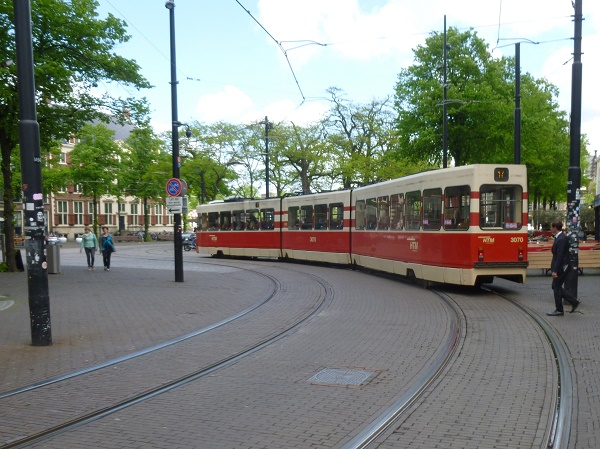
This blog post would not be complete without a photo of a tram. Here’s tram 17 by Gravenstraat back in 2015. Nowadays, tram 17 runs with the Avenio type and not this old GTL type which is being phased out.


