Learning Dutch

Er was eens… (Or: Dutch lesson 6 of 14)

Last night was my 6th Dutch lesson at the Volksuniversiteit in The Hague. The main topic for this lesson was learning the simple past. The title of this blog post reflects that, as Er was eens… is the beginning of a faerie tale, much like “Once upon a time” starts English faerie tales… [“was” is used for the past tense in both English and Dutch.]

I definitely felt a bit out of my element here even though I had done the homework in advance. There are rules for when you can use the perfect (I have called) and the imperfect (I called), otherwise known in English as the present perfect and the simple past.

The imperfect/simple past is used with description and a description of habits that occur over a period of time. I don’t quite grasp it yet, but you use the perfect/present perfect when you are describing a single moment in time, or a single action. Thus when you ask about someone’s vacation, the answer usually starts off in the perfect before moving to the imperfect/simple past for the description of events. One example:

– Hoe lang ben je op vakantie geweest?

Ik ben twee weken op vakantie geweest. In de eerste week ging ik naar Turkije. De eten smaakte lekker. In de tweede week ging ik naar Rome. Ik vond de stad mooi.

– How long have you been on vacation?

I have been on vacation for two weeks. In the first week I went to Turkey. The food tasted nice. In the second week I went to Rome. I found the city beautiful.

Now, I can already tell you my explanation has holes in it, so don’t think about it too much. Just do!

Some other things: there is no class next week due to the Easter holiday – pasvakantie. (Easter = Pasen). This is cool because it means I can hang out with Roger, as he usually visits on Tuesday nights. ;p

Another thing we did was mention what we heard in the news (to practice our Dutch speaking skills). One tidbit – the Netherlands is now ranked 3rd in the world for its proficiency of English as a second language. This led to the professor telling us a joke about mixing English and Dutch together in unpredictable ways, though it’s unconfirmed. Here it is, taken from Wikipedia:

One of the best quoted examples of Dunglish was said to have taken place between the Dutch foreign minister Joseph Luns (a man whose main foreign language was French, the language of diplomacy prior to World War II) and John F. Kennedy. At one point Kennedy inquired if Luns had any hobbies, to which he replied “I fok horses” (the Dutch verb fokken meaning to breed). Likely taken aback by this strangely obscene reply, Kennedy asked “Pardon?”, which Luns then mistook as the Dutch word for “horses” (“paarden”) and enthusiastically responded “Yes, paarden!”

With that craziness – until next time!
Categories: Courses | Tags: | 4 Comments

Zij zegt dat… (Or: Dutch lesson 5 of 14)

Last night I had my 5th lesson (of 14) for Dutch level A2. This week was more review for me (versus last week when we learned about object/subject forms of “it”). There were 16 students in the class – and 4 of them walked in late enough for it to be noticeable. People also talk a bit too much at times, which makes it hard to hear the teacher or the other students.

Both of the main grammer things we covered this week were things that Marco has already drilled into my head (I can just see him saying “Word order! Word order!” over and over…and over). The first is indirect speech – repeating what someone else has said.

Marcia: Ik ga in de zomer naar mijn vakantiehuisje in Zweden.
Marcia: I go in the summer to my vacation house in Sweden.

Simone: Marcia zegt dat zij in de zomer naar haar vakantiehuisje in Zweden gaat.
Simone: Marcia says that she goes in the summer to her vacation house in Sweden.

(Notice how ‘gaat’ moves to the end. This is typical of most complex Dutch sentence – inversion of the verb.)

Of course, it’s a rule used not just in indirect speech.

Ik hoop dat mijn Nederlands goed is.
[I hope that my Dutch is good.]

The other grammatical aspect that we learned was negating “moeten” or must. That verb gave me trouble for the longest time, because I would constantly ask Marco what the verb for “to need” was. But most of the time you use “must” instead. There is a way to talk about need, though. “hebben nodig”, although the nodig doesn’t usually stick with the verb “hebben” (to have). It roughly translates to the following “to have need”.

We hebben meer tijd nodig.
We need more time. (We have need for more time.)

But when you want to negate “moeten” you instead change the verb to “hoeven”. For some reason no one in the world will ever know, I suppose.

Ik moet vandaag werken, maar morgen hoef ik niet te werken.
I must work today, but tomorrow I don’t have to work.

It is official that the student I mentioned last week will drop the class – she decided to wait for the easier A1 class taught in September. On my end I (and Marco) are wondering if there’s anyway to skip any more levels… especially since there will probably be a break from June to September for the next set of classes to be taught. In theory this means more time to study and practice, but you know how that goes.

Looking over the Volksuniversiteit website, it states that there are another 3 sections to go (B1, B2, and C1) before I reach the level I want. At the C1 level is when they talk about the NT2 examen, program 2. Program 1 (B2) level is for lower level jobs, and program 2 (taught at the C1 level) is for higher level jobs, which complements the Master’s degree I already have. This means that down the road I can apply for higher level jobs.

Categories: Courses | Tags: | 5 Comments

Talking about objects (Or: Dutch lesson 4 of 14)

Tuesday’s class actually had an awesome moment. We had a speaking exercise where we were paired up with our buurvrouw (neighbor, female). We had to roleplay one of us being the one asking for employment (me) and the other being the receptionist from the company giving information (her). So all the groups practiced their speaking bits. I said I was looking for a preschool teacher job (peuterleidster), but that as partly because it was a vocabulary word we learned the page before.

For us, there was a section where my partner struggled a bit with what to ask – describing what would I do at the job. After a few seconds, I spoke up and just stated what I would do (play with the kids and teach them). And then the practice section was done, a bit before the rest of the students. I am not sure if the teacher noticed that, because we got called on…

So we recited our “phone conversation” to the entire class.  I was a bit nervous, as I am used to writing everything down so I don’t forget anything, but I hadn’t done that. As you know, I am definitely not one of the best speakers in the class. The nice thing during the exercise was that my partner switched it up a bit – she asked me what I could do for the job, rather than trying to describe it herself (where she got into trouble last time). So we rattled everything off…

…and after we were done a few people looked stunned and one even said “Whoa.” at what we had put together. Booyah! Niki looks smart when speaking for once.

(Of course, the teacher said it was good and then spent the next few minutes dissecting the conversation and telling us what the mistakes were. Ha.)

This time there were more students (18) than the last time (12). It seems like a handful of them were on vacation last week. It made it a bit harder for everyone to find a seat in the newly improvised “sit in a large square with our desks” seating arrangement, but it worked out. I am sure it was against fire code (people were technically blocked in on all sides), but otherwise okay.

During the break, one of the students went up to speak to the teacher. It seems that the student was finding the class a bit difficult and was hoping to go back down to level A1. The teacher told her to go to the register’s office at the front of the building and see if there was anything they could do. Unfortunately when she came back, she said that the next A1 class wasn’t until September. I am not sure what she is going to do – maybe she’ll stick around.

One of the grammar things that we learned this time was referring to an object as “it” or similar. Of course, Dutch has three variations – de, het, and plurals.

De words (most popular)

Subject form – hij

Object form – hem

* Waar is mijn brief? Waar is hij? (Where is it [my letter]?)

* Hij heeft je brief. Hij heeft hem. (He has it.)

—Yes, if you’re playing along, you’ll realize ‘hij’ is also the word for ‘he’!

Het words

Subject form – het

Object form – het

* Het paspoort ligt op de tafel. Het ligt op de tafel. (It lies on the table.)

* Heb jij mijn paspoort? Heb jij het? (Do you have it?)

Plurals

Subject form – ze

Object form – ze

* Mijn pasfoto’s zijn niet goed. Ze zijn niet goed. (They [passport photos] are not good.)

* Ik vind mijn pasfoto’s niet leuk. Ik vind ze niet leuk. (I don’t like them.)

Categories: Courses | Tags: | Leave a comment

Samenspraak (Or: Meetup in Den Haag Bibliotheek)

Yesterday I decided to try something new.  A few months ago I had heard about Samen Spraak (speaking together), which is sponsored by Gilde Den Haag. The first Wednesday of every month they have Samenspraak Café in The Hague’s centraal library. You can go there and speak with other people in Dutch – both with native Dutch speakers and with foreigners who are learning the language.

In addition, you have an intake meeting where they ask what your interests are. Based on that they pair you up with someone who can help you learn the language (and you both learn about each other’s culture). They suggest that you meet weekly but understand if that doesn’t work out. The two speakers need to schedule when they will meet. It’s a volunteer effort but requires some subsidy to keep it running – everyone pays 25 euros.

When I went there last night I lucked out because the same woman who had told me about it a few months ago was the person who spied me standing there looking a bit lost. Although you can arrive anytime between 5:30 – 7:30PM, it was already pretty crowded by 5:45 when I arrived. There weren’t many chairs left to be found, but she sat me next to a lovely gentleman who has been living in the Netherlands for almost 15 years. After a few minutes more people arrived and the table was full.

There was also a few ladies from Russia, a native Dutch speaker who works in parliament as a stenographer, and a gentleman who spoke mostly Arabic and was also keen to learn English. As I had moved pretty recently, my Dutch speaking skills were still pretty rusty. Everyone was patient though, and the woman I mentioned before also slipped in a few English words here and there when she realized I couldn’t exactly follow the subject of the conversation. I ended up staying for the full two hours, although I definitely had a slight headache after that due to the amount of concentration needed to listen to the Dutch. But I did pretty well!

Categories: Learning Dutch | Tags: , | 6 Comments

Seating arrangements (Or: Dutch lesson 3 of 14

Last night was the third Dutch lesson. I still have a pretty big fear of opening my mouth and actually talking Dutch (unless you’re a friend/family member) so it makes it interesting. As usual, I did my routine of finishing the homework before actually attending the class – it helps me pay attention a bit better.

Of course, it’s still possible to:

1. Not be paying attention when called on. Twice the teacher asked me a question or to do something, and both times I was distracted by an upcoming grammar section. (What can I say? I love grammar and rules.) But, how embarrassing!

It’s interesting – you never realize how much you can multitask and still listen to your native language, because things are stored in your short term memory. I was walking on the street. Since I am not yet fluent in Dutch, I still subconsciously tune out  language and ignore conversations around me. But I passed two women who ended up speaking in English. It was only after a few seconds and their sentence was half done that my brain realized it was English. So it automatically went back and replayed what it heard so I could know what they were saying.

But that isn’t possible yet in Dutch – the language doesn’t make enough sense to stick in my short term memory, and thus if I am not concentrating on listening I can’t go back and re-hear what was said.

2. It’s also possible to make a mistake on the one sentence you are called on to answer, even if you have the other 9 sentences correct. (The present perfect participle for komen [to come] is gekomen, not gekwam.) I mixed it up the with the straight past tense conjugation, which for the ‘I’ form is gekwam. Opps.

Continue reading

Categories: Courses | Tags: | 2 Comments

Huisfeest (Or: Dutch lesson 2 of 14)

Last night was my second Dutch class at Volksuniversiteit in The Hague. This time I acted a bit more like Niki: I answered all of the textbook questions and workbook exercises for the lesson we would be going over — in advance. The class was for chapter 7, section B. (Normally the textbook exercises are in class.) It’s not that I have to do so – it just makes me feel a lot more prepared.

And then in the end of the class we started on chapter 7, section C. D’oh! :p

I am looking forward to the next class (in two weeks – next week is Spring vacation). During the first class she asked us to sit in the same seats for week 2, but said we would move into more of a circular format for class 3 and beyond. I never realized how much I need to see a Dutch speaker to understand what they are saying, but I do. Some people give some nice visual clues (with their hands) when they talk. But I am currently sitting in the second row and rather short, so it’s hard to see over the students in the first row…

Today’s subject was “At the doctor”. One thing we looked at was giving advice. One of the sentences constructions is with the verb zullen (which is similar to ‘shall’ in English). There’s only two forms for giving advice using zouden: the singular and the plural. ik zou translates to “If I were you…”. The other one you can use is we zouden – “If we were you…”

And then she started asking for advice. She asked what advice you could give a friend whose birthday was today. Someone said: “ik zou een huisfeest hebben!” If I were you I would have a house party.

After a few seconds the somewhat confused teacher replied quite seriously: “Huisfeest!…

… isn’t a word.” And then laughed with the rest of the class.

She said you could use thuisfeest, except that that is more for a house warming party (after you move in). So probably just use feest, a party.

Another thing we looked at was separable verbs. Some verbs have components that, well, separate from the verb if conjugated. For example:

afwassen  = to wash the dishes

Ik was de borden af. (I wash the plates.)

There’s way-y-y too many separable verbs to name. Wiktionary has a long list of separable verbs, and Dutch grammar has a short list of example separable verbs. One thing we learned in class was that if a verb was separable, the stress would be on the prefix (af-was-sen). If it was not separable, the stress would be somewhere in the verb.

Some other interesting things: the professor still has to cover the pronunciation of the alphabet a lot. Mind you, I am not saying I can quickly rattle off the spelling of a random word, but I can do it if I think about each letter. But some students don’t even know the alphabet yet. Though I do get the confusion where “e” is pronounced as the English “a” and “i” is pronounced as the English “e”…

Sadly in a few students’ cases it is because they wanted to sign up for the beginning Dutch course but the timing wasn’t just right – so Volksuniversiteit recommended that they cram for a month and join the second level. It’s obviously not working out that well for them.

Finally, it’s a long class – 7PM to 10:15PM. And of course the bus arrives at 10:17, though the teacher understands and lets students leave early if needed. Apparently some students missed the 10:17 last time and said the next bus was pretty late, so hopefully I don’t ever miss this bus. But it will happen. ;p

Until next time! (March 5)

Categories: Courses | Tags: | 2 Comments

New experiences (Or: Dutch lesson 1 of 14)

Last night was my first Dutch lesson at the Volsuniversiteit. This is the A2 level.

My night started out with the bus I needed to take being 7 minutes late. This is actually not a long time considering – but buses run every 15 or 20 minutes so it was a lot more noticeable. Interestingly, I still arrived at the school at the same time I should have been there. Not sure how to explain that one, except that we did skip a few stops along the way.

Thankfully my class was in the same place that my oral test was in, so I only had to find the classroom. I knew that there would be a board with a list of classes and their rooms right inside the front entrance. Since the class was starting this week, it was one of the classes that had information on its own piece of paper in large font. (Of course the directions to get to the classroom were in Dutch using vocabulary I didn’t understand yet, though I wasn’t the only person needing help finding it.)

Continue reading

Categories: Courses | Tags: | 1 Comment

Studeren (Or: Contact 1 tekstbook; Nederlands voor anderstaligen)

As I have previously mentioned, in my A2 class at the Volksuniversiteit I am using the Contact 1 textbook. If my memory is correct, the A1 class finished chapters 1 through 4. My current plan is to get through the first four chapters before next week’s class on Tuesday night, but we’ll see how that goes.

Each chapter is split into three sections – A, B, C. I am currently at 2C after about six total hours of studying (it never ends!). So far it seems like the “A” section of each chapter is pretty easy, and then the “B” section has medium difficulty, and finally the “C” section tends to take forever to finish due to its emphasis more on speaking and listening.

So far the topics that have been covered:

Chapter 1: Waar komt u vandaan? = Where do you come from? which covers names, nationalities and the country you came from. It also covers your address, town, age, birthday, the alphabet, counting, and talking with someone (formally and informally).

Chapter 2: Zullen we iets afspreken? = Shall we make an appointment? (i.e. shall we do something?), which covers how someone is feeling, the days of the week, times, opening times for businesses, and filling out forms. The last section is set in a restaurant: reading a menu, ordering, saying there’s something you don’t understand, and etc.

Of course, 95% of it is review for the next class, but every once in a while something slips by that I didn’t know (or remember). A funny example I came across is how to say how you are doing. Het gaat wel does not, unfortunately, translate into “It goes well” as an English speaker might expect. Wel is not well. It’s closer to “okay”, so if you tell someone “Het gaat wel” it is a slightly negative response.

Hoe gaat het met jou?

Uitstekend! (=outstanding)

Categories: Courses, Speaking | Tags: | Leave a comment

Contact 1 (Or: My Dutch school books have arrived!)

Today Marco and I went to Paagman bookstore in The Hague to pick up the material for my class next week. Eight days from now!

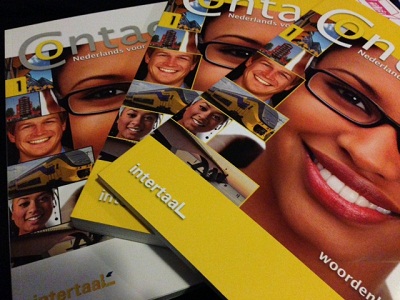
There actually ended up being three books to pick up — the tekstboek and woordenlijst (textbook and word list) came together. Those are the yellow books. I didn’t expected a word list book. The white book is the workbook that you pay for separately.

Contact 1 Dutch tekstboek woordenlijst and werkboek

Since I am in the A2 level course, the class won’t be focusing on the first set of chapters. I don’t remember where the A2 class starts – maybe chapter 5 or so.

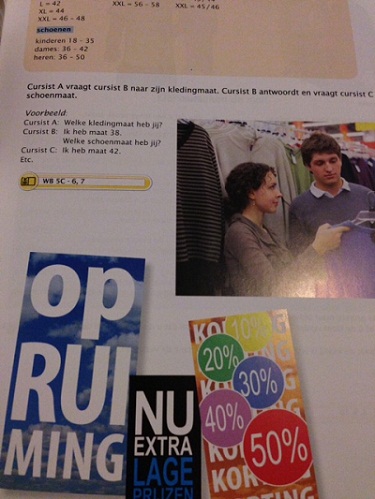
Contact 1 Dutch textbook

The books are printed on a thicker paper with a lot of color splashed throughout. The page above is a shopping scenario where one person is asking another what their size is. On the bottom of the page, you have various sales flyers.

So my plan for the next week is to do the work for the first set of chapters to make sure I am caught up to where the A2 class will begin. Should be interesting!

Categories: Courses | Tags: | 12 Comments

Dutch apps (Or: Guess Words)

This game has been added to the Dutch Apps page.

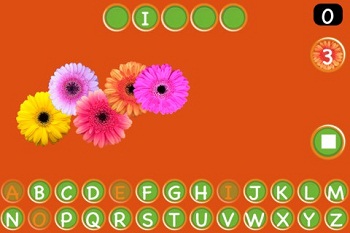
Guess Words is a Hangman type app made for Dutch, English, French and German. English is the default language but you can switch to Dutch in the settings.

Guess Words Dutch hangman app

This app does not get the best reviews, but if you are looking to learn random vocabulary, it should be useful. When you first start to learn Dutch, this app might be more frustrating than helpful because you do not have a large vocabulary to work with. Instead, you will just find yourself picking random letters (usually vowels or R, S, T!) in the hopes that something will pop up.

The free version is limited to five letter words, although the paid version allows for three to seven letter words. This app also gives you the option of entering a word yourself (up to 12 letters) and then having your partner guess it.

Categories: Apps, Learning Dutch | Tags: | Leave a comment

Blog at WordPress.com.