Here is a momento from the day we met (after the hockey game he went to, not at).
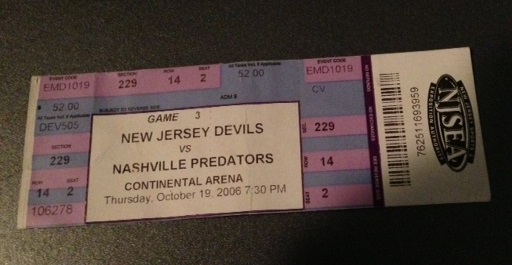
October 19, 2006 hockey game
September 19, 2013: the day we married.
Here is a momento from the day we met (after the hockey game he went to, not at).
October 19, 2006 hockey game
September 19, 2013: the day we married.
Here’s a picture from a month or two ago when Marco, Roger and I went to Rodizio in Scheveningen – a city name which I still cannot spell for the life of me.

I do remember that the huge building on the left is a casino, and is also shaped like a cruise ship (being that it is right next to the beach). Unfortunately the weather is a bit colder now, so the beach isn’t as nice as it was over the summer.
Today we are going to pick up my parents, brother, and sister-in-law at Schiphol airport. It is only one day before the wedding!
Here are some pictures that Marco and I took back in July while waiting for our flight (so beyond the security area):
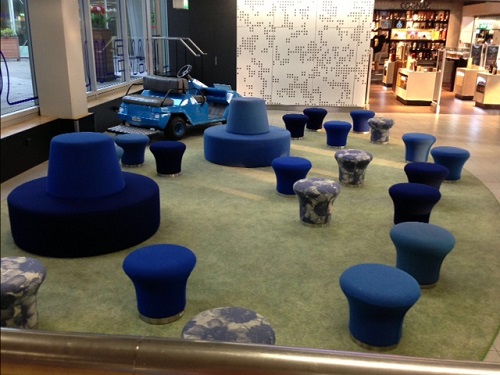
Where would you like to sit?

Can you see the cat?
It seems like all of The Hague is under construction, though I’ve been told that the construction is perpetual and never-ending.
Here’s a view of what my parents, brother, and sister-in-law will see when they arrive tomorrow at the crack of dawn (!):

It is just one example of many things which are under construction. At the next corner, they are building a Mark and Spencer’s, which you can read more about at this link.
This photo is from a few months ago, and shows the bike area of Holland Spoor. That’s a lot of bikes!
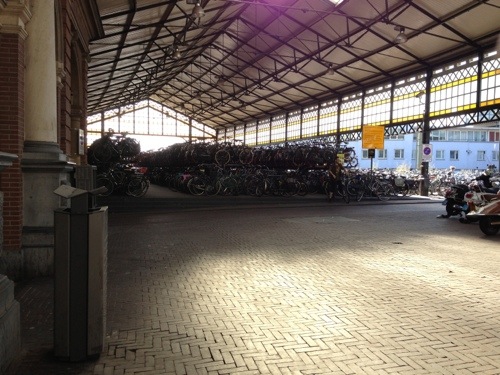
Holland Spoor is one of the transportation hubs of The Hague, along with Central Station. The latter is bigger, although that is mostly because Holland Spoor is classified as a public monument and can’t be expanded.
Here’s some pictures of The Hague that I took over the last few weeks. The first one is a building across from the Noordeinde Palace, one of the three palaces for the royal family. Of course, I mostly took the picture because the window covers were a lovely shade of blue!

I also ended up taking a picture of a canal, though I forget where it was at or where I was going at the time. The flowers dominate the photograph, almost hiding the water completely:
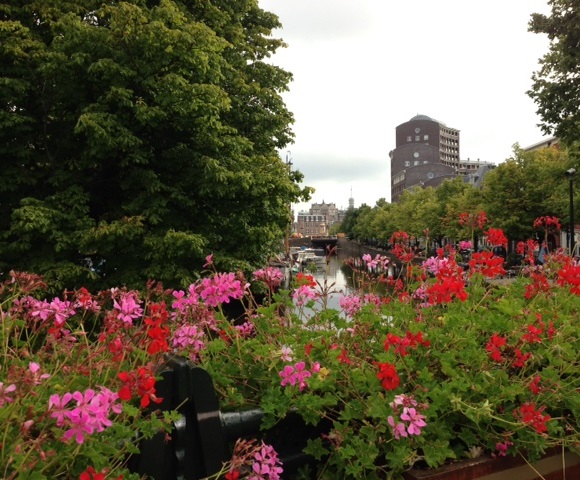
Of course, as I already mentioned this is from a few weeks ago, before the weather went all cold and rainy!
Fourth lesson by ROC Mondriaan. I’m starting to make some stupid mistakes, which of course I find really annoying. With this type of endeavor I want to be perfect. Oh, and did I mention that the wedding vows we are telling each other will be in Dutch? Yeah, I’m crazy. But I’ll come armed with note cards! (Thankfully I have pretty understanding parents who are willing to listen and consult the translation we provide as needed…)
There were a few choices quotes from the teacher today:
Schrijven is blijven. Niet schrijven is vergeten.
Loosely translated: Writing is remembering (lit: staying). Not writing is forgetting.
Als je het niet weet, kies de.
Translated: If you don’t know it [whether to use ‘het’ or ‘de’ before nouns], choose ‘de’. 80% of Dutch nouns take ‘de’, whereas only 20% take het.
Interestingly, ‘de’ is for both masculine and feminine nouns. Back in the day there was a 3rd form for feminine nouns, but they were since consolidated into the same category as masculine. ‘het’ is actually for neutral nouns like professions, diminutives, metals, and other various things.
We then did some exercises where we switched around the word order, similar to Monday’s class:
Morgen ga ik met mijn kinderen voor het eerst naar de kinderopvang.
Tomorrow go I (:p) with my kids voor the first [time] to [the] daycare.
Ik ga morgen met mijn kinderen voor het eerst naar de kinderopvang.
I go tomorrow with my kids for the first [time[ to [the] daycare.
The main thing is that the verb stays in the first or second position… morgen ik ga is wrong as ‘ga’ is in the third position, but it’s a common mistake.
You can actually put phrases into the first position (thus, it is not limited to just one word). It mainly just changes the emphasis of the sentence.
Met mijn kinderen ga ik morgen voor het eerst naar de kinderopvang.
The subject and the verb always stick together (in simple sentences anyway). If the time element (morgen, tomorrow) is not in the first position it usually follows right after the subject, as it did in the last example.
One week to go until the wedding… Crazy times ahead!
Last night was another class by ROC Mondriaan. The good news is hopefully we figured out what classroom(s) we are going to be in permanently – one classroom for Monday and another for Wednesday. We had the same teacher as last Monday and she did not mention us having a different teacher next Monday so perhaps she is permanently our teacher for that day.
I think one of the more amusing things about this class is everyone wants to answer, even if the teacher calls on one person. They seem pretty adamant about answering.
The course itself is still a bit sluggish – it starts at 6:45 but we really didn’t begin until 7:05PM. In the end there were 15 people there, +1 for the mother who brought her 10 year old son. He was cute, quiet and respectful though. One thing he said (as we were in the family chapter…):
verliefd (in love)
verloofd (engaged)
getrouwd (married)
The main thing that we covered in the lesson was spelling for a few different instances. Amusingly, the 10 year old boy said he learned that last year when he was in groep vijf (group 5/age 9). Two rules we learned are:
If you have one vowel between two consonants for a singular noun, then in the plural you double the consonant before adding the traditional -en ending.
de bom -> de bommen (the bomb)
de kat -> de katten (the cat)
de kip -> de kippen (the chicken)
If you have two vowels between two consonants for a singular noun, then in the plural you remove one vowel.
de muur -> de muren (the wall)
het haar -> de haren (the hare)
de peer -> de peren (the pear)
Of course, there are always exceptions! Although I am a fan of grammar, it seems like I never stared at these rules too much, instead relying on memorizing and going by what ‘looks right’. But it’s interesting to have the rules somewhere in the back of my head now.
After that, we covered the word order of sentences — where do the subject and verb go in various situations — although that is old news to me. That is thanks to the previous class and Marco’s hard work constantly saying “word order” “word order” “word order!” these last months.
The weather has changed after the first few days of September (when we actually hit 30c/86f). The last few days have been nothing but rain, rain, and more rain. It was pouring about 10 minutes ago and I am afraid to look outside to see if it still is.
After a slow start to the summer, we have been spoiled by some moderate, dry weather since then. Of course I am only worried because the wedding is in 11 days… it is truly crazy to realize that!
Today’s the start of another week (and the start of another school week). I was able to get my textbook on Thursday morning (Taaltalent) so I do not have to worry about that anymore.
Here’s a random photo from a few weeks ago. The sign amused me, but I’m not sure why:

Of course there is a stereotypical bike nearby.
If it was me, I would have drawn a line from “sure you do” to “yes”, rather than “buy a new pair of jeans”. The person who originally said no to a new pair of jeans needs to still agree that they need a new one. Seen at Baretta Jeans.
Random, I know.
Last night was another Dutch class by ROC Mondriaan, where we met our Wednesday night teacher. While he is our teacher for the rest of the classes, the school still has not found a permanent teacher for Monday nights.
The teacher put some information about himself on the board – he is in his 60s and has been teaching Dutch for 34 years. He has taught Dutch for buitenlanders (people from other countries) for 14 years. Before that he taught Dutch for Dutch students ages 11 to 18. He loves language in general, and has written two books. He normally teaches by the ROC Mondriaan in Delft, so this was his first time in The Hague building. He didn’t even have a key for the classroom yet, or the textbook. So he brought along some other stuff for us to look at.
One thing was a story that we read aloud (voorlezen, to read aloud):

Not too bad of a story. Peter is trying to get from Gouda to Rotterdam to visit his friends. First he gets in the wrong train (it goes in the wrong direction) and then the second train is delayed (vertraging, a hated word among Netherlanders and Roger in particular). But on the third train, he meets a girl. The teacher taught us the phrase: “Een geluk bij een ongeluk” which is roughly “a good (thing) out of an accident” though it is really translated as “a blessing in disguise”.
He had another worksheet with just verbs:
Ik probeer = I try
Ik kies = I choose
Ik koop = I buy
Ik betaal = I pay
Ik ruil = I return (the item)
And the associated Dutch saying: “Van ruilen komt huilen.” (From returning comes crying.)
Another thing that was mentioned was the nummer van de week, or the number of the week (It’s week 36 out of 52, by the way). I must admit I never thought about the number of the week I was in when I lived in America, but it does seem to be pretty important in the Netherlands for appointments. A few of the wedding to-do lists Marco made included the week number. Incredulous, I asked him why. Week x just does not mean anything to me.
Another interesting thing we discussed in class were Dutch words that are spelled the same but have two different meanings:
bank = where you go to deal with your money, but it also means ‘couch’
zijn = it means ‘his’, but it’s also the unconjugated ‘to be’ verb
haar = it means her AND hers, but it also means ‘hair’ (!)
licht = light (in terms of darkness, but also the weight of something. Same as English.)
regel = rule, but it also means ‘line’. In the story above the first page had 37 lines/regels. I also found it amusing that the word for ‘paragraph’ in Dutch is alinea, which to me looks like ‘line’…
Until next week!

 Life in the Hague