Posts Tagged With: Dutch language

Ghost town (Or: Dutch lesson 10 of 14)

“Ghost town” betekent ‘Er is niemand hier. Iedereen weg is.’ Soms is de plaats een dorpje, maar niet alttijd.

I knew it was going to be a weird night when the other student who usually rides the bus (from Centraal Station) wasn’t there. There was a lot of traffic (verkeer) and it seemed to take forever for the bus to arrive at the school. We were really only 3 or 4 minutes late, though.

At the start of class (7PM) there was only three students including me, and the teacher. I think traffic played a part in it though, because by 7:05 there were 9 students. We even had one student who arrived after 9PM for some reason. That was strange.

We have officially moved into the first part of chapter 11 (11A) which means that I am only caught up on my homework through this week. I haven’t started 11B yet. I had a few good moments. We split up into groups of 2 and made up our own fairy tale using the imperfectum (simple past tense). While the fairy tale didn’t make much sense – you can ask Marco, he’ll confirm that after I told him it later – I could tell that my grasp on that tense was improving quickly.

The last two or three weeks have shown an improvement in speaking. While I still only know the main tenses (present, present perfect, simple past, and some future using ‘to go’/gaan) the main thing that is holding me back is the vocabulary. I must learn more of it! Time to break out the themed dictionary that Roger got me a few years ago.

Oh, and apparently I am 1.58 meters tall. I had no clue how to convert feet & inches into meters, but that was one of the random questions the teacher asked during the class. Thankfully she didn’t ask me so I could look it up later.

A few more weeks to go before we have our test (week 13). I am not worried. The only thing I want is to be the best in the class, or maybe 2nd best. Maybe I will settle for that. Maybe… 😉

Categories: Courses | Tags: | 2 Comments

Springtime distractions (Or: Dutch lesson 9 of 14)

The class seems to be shrinking again. Last night we only had 11, and one of those left at the break due to a headache. The weather is getting good – light jacket weather, but you didn’t even have to close it at night while waiting for the bus. It is definitely “spring fever” – no one seems to be able to concentrate on much. I heard a lot of English thrown in by the other students – Hoe is het met de transport? (How is it with the transport?, complete with “Hoe” pronounced as the English “how”) You could say instead: Hoe is het openbaar vervoer? or How is the public transportation?)

One of the students brought in the A1 test (she had the same teacher for that class as well) and the format didn’t seem that no annoying. No speaking, which is in theory good for me but not in reality. Ik moet meer Nederlands praten! (I must speak more Dutch).

We covered almost two sections yesterday (10B and 10C), so I am now only a week ahead (11A). That’s fine with me.  A few things that we learned today included materials (leer = leather, plastic = plastic, hout = wood, and etc).

muur van steen = a wall (made) of stone
een stenen muur = a stone wall

So when you put the material before the object (acting as an adjective), than you add -en to the word. (The number of e’s change to keep the pronunciation the same.) Leer = leren (leather), hout = houten (wood, wooden), wol = wollen (wool, woolen. The l doubles to keep the pronunciation of the ‘o’ the same.)

Another thing we learned was afmeting, or dimensions. Admittedly I complained to Marco that I don’t even care about this in English, much less a different language. The most important thing to keep in mind is meter (meter) usually stays singular, and is pronounced differently than English (may-ter) due to the first e not being enclosed by a consonant (me-ter, as there’s no doubling of the t… met-ter). But that’s boring for most folks!

Afmeting =

3m bij 5m = 15 vierkante meter (3 meters by 5 meters equals 15 square meters)

Also, where we usually use a period, they use a comma, and vice versa.

2,5m bij 4m = 12 vierkante meter

6.200 = zesduizend tweehonderd (six thousand and two hundred)

6,47%

I am not sure if I will ever get used to writing commas and periods properly!

Next week there is no class due to Koninginnedag. The next class is May 7th.

Tot dan!

(until then)

Categories: Courses | Tags: | Leave a comment

Studying (Or: A level of difficulty)

So a few days ago I started chapter 11, section A in Contact 1. The class is about 1-2 lessons behind. It’s hard to describe, but I think this 12 chapter book (3 sections each) finally got hard enough for me to pay attention. Note: I still need lots of help with speaking. Nothing’s changed there!

Here’s an example:

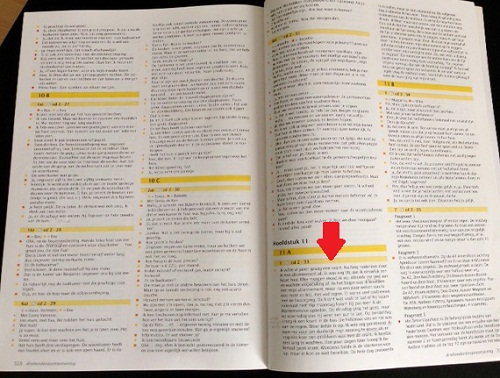
Contact 1 Nederlands voor anderstaligen

The highlighted section with the red arrow is the first real dialogue which is only a wall of text. Until this point, it’s usually two or more people talking to each other in simple sentences.

The section’s theme is “what a blunder”, or, the embarrassing things you’ve done in your life. The dialogue is simply a man telling a story (using the imperfectum/past tense) over how happy he was to finally get a newspaper subscription, and he looked forward to it every day because he always read the paper over breakfast. But helaas (unfortunately), the paper doesn’t come on time that often and sometimes doesn’t arrive at all.

So one day he calls up, but there’s no answer. Angry, he calls back the next day and finds out (after talking for 10 minutes straight and not letting the worker answer his questions), that the paper wasn’t delivered yesterday because it was Sunday and he doesn’t have a subscription for that day. He says: ik kon wel door de grond van schaamte (he cringed in shame – “fell to the ground from shame”) and quickly hung up.

But then you have to ignore the fact that he had a legitimate complaint with the newspaper arriving an hour or two late the other days… oh well. Crazy textbook!

Categories: Learning Dutch | Tags: | 1 Comment

Paying attention to homework (Or: Dutch lesson 8 of 14)

Last night I had my 8th Dutch lesson at the Volkuniversiteit (A2 level). This lesson seemed a bit “off” — as in, it wasn’t that good. Neither the person to my right nor the person to my left did their homework and it seemed to be the same for most of the people in the class. Technically I am a few lessons ahead already, as we did 9C and 10A today, and I’ve already finished the homework through 10B.

Perhaps it is the warmer weather – it is harder to concentrate on the homework and during the class itself. I can definitely tell that it stays lighter outside longer. We didn’t turn the classroom lights on until almost 9PM due to ample light from outside.

The main grammatical thing that we learned was Er, in its simplest form. (There are many uses of Er that are a lot harder to explain. I don’t know all of them.) This version simply translates to “there”. So:

Er is een… There is a...

Er zijn… There are…

Er is geen zolder. There is no attic.

Er zijn geen winkels in de buurt. There are no shops in the neighborhood.

So it follows English pretty closely. The most surprising thing is that it didn’t appear in the textbook until now — I’ve been using it in Dutch speech for some months already, and I suspect most of my classmates have as well.

One random thing I heard the professor mutter quietly under her breath was Waarom zijn bananen krom? (Why are bananas curved?) Unfortunately I forget why she said it. I asked Marco and he said this is a rhetorical question you ask when there really isn’t an answer that can be given. She definitely seemed a bit more exasperated with the class in general this week.

One thing that was mentioned a lot in today’s chapter was the song A beetje verliefd (A little love) by Andre Hazes, a Dutch singer who passed away in 2004. It’s one of those songs that almost everyone in the country knows, even if they don’t care for it. It’s classified as a Smartlap (tearjerker). YouTube with Dutch Lyrics. Marco hates the music but wanted to tell you that that singer has an Amsterdam accent, as does 90% of the Smartlappen singers.

Another thing that was mentioned randomly was Koetjes en kalfjes (literal translation = cows and calfs, actual translation = small talk). Perhaps back in the day when there was even more farmland than there is now,  small talk did refer to how the animals were doing. Maybe!

Categories: Courses | Tags: | 3 Comments

Speech! Speech! (Or: Dutch lesson 7 of 14)

The blog title refers to the tradition (at least in America) of a person being in front of a group of friends or family during an event (like receiving a surprise award). The audience then requests the person say something about the event/award by shouting “Speech! Speech!” (toespraak in het Nederlands?)

Last night was my 7th Dutch lesson. Halfway there! It was a pretty good lesson – this time I learned a lot of little things, rather than anyone one big thing.

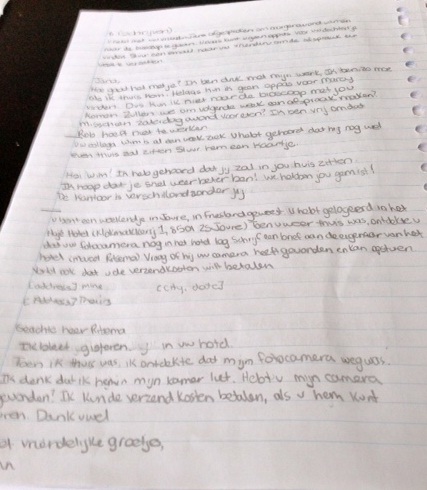
In the previous class the teacher asked that we write about something (anything we wanted) and speak for not more than two minutes. I had no idea what to write about (in English or in Dutch!) so I asked Marco for help. You can see what it looked like below. I still had some errors of my own, like where I said “a” when I should have said “een” in the first line.

Dutch writing homework

Before I came to the Netherlands, I lived in a little town called “Pearl River” in New York. Nothing happened in the town. The craziest day was St. Patrick’s Day because most of the people were Irish. Pearl River had a big parade for that day  – the second biggest in all of New York. The parade draws about 70,000 visitors or more. There are also many bars where people could drink – the main street had four bars in a hundred meters. My fiance said that Queen’s Day is the same – there are many drunk people.

And that’s what you write about when you do not know what to write about!

Some other things I learned in the class included “little” words that changed based on whether the situation was formal or informal. (Are you close to the person you are talking to? Then you can be more informal.)

niets (formal) / niks (informal) = nothing

nou (informal) = well (also used as a “stall for more time” word.) Nou, ja

****

If the question contains al, you’ll probably answer with nog niet. If the question contains the word nog, you’ll probably answer with meer and a denial word (nietgeen).

Ben je al vrij? Nee, ik ben nog niet vrij.
Heb je nog vakantie? Nee, ik heb geen vakantie meer.

Are you free already? No, I am not yet free.
Do you have vacation still? No, I have no more vacation.

Categories: Courses | Tags: | Leave a comment

Dutch homework (Or: Talking about the past…)

If Marco’s wondering why he hasn’t received an email yet from me, here’s why…

Dutch homework 1 of 2

Two pages of Dutch writing…

Dutch homework 2 of 2

Wait, make that three pages of Dutch writing…

They are just random exercises using the perfect (I have gone) and the imperfectum (I went). It’s starting to make a little more sense at least…

Categories: Learning Dutch | Tags: | 4 Comments

Moments of Dutch (Or: Speaking the language)

Sorry for the lack of updates! Yesterday was April Fool’s Day, so Marco and I pulled a prank on the game that we help run. It lasted 24 hours so we logged in a lot. Most people were happy with the prank, although there were a few folks who were unhappy with how it turned out. Admittedly it was a bit serious sounding – ownership changes. But all in good fun…

Today was pretty interesting. I had a list of things to get from Albert Heijn, including tortilla wraps (we made fajitas for dinner), cookies for coffee, and coffee pads. The coffee was on sale – two bags of coffee pads for €4 instead of €6.40. But when I went into the line I was surprised that the total price was just over €9. After I left the line and was packing my items, I realized that I forgot to hand over my bonus card. Normally the cashiers prompt you for it.

So I had a dilemma – I could go back and ask the cashier what I could do, but I didn’t want to do it in English. I hate assuming that everyone knows English as it’s not always true. I also wasn’t sure what to do because I had answered “no” to whether or not I wanted a receipt so I had no proof. I usually just throw those away.

So after a few minutes I steeled myself up and went back to the line I had been in. Thankfully I only had to wait for one person to finish. I then managed to explain my predicament to the cashier in simple (simple) Dutch!

Ik heb een vraagje. Ik spreek een beetje Nederlands maar ik vergeet mijn bonuskaart en de koffie is voor aanbeiding. Ik zei “nee” voor een bonnetje. Wat kan ik doen? (may or may not be good Dutch)

I have a question. I speak a little Dutch but I forgot my bonus card and the coffee is on sale. I said “no” to a receipt. What can I do? … It wasn’t quite what I said at the time, but you get the idea. After a few more lines I had to switch back to English because I didn’t understand what she was saying, but thankfully she spoke English. She mentioned that I need to give my bonus card – I understand that.  I think she thought I was blaming her for the trouble – far from it!

She explained (in English) that I could try at the customer service desk, so I thanked her and went there. Again I only had to wait for one person ahead of me in the line. I spoke in Dutch again, and actually only had a few lines in English. I even said my Dutch wasn’t that good but I was trying, and she smiled and said I was. She said her English wasn’t that good either but she was trying as well. (I am sort of paraphrasing the conversation but it was 90% Dutch.)

It went pretty well – she asked who my cashier was and pulled up my transaction. She confirmed that it was mine and then gave me some euros back (in coins). I was somewhat embarrassed about the situation in general but quite glad that if I am desperate I can survive on my own if needed. I was also glad I didn’t let the language barrier stand in my way if I wanted something.

Of course, sometimes when you’re happy about something, something else happens to shake you up a bit. 😉 When I was walking home, I stepped on a tiny branch and heard it snap. I took one more step, slightly distracted. I tripped and managed to fall. I didn’t trip over anything in particular – I just didn’t pick up my feet enough I guess!

A gentleman that had been passing by me stopped and asked if I was okay. I started talking in English as I stood up, quite embarrassed   Considering I had just been proud to speak a bit of Dutch at Albert Heijn, it’s amazing to consider that in times of distress, all you have left is your native language. It is all you can remember in the heat of the moment. Though I did utter a quick Dag! (goodbye) before I turned to quickly walk home.

It wasn’t that bad of a fall, in the end. My left knee was scrapped up, but nothing a band-aid can’t fix. My right pinky is definitely sore but I can stretch it fully if needed. It hurts slightly when I curl it up too far. I figure a good night’s rest will help a lot.

So… just some of my language observations on a day I thought would be much more quiet than it ended up being. But it was overall a good day.
Categories: Everyday purchases | Tags: | 3 Comments

Er was eens… (Or: Dutch lesson 6 of 14)

Last night was my 6th Dutch lesson at the Volksuniversiteit in The Hague. The main topic for this lesson was learning the simple past. The title of this blog post reflects that, as Er was eens… is the beginning of a faerie tale, much like “Once upon a time” starts English faerie tales… [“was” is used for the past tense in both English and Dutch.]

I definitely felt a bit out of my element here even though I had done the homework in advance. There are rules for when you can use the perfect (I have called) and the imperfect (I called), otherwise known in English as the present perfect and the simple past.

The imperfect/simple past is used with description and a description of habits that occur over a period of time. I don’t quite grasp it yet, but you use the perfect/present perfect when you are describing a single moment in time, or a single action. Thus when you ask about someone’s vacation, the answer usually starts off in the perfect before moving to the imperfect/simple past for the description of events. One example:

– Hoe lang ben je op vakantie geweest?

Ik ben twee weken op vakantie geweest. In de eerste week ging ik naar Turkije. De eten smaakte lekker. In de tweede week ging ik naar Rome. Ik vond de stad mooi.

– How long have you been on vacation?

I have been on vacation for two weeks. In the first week I went to Turkey. The food tasted nice. In the second week I went to Rome. I found the city beautiful.

Now, I can already tell you my explanation has holes in it, so don’t think about it too much. Just do!

Some other things: there is no class next week due to the Easter holiday – pasvakantie. (Easter = Pasen). This is cool because it means I can hang out with Roger, as he usually visits on Tuesday nights. ;p

Another thing we did was mention what we heard in the news (to practice our Dutch speaking skills). One tidbit – the Netherlands is now ranked 3rd in the world for its proficiency of English as a second language. This led to the professor telling us a joke about mixing English and Dutch together in unpredictable ways, though it’s unconfirmed. Here it is, taken from Wikipedia:

One of the best quoted examples of Dunglish was said to have taken place between the Dutch foreign minister Joseph Luns (a man whose main foreign language was French, the language of diplomacy prior to World War II) and John F. Kennedy. At one point Kennedy inquired if Luns had any hobbies, to which he replied “I fok horses” (the Dutch verb fokken meaning to breed). Likely taken aback by this strangely obscene reply, Kennedy asked “Pardon?”, which Luns then mistook as the Dutch word for “horses” (“paarden”) and enthusiastically responded “Yes, paarden!”

With that craziness – until next time!

Categories: Courses | Tags: | 4 Comments

Zij zegt dat… (Or: Dutch lesson 5 of 14)

Last night I had my 5th lesson (of 14) for Dutch level A2. This week was more review for me (versus last week when we learned about object/subject forms of “it”). There were 16 students in the class – and 4 of them walked in late enough for it to be noticeable. People also talk a bit too much at times, which makes it hard to hear the teacher or the other students.

Both of the main grammer things we covered this week were things that Marco has already drilled into my head (I can just see him saying “Word order! Word order!” over and over…and over). The first is indirect speech – repeating what someone else has said.

Marcia: Ik ga in de zomer naar mijn vakantiehuisje in Zweden.
Marcia: I go in the summer to my vacation house in Sweden.

Simone: Marcia zegt dat zij in de zomer naar haar vakantiehuisje in Zweden gaat.
Simone: Marcia says that she goes in the summer to her vacation house in Sweden.

(Notice how ‘gaat’ moves to the end. This is typical of most complex Dutch sentence – inversion of the verb.)

Of course, it’s a rule used not just in indirect speech.

Ik hoop dat mijn Nederlands goed is.
[I hope that my Dutch is good.]

The other grammatical aspect that we learned was negating “moeten” or must. That verb gave me trouble for the longest time, because I would constantly ask Marco what the verb for “to need” was. But most of the time you use “must” instead. There is a way to talk about need, though. “hebben nodig”, although the nodig doesn’t usually stick with the verb “hebben” (to have). It roughly translates to the following “to have need”.

We hebben meer tijd nodig.
We need more time. (We have need for more time.)

But when you want to negate “moeten” you instead change the verb to “hoeven”. For some reason no one in the world will ever know, I suppose.

Ik moet vandaag werken, maar morgen hoef ik niet te werken.
I must work today, but tomorrow I don’t have to work.

It is official that the student I mentioned last week will drop the class – she decided to wait for the easier A1 class taught in September. On my end I (and Marco) are wondering if there’s anyway to skip any more levels… especially since there will probably be a break from June to September for the next set of classes to be taught. In theory this means more time to study and practice, but you know how that goes.

Looking over the Volksuniversiteit website, it states that there are another 3 sections to go (B1, B2, and C1) before I reach the level I want. At the C1 level is when they talk about the NT2 examen, program 2. Program 1 (B2) level is for lower level jobs, and program 2 (taught at the C1 level) is for higher level jobs, which complements the Master’s degree I already have. This means that down the road I can apply for higher level jobs.

Categories: Courses | Tags: | 5 Comments

Talking about objects (Or: Dutch lesson 4 of 14)

Tuesday’s class actually had an awesome moment. We had a speaking exercise where we were paired up with our buurvrouw (neighbor, female). We had to roleplay one of us being the one asking for employment (me) and the other being the receptionist from the company giving information (her). So all the groups practiced their speaking bits. I said I was looking for a preschool teacher job (peuterleidster), but that as partly because it was a vocabulary word we learned the page before.

For us, there was a section where my partner struggled a bit with what to ask – describing what would I do at the job. After a few seconds, I spoke up and just stated what I would do (play with the kids and teach them). And then the practice section was done, a bit before the rest of the students. I am not sure if the teacher noticed that, because we got called on…

So we recited our “phone conversation” to the entire class.  I was a bit nervous, as I am used to writing everything down so I don’t forget anything, but I hadn’t done that. As you know, I am definitely not one of the best speakers in the class. The nice thing during the exercise was that my partner switched it up a bit – she asked me what I could do for the job, rather than trying to describe it herself (where she got into trouble last time). So we rattled everything off…

…and after we were done a few people looked stunned and one even said “Whoa.” at what we had put together. Booyah! Niki looks smart when speaking for once.

(Of course, the teacher said it was good and then spent the next few minutes dissecting the conversation and telling us what the mistakes were. Ha.)

This time there were more students (18) than the last time (12). It seems like a handful of them were on vacation last week. It made it a bit harder for everyone to find a seat in the newly improvised “sit in a large square with our desks” seating arrangement, but it worked out. I am sure it was against fire code (people were technically blocked in on all sides), but otherwise okay.

During the break, one of the students went up to speak to the teacher. It seems that the student was finding the class a bit difficult and was hoping to go back down to level A1. The teacher told her to go to the register’s office at the front of the building and see if there was anything they could do. Unfortunately when she came back, she said that the next A1 class wasn’t until September. I am not sure what she is going to do – maybe she’ll stick around.

One of the grammar things that we learned this time was referring to an object as “it” or similar. Of course, Dutch has three variations – de, het, and plurals.

De words (most popular)

Subject form – hij

Object form – hem

* Waar is mijn brief? Waar is hij? (Where is it [my letter]?)

* Hij heeft je brief. Hij heeft hem. (He has it.)

—Yes, if you’re playing along, you’ll realize ‘hij’ is also the word for ‘he’!

Het words

Subject form – het

Object form – het

* Het paspoort ligt op de tafel. Het ligt op de tafel. (It lies on the table.)

* Heb jij mijn paspoort? Heb jij het? (Do you have it?)

Plurals

Subject form – ze

Object form – ze

* Mijn pasfoto’s zijn niet goed. Ze zijn niet goed. (They [passport photos] are not good.)

* Ik vind mijn pasfoto’s niet leuk. Ik vind ze niet leuk. (I don’t like them.)

Categories: Courses | Tags: | Leave a comment

Create a free website or blog at WordPress.com.