Courses

Into the unknown (Or: Dutch class 9 by ROC Mondriaan)

Yesterday’s class was interesting to say the least. The main grammatical thing discussed was “Er”, a small little word that usually doesn’t translate that well. In the simplest sense, however, it is translatable. Er is  or Er zijn translates to There is or There are. It is used with subjects that are considered onbepaald/undetermined, that is, the subject of the sentence is something not that well known. While it isn’t something that you think a lot about in English, it has the same basic rules in both languages.

For instance – De vrouw stat voor de deur, or The woman stood before the door. In English and Dutch, the use of “The” and “De” implies that the woman is known, likely that she was referred to in a previous sentence.

But if the woman isn’t known yet, or is “undetermined”, than in Dutch you can use Er is. Example: Er is een vrouw voor de deur. There is a woman before the door.

Er loopt niemand op straat. (There walks no one in the street, or less awkwardly – No one walks in the street.)

Er ligt een boek op tafel.  (There lies a book on the table, or less awkwardly – There is a book on the table.)

Of course, the above two examples provide translation frustration because they use the “positional” verbs to describe an object. liggen = to lie, zitten = to sit, staan = to stand, and lopen = to walk. There’s a fifth one that is less used hangen = to hang. These five verbs are used to describe the position of someone or something. It’s something that I don’t quite have the hang of yet and need to practice more. A lot more!

The fourth post in this link explains things a bit better than I could, although they don’t always translate the Dutch. If needed, open two copies of the url and translate one of them but not the other. Or use Google translate as needed. ;p

Categories: Courses | Tags: | Leave a comment

Woordenschat (Or: Dutch class 8 by ROC Mondriaan)

The theme of this lesson was synonyms (synoniemen) and vocabulary (woordenschat). The latter is a fun word, as it literally translates to word treasure.

Here were some of the words we had:

lui – je wil niks doen (lazy – you don’t want to do anything)

plezierig – iets leuk  (pleasurable – something fun)

ergernis – je vind het niet leuk (irritation, you find it not fun)

hekel – ik vind het helemaal niet leuk (hatred – you find it completely not fun)

Although this class is definitely slower than my last class, one nice thing is there is absolutely no English spoken in the class (mainly because there’s only a few people here where English is their native language!). Spoken Dutch and pronunciation are much better as well.

Another thing that was discussed was bijvoeglijk naamwoord (or adjectives). This was one thing that I did not understand for the longest time. The first thing you need to look at is whether the adjective comes before or after the noun. If it comes after, it’s pretty simple.

Het huis is groot. (The house is big.)

De auto is rood. (The car is red.)

De tafel is zwart. (The table is black.)

If the adjective comes before the noun, you usually add an e (and possibly alter the spelling a bit):

Het grote huis

De rode auto

De zwarte tafel

If you use een (or ‘a’) instead of de/het (or ‘the’) then the -e is dropped before ‘het’ words only:

Een groot huis (groot instead of grote)

Een rode auto (rode stays the same)

Een zwarte tafel (zwarte stays the same)

We also discussed the differences between words that might translate the same:

benieuwd = curious (you want information in general)

nieuwsgierig = curious (you want information over private things, a bit nosy)

Crazy vocabulary!

Categories: Courses | Tags: | Leave a comment

Fierljeppen (Or: Dutch class 7 by ROC Mondriaan)

Note: I was not at class 6 due to the wedding (!) so there was not a blog post last week Wednesday.

Today was an interesting class as the chapter was “Sport”. We learned about a sport that is mostly in the Dutch province Friesland. The name of the sport is Fierljeppen (Wikipedia: Dutch | English). The sport originated in Friesland in the 1700s where there are lots of canals but not a lot of bridges to get across. Facing a lack of bridges in the area they used long poles to spring across.

The goal of the sport is to run towards the pole (which is already in the water) and climb up it as fast as possible while also maneuvering your body forward to reach the other side of the water. As the stick falls towards the other side you jump into the sand. The person who lands the farthest in the sand wins the competition.

And if that was not confusing enough, here is a YouTube video of it. :p

The wedding was good by the way. Afterwards we then spent a few days touring The Hague and Delft with my parents, brother, and sister-in-law. 🙂

Categories: Courses | Tags: | 2 Comments

Schrijven is blijven (Or: Dutch class 4 by ROC Mondriaan)

Fourth lesson by ROC Mondriaan. I’m starting to make some stupid mistakes, which of course I find really annoying. With this type of endeavor I want to be perfect. Oh, and did I mention that the wedding vows we are telling each other will be in Dutch? Yeah, I’m crazy. But I’ll come armed with note cards! (Thankfully I have pretty understanding parents who are willing to listen and consult the translation we provide as needed…)

There were a few choices quotes from the teacher today:

Schrijven is blijven. Niet schrijven is vergeten.

Loosely translated: Writing is remembering (lit: staying). Not writing is forgetting.

Als je het niet weet, kies de.

Translated: If you don’t know it [whether to use ‘het’ or ‘de’ before nouns], choose ‘de’. 80% of Dutch nouns take ‘de’, whereas only 20% take het.

Interestingly, ‘de’ is for both masculine and feminine nouns. Back in the day there was a 3rd form for feminine nouns, but they were since consolidated into the same category as masculine. ‘het’ is actually for neutral nouns like professions, diminutives, metals, and other various things.

We then did some exercises where we switched around the word order, similar to Monday’s class:

Morgen ga ik met mijn kinderen voor het eerst naar de kinderopvang.

Tomorrow go I (:p) with my kids voor the first [time] to [the] daycare.

Ik ga morgen met mijn kinderen voor het eerst naar de kinderopvang.

I go tomorrow with my kids for the first [time[ to [the] daycare.

The main thing is that the verb stays in the first or second position… morgen ik ga is wrong as ‘ga’ is in the third position, but it’s a common mistake.

You can actually put phrases into the first position (thus, it is not limited to just one word). It mainly just changes the emphasis of the sentence.

Met mijn kinderen ga ik morgen voor het eerst naar de kinderopvang.

The subject and the verb always stick together (in simple sentences anyway). If the time element (morgen, tomorrow) is not in the first position it usually follows right after the subject, as it did in the last example.

One week to go until the wedding… Crazy times ahead!

Categories: Courses | Tags: | 2 Comments

Vowels and consonants (Or: Dutch class 3 by ROC Mondriaan)

Last night was another class by ROC Mondriaan. The good news is hopefully we figured out what classroom(s) we are going to be in permanently – one classroom for Monday and another for Wednesday. We had the same teacher as last Monday and she did not mention us having a different teacher next Monday so perhaps she is permanently our teacher for that day.

I think one of the more amusing things about this class is everyone wants to answer, even if the teacher calls on one person. They seem pretty adamant about answering.

The course itself is still a bit sluggish – it starts at 6:45 but we really didn’t begin until 7:05PM. In the end there were 15 people there, +1 for the mother who brought her 10 year old son. He was cute, quiet and respectful though. One thing he said (as we were in the family chapter…):

verliefd (in love)

verloofd (engaged)

getrouwd (married)

The main thing that we covered in the lesson was spelling for a few different instances. Amusingly, the 10 year old boy said he learned that last year when he was in groep vijf (group 5/age 9). Two rules we learned are:

If you have one vowel between two consonants for a singular noun, then in the plural you double the consonant before adding the traditional -en ending.

de bom -> de bommen (the bomb)

de kat -> de katten (the cat)

de kip -> de kippen (the chicken)

If you have two vowels between two consonants for a singular noun, then in the plural you remove one vowel.

de muur -> de muren (the wall)

het haar -> de haren (the hare)

de peer -> de peren (the pear)

Of course, there are always exceptions! Although I am a fan of grammar, it seems like I never stared at these rules too much, instead relying on memorizing and going by what ‘looks right’. But it’s interesting to have the rules somewhere in the back of my head now.

After that, we covered the word order of sentences — where do the subject and verb go in various situations — although that is old news to me.  That is thanks to the previous class and Marco’s hard work constantly saying “word order” “word order” “word order!” these last months.

Categories: Courses | Tags: | Leave a comment

Van ruilen, komt huilen (Or: Dutch class 2 by ROC Mondriaan)

Last night was another Dutch class by ROC Mondriaan, where we met our Wednesday night teacher. While he is our teacher for the rest of the classes, the school still has not found a permanent teacher for Monday nights.

The teacher put some information about himself on the board – he is in his 60s and has been teaching Dutch for 34 years. He has taught Dutch for buitenlanders (people from other countries) for 14 years. Before that he taught Dutch for Dutch students ages 11 to 18. He loves language in general, and has written two books. He normally teaches by the ROC Mondriaan in Delft, so this was his first time in The Hague building. He didn’t even have a key for the classroom yet, or the textbook. So he brought along some other stuff for us to look at.

One thing was a story that we read aloud (voorlezen, to read aloud):

Dutch story and questions

Not too bad of a story. Peter is trying to get from Gouda to Rotterdam to visit his friends. First he gets in the wrong train (it goes in the wrong direction) and then the second train is delayed (vertraging, a hated word among Netherlanders and Roger in particular). But on the third train, he meets a girl. The teacher taught us the phrase: “Een geluk bij een ongeluk” which is roughly “a good (thing) out of an accident” though it is really translated as “a blessing in disguise”.

He had another worksheet with just verbs:

Ik probeer = I try

Ik kies = I choose

Ik koop = I buy

Ik betaal = I pay

Ik ruil = I return (the item)

And the associated Dutch saying: “Van ruilen komt huilen.” (From returning comes crying.)

Another thing that was mentioned was the nummer van de week, or the number of the week (It’s week 36 out of 52, by the way). I must admit I never thought about the number of the week I was in when I lived in America, but it does seem to be pretty important in the Netherlands for appointments. A few of the wedding to-do lists Marco made included the week number. Incredulous, I asked him why. Week just does not mean anything to me.

Another interesting thing we discussed in class were Dutch words that are spelled the same but have two different meanings:

bank = where you go to deal with your money, but it also means ‘couch’

zijn = it means ‘his’, but it’s also the unconjugated ‘to be’ verb

haar = it means her AND hers, but it also means ‘hair’ (!)

licht = light (in terms of darkness, but also the weight of something. Same as English.)

regel = rule, but it also means ‘line’. In the story above the first page had 37 lines/regels. I also found it amusing that the word for ‘paragraph’ in Dutch is alinea, which to me looks like ‘line’…

Until next week!

Categories: Courses | Tags: | 2 Comments

New classes (Or: Dutch class 1 by ROC Mondriaan)

Last night I started my first Dutch class by ROC Mondriaan. It is B1 level and my particular class meets on Monday and Wednesday nights from 6:45 to 10:00PM. It runs for 20 weeks, so with some holidays factored in it will probably end sometime in February (!). I knew that I had to get there early to pay for the class so I arrived at the school at 6:30. There were 5 people ahead of me in line, but I managed to get done just before 6:40, though I then had to go to another line to get my official roster and figure out what classroom I was in. By the time I was done at 6:40, there were about 20 people waiting behind me in first line to pay.

Needless to say, when I actually made it to the classroom there was only one other person there, a student. I tried to speak to him in Dutch but he looked really confused and kept switching to English. (He would then confuse me later when he spoke pretty decent Dutch to the teacher and had good pronunciation skills when reading a passage from a book. Okay…)

The first class was… the first class. People trickled in over the next hour as they paid for the course and came upstairs. While there were 24 students signed up for this section, only 15 were there last night.

There were a few interesting stories from the students… one of them studying as a software engineer in India but when she moved here the only work she could find was as a cleaner (schoonmaker). That is probably partially the language barrier and partially just the poorer economy in general. Or perhaps she didn’t finish her degree. Another gentleman moved here from Iran in 1995 as a vluchteling (refugee) but was stuck as a vluchteling for 11 years! During that time you are not allowed to work, study, or do anything much while they decide whether you can stay. You also have to live in assigned housing areas.

We didn’t find out until we were at the first class what book we needed to buy. While the professor had copied the first chapter, we need to find our own copy. I went to the recommended bookstore (a bit of a walk) but they did not have it so I decided to reserve a copy at a bookstore a bit closer to home. I can pick it up on Thursday morning.  Also the professor we had tonight was a substitute of sorts – they are not sure who are final professor is for Monday nights. So it seems like we will have a different person teaching us for the Monday class than the Wednesday class, which might prove interesting.

Finally (as I need to wrap this up and head to my volunteer job), the class itself wasn’t as hard as I had hoped. They used to use a different textbook but due to price issues (120 euros) they went with the current textbook (40-42.50 euros). Unfortunately the professor said that the cheaper one is not as good. Also, like every class, some students learn faster than others (to put it diplomatically) so it seems like I will continue with my self studying while the class itself goes on. Geen probleem. (No problem.)

But considering the subsidized price (30 euros for the entire 20 weeks, 42.50 for the textbook) it is completely worth it!

Categories: Courses | Tags: | 4 Comments

ROC Mondriaan (Or: A new class for me)

Today I received a letter from ROC Mondriaan (a school) — I was officially accepted into the B1 Dutch language course! It feels like ages since I have been in a Dutch course, but it’s really only been 2 and a half months…

Since I live in The Hague, the lessons are mostly subsidized by the city and I only have to pay €30 and also the cost of the textbooks (and that covers 14-16 weeks or so).

The classes are on Monday and Wednesday nights (!) from 6:45 until 10:00PM. That is double what I had for the A2 course. Should be interesting!

Categories: Courses | Tags: | Leave a comment

B1 (Or: Courses at ROC Mondriaan)

On Monday night I went to an open house at ROC Mondriaan in The Hague to look into a different option for continuing my Dutch language lessons at level B1 (pdf). The nice thing is that this school receives a subsidy from the city’s government, so it doesn’t cost the student nearly as much. €20 if you registered that day, €30 otherwise, plus the cost of textbooks. I decided that I would continue with B1 rather than trying to skip ahead to B2 after doing some crazy amount of studying over the summer. Probably for the best.

The open house went pretty well. There was actually a line of people waiting, but perhaps they were here for a lower level as I ended up getting taken before I even sat down. There was a bit of confusion when I said I was American (for a few minutes I thought I didn’t qualify for a subsidy) but it seems to have just been a case of the person not knowing what the rules were for Americans. My intake person asked another colleague, and he asked me for my education level. When I said Master’s that seemed to satisfy him.

All I know is that the course will likely start in September and that it will last for 20 weeks. I did say my preference was for a night course. The intake person also mentioned that I would probably take a test before the class started, to gauge my learning level so that students who learn faster (or slower) are put together.

Lastly, I’ll still be doing self-study over the summer with the other B1 course textbooks that I bought (Contact 2) so hopefully this class is also a breeze.

Categories: Courses | Tags: | 13 Comments

Test scores (Or: Dutch lesson 14 of 14)

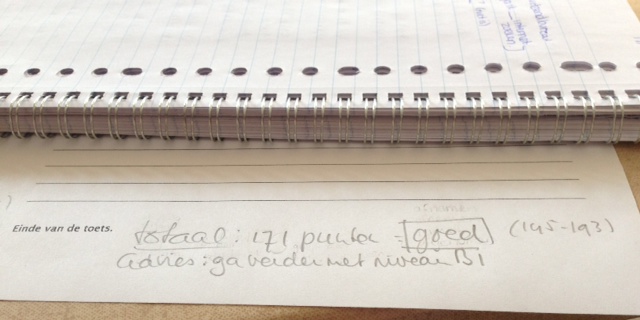
Yesterday was the last lesson for the A2 Dutch course. We also got our test results back. I scored a 171/193 points. That’s pretty good.

Score on Dutch A2 test

Total points: 171 (goed/good). Good range: 145-193. Advice: Go further with level B1.

I did of course make a few stupid mistakes. 😉 Two mistakes with the perfectum (example: I have gone) and two with the imperfectum (example: I went). And my Achilles heel is prepositions … I think I missed 5 out of 22 or something similar! But otherwise, it was good.

The rest of the class went pretty well. We didn’t look at the textbook or the workbook to do the last chapter, but rather did some more fun things. First she mentioned some good books to look at:

Nederlandse Grammatica voor Anderstalingen; ISBN 90 5517 014 3. She said this grammar book was rather comprehensive.

Nederlands in actie: Methode NT2 voor hoogopgeleide anderstaligenISBN: 978 90 469 0298 1. Apparently this is a good replacement for Contact 2, which is the textbook that we would be using in the next class.

Then we took turns doing voorlezen (reading aloud) from a 1973 children’s book called Floddertje. We read two of the short stories — “Opgesloten” and “Allemaal kaal” (which are ‘locked’ and ‘totally bald’). In the first story, she gets locked in her room so she won’t get dirty before guests come over. Doesn’t work. In the second story, she goes to the hair salon but due to a misunderstanding between her and her mom, ends up totally bald.

After that, we finished up by playing a vocabulary game: Pim Pam Pet. You have a stack of cards with vocabulary questions and one player spins to see what letter the answer must start with.

For example, I won these two cards:

een transport middel -> R -> Randstad Rail

Wat zie je op een boederij? -> K -> Koe

*

Method of transport -> R -> Randstad Rail (name of a Dutch train service)

What do you see on a farm? -> K-> Cow

And that was the end!

Categories: Courses | Tags: | 3 Comments

Create a free website or blog at WordPress.com.