AVI niveaus (Or: Reading levels for kids)

I finally sat down and tried to figure out how a certain set of books we own in our neighborhood library works. I knew that they correspond to reading levels for the kids, but I didn’t quite know how. To the untrained eye the system would definitely look out of order – for instance the books in our library are in order by M3, E3, M4, E4, M5, and E5. (It’s quite possible that they could have been out of order, as I ended up putting all of the comic books in order when I arrived.) But no, it’s quite intended.

I looked up the reading system (AVI niveau) on the internet. The number refers to the groep (grade) that the student is in, with groep 1 being 4 or 5 years old. The ‘M’ refers to them being in the  middel/middle of their reading level and the ‘E’ refers to einde/end of the reading level. Thus on average a groep 4 student might be reading E3, M4, or E4 books.
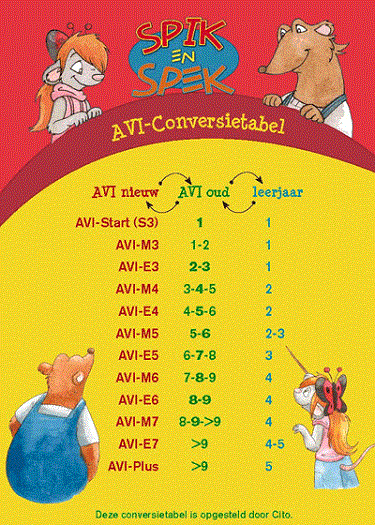
avi conversietabel

AVI conversion table from the old (oud) system to the new (nieuw) system, with the leerjaar/groep number on the side.

Categories: Working & Volunteering | Tags: , | Leave a comment

ij to ee to e (Or: Dutch class 11 by ROC Mondriaan)

In this Dutch class we randomly looked at the vowel changes that occur in Dutch when a verb changes from the present tense to the simple past and to the present perfect. Some groups of irregular verbs can be studied as groups because their vowels change in a predictable pattern. For example, ij in the present tense, ee in the simple past, and in the present perfect.

(to receive) krijgen -> kreeg -> gekregen

(to write) schrijven -> schreef -> geschreven

(to stay) blijven -> bleef -> gebleven

(to iron) strijken -> streek -> gestreken

(to drive) rijden -> reed -> gereden

At some point earlier this year I was reading something that made me realize the exact same phenomenon occurs in the English language as well. Of course, these examples are listed as the “craziest verb changes” on the linked page.

i -> a -> u

beginnen  to begin -> began -> begun
drinken  to drink -> drank -> drunk
bellen  to ring -> rang -> rung
zingen  to sing -> sang -> sung
springen to spring -> sprang -> sprung
zwemmen to swim -> swam -> swum

In other news, on Monday we have a test for chapters 1 through 3. Nothing major – it’s mainly for us to see where we are at and the teacher to see where we are at.

Here are the notes that I had taken:

notes for Dutch text chapters 1 through 3

I kept the photo a bit larger so my crazy handwriting could actually be deciphered. One nice thing I have noticed is that I tend to write most of my notes in Dutch these days, with the exception of word definitions. I try to write those in Dutch, but sometimes English is much simpler and quicker.

The one thing I haven’t quite got the hand of is the abbreviation for page. While Dutch use both pagina and bladzijde to mean ‘page’, they tend to use the latter more often and thus use ‘blz’ for the abbreviation. My English habits of ‘pg. #’ die hard, it seems.

Until next time!

Categories: Courses | Tags: | 1 Comment

Kruidnoten (Or: Christmas comes earlier every year)

Just like many cultures, the Netherlands has this crazy thing where the Christmas displays and food related items appear earlier and earlier every few years. This year it seems the agreed-upon date for all of the supermarkets was September 1 for Sinterklaas sweets, especially kruidnoten (yum) and gevulde speculaas (double yum – thanks Roger for showing me that one). I made sure my parents went home with a package of that, as it’s a seasonal treat.

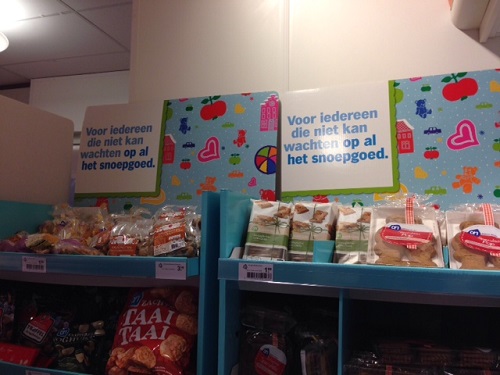
At least Albert Heijn realizes that the treats are ending up on the shelves earlier and earlier. Above the seasonal area they had this message:

cant wait for Christmas treats at Albert Heijn

Voor iedereen die kan niet wachten op al het snoopgoed.

For everyone who cannot wait for all of the treats/candy. 🙂

Categories: Culture, Food, Holidays | Tags: , , | Leave a comment

Expensive imports (Or: Twinkies for 15 euros)

When Marco and I dropped my family off at Schiphol airport, we stopped at a shop next to the Starbucks. This shop is known for having a small selection of imported American items, including candy, barbecue sauce, and other less than healthy snacks. Imagine my surprise when I found a 15 euro box of twinkies:

15 euro box of twinkies

Granted, it is a box of 10 twinkies but that still works out to €1.50 per twinkie, or $2. I have also found similar price increases for pop-tarts (English | Dutch) which I have fond memories of being able to get 2 for $5 in America. Here it is €5.50 for one box, although we recently found a €4.50 deal at an Asian supermarket of all places.

The only import place I have visited in The Hague is Kelly’s expat shop which had some interesting stuff with about the prices you expect. Unfortunately sometimes it is easier and cheaper to shop on Amazon UK and have it delivered to the Netherlands. But it’s more fun to go to the stores directly.

Categories: Food | Tags: , | 8 Comments

Leuk? Gezellig? (Or: Dutch class 10 by ROC Mondriaan)

One of the random things we learned in class last night was the difference between leuk and gezellig. While leak can translate to ‘fun’, gezellig is a bit harder to translate. The usual translation given is ‘cozy’, especially in terms of warm feelings.

He said the difference between leuk and gezellig is that something gezellig can only be done with another person, not by yourself. Leuk is generally something you yourself find fun, though it can also be said of a group.

Another nice thing about the Wednesday night class is sometimes we do the exercises more than one time. While I don’t really need the help (I’m not kidding – this class is basically 95% review for me), it is nice for the other students. For example, last night we repeated the same exercise three times. The first time was just to state the answers. The second time was to find the verbs and circle them, and explain that if the verb was plural, the subject also needed to be plural (which for some students is a helpful trick to find the subject). The third and last time was to switch both the subject and the verb into plural or single – the opposite of what the sentence was originally.

Another interesting side note that he had was over the word nogal which translates to ‘rather’ in English. He then compared that to other, similar words.

Het is een beetje duur. Ik koop het. It’s a little expensive. I (will) buy it.

Het is nogal duur. Misschien koop ik het. It’s rather expensive. I might buy it.

Het is heel (erg) duur. Ik koop ik niet. It’s very expensive. I will not buy it.

He is also a fan of synonyms  (just ask Marco who had to look over my homework ;)).  The teacher mentioned that a synonym for ‘nogal’ is ‘tamelijk’.

So although the classes are mostly review, I do learn a lot of random things, and I do think it is helping improve my vocabulary.


Categories: Courses | Tags: | Leave a comment

Wet newspapers (Or: Scenes from Delft)

Here are a few random pictures that I took while my family and I were walking through Delft on the way to the churches. I just could not pass up the lonely looking newspaper stuck in the canal…

paper in Delft canal

Nearby was a residence overlooking the water:

Delft canal scene

It was a nice day to walk through Delft – still jacket weather, but warm enough. Relaxing.

Categories: Delft | Tags: | Leave a comment

Into the unknown (Or: Dutch class 9 by ROC Mondriaan)

Yesterday’s class was interesting to say the least. The main grammatical thing discussed was “Er”, a small little word that usually doesn’t translate that well. In the simplest sense, however, it is translatable. Er is  or Er zijn translates to There is or There are. It is used with subjects that are considered onbepaald/undetermined, that is, the subject of the sentence is something not that well known. While it isn’t something that you think a lot about in English, it has the same basic rules in both languages.

For instance – De vrouw stat voor de deur, or The woman stood before the door. In English and Dutch, the use of “The” and “De” implies that the woman is known, likely that she was referred to in a previous sentence.

But if the woman isn’t known yet, or is “undetermined”, than in Dutch you can use Er is. Example: Er is een vrouw voor de deur. There is a woman before the door.

Er loopt niemand op straat. (There walks no one in the street, or less awkwardly – No one walks in the street.)

Er ligt een boek op tafel.  (There lies a book on the table, or less awkwardly – There is a book on the table.)

Of course, the above two examples provide translation frustration because they use the “positional” verbs to describe an object. liggen = to lie, zitten = to sit, staan = to stand, and lopen = to walk. There’s a fifth one that is less used hangen = to hang. These five verbs are used to describe the position of someone or something. It’s something that I don’t quite have the hang of yet and need to practice more. A lot more!

The fourth post in this link explains things a bit better than I could, although they don’t always translate the Dutch. If needed, open two copies of the url and translate one of them but not the other. Or use Google translate as needed. ;p

Categories: Courses | Tags: | Leave a comment

Marzipan (Or: pigs and other sweets)

Last week Marco and I walked through V&D to look at their deals. They had a sale event going on called Prijzen Circus.  According to Marco you can also (sometimes) get some interesting things in the bakery during this time.

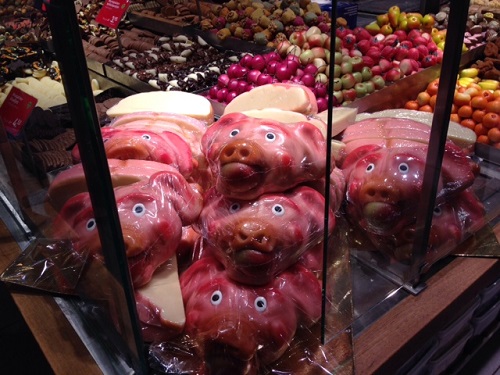
Lo and behold, I found pigs made out of marzipan:

pig made out of marzipan

They looked quite cute if you ask me. And full of sugar… In the background you can see other treats – everything in that display case was made with marzipan. Crazy!

Categories: Food | Tags: | 6 Comments

Woordenschat (Or: Dutch class 8 by ROC Mondriaan)

The theme of this lesson was synonyms (synoniemen) and vocabulary (woordenschat). The latter is a fun word, as it literally translates to word treasure.

Here were some of the words we had:

lui – je wil niks doen (lazy – you don’t want to do anything)

plezierig – iets leuk  (pleasurable – something fun)

ergernis – je vind het niet leuk (irritation, you find it not fun)

hekel – ik vind het helemaal niet leuk (hatred – you find it completely not fun)

Although this class is definitely slower than my last class, one nice thing is there is absolutely no English spoken in the class (mainly because there’s only a few people here where English is their native language!). Spoken Dutch and pronunciation are much better as well.

Another thing that was discussed was bijvoeglijk naamwoord (or adjectives). This was one thing that I did not understand for the longest time. The first thing you need to look at is whether the adjective comes before or after the noun. If it comes after, it’s pretty simple.

Het huis is groot. (The house is big.)

De auto is rood. (The car is red.)

De tafel is zwart. (The table is black.)

If the adjective comes before the noun, you usually add an e (and possibly alter the spelling a bit):

Het grote huis

De rode auto

De zwarte tafel

If you use een (or ‘a’) instead of de/het (or ‘the’) then the -e is dropped before ‘het’ words only:

Een groot huis (groot instead of grote)

Een rode auto (rode stays the same)

Een zwarte tafel (zwarte stays the same)

We also discussed the differences between words that might translate the same:

benieuwd = curious (you want information in general)

nieuwsgierig = curious (you want information over private things, a bit nosy)

Crazy vocabulary!

Categories: Courses | Tags: | Leave a comment

Fierljeppen (Or: Dutch class 7 by ROC Mondriaan)

Note: I was not at class 6 due to the wedding (!) so there was not a blog post last week Wednesday.

Today was an interesting class as the chapter was “Sport”. We learned about a sport that is mostly in the Dutch province Friesland. The name of the sport is Fierljeppen (Wikipedia: Dutch | English). The sport originated in Friesland in the 1700s where there are lots of canals but not a lot of bridges to get across. Facing a lack of bridges in the area they used long poles to spring across.

The goal of the sport is to run towards the pole (which is already in the water) and climb up it as fast as possible while also maneuvering your body forward to reach the other side of the water. As the stick falls towards the other side you jump into the sand. The person who lands the farthest in the sand wins the competition.

And if that was not confusing enough, here is a YouTube video of it. :p

The wedding was good by the way. Afterwards we then spent a few days touring The Hague and Delft with my parents, brother, and sister-in-law. 🙂

Categories: Courses | Tags: | 2 Comments

Blog at WordPress.com.