Posts Tagged With: Dutch language

Compare and constrast (Or: Dutch class 22 by ROC Mondriaan)

The main grammar that we had this week was de vergrotende trap (comparative) and de overtreffende trap (superlative).

English: good, better, best
Dutch: goed, beter, het best(e)
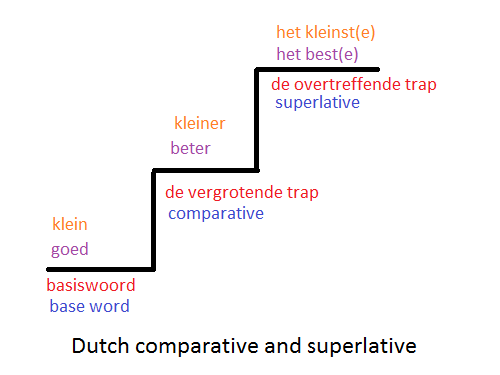
Dutch comparative and superlative

trap in Dutch means stairs. Officially this chapter only comparatives, although we’ve had both a few times in the last week. For me it’s one of those things where I just “use it”, but don’t exactly know the rules behind it in either language.

Comparative –

bijvoeglijk naamwoord + er:
groot -> groter (big, bigger)
klein -> kleiner (small, smaller)

As you can see, English has the same basic rule – add -er. Sometimes you have to add -der, though – when the noun ends in r.

bijvoeglijk naamwoord + der:
donker -> donkerder (dark, darker)
lekker -> lekkerder (tasty, tastier)

And then the words that don’t fit the pattern at all, just make kids and students crazy:

veel -> meer              (much -> more)
weinig -> minder        (little -> less)
graag -> liever           (like -> prefer)
goed -> beter            (good -> better)

Patat is lekkerder dan spaghetti. Fries are tastier than spaghetti.

Een auto is kleiner dan een vliegtuig. A car is smaller than an airplane.

If you want to say the two objects are the same, you have a few choices:

even … als (or: evenveel … als)
net zo … als
English (just as … as)

De blauwe sjaal is even mooi als de rode sjaal. The blue scarf is just as pretty as the red scarf.

And there you have it – comparatives or de vergrotende trap. Perhaps I can cover superlatives and de overtreffende trap.

Categories: Courses | Tags: | Leave a comment

A question of pronunciation (Or: Dutch class 21 by ROC Mondriaan)

In every language it seems you have a word that must be pronounced perfectly, lest the native speakers laugh at you mercilessly for saying a much, much different word.

Somehow we randomly got on this example last night – a student said she had trouble pronouncing huur, or rent in English. (This is understandable as the double uu sound is not a natural sound in English, though it is similar to pronouncing tu in Spanish or French.) She mentioned that her coworkers laugh good naturedly when she tries. And why is that?

huur = rent

hoer = a woman who earns her money in bed. ;p ‘Whore’ in English. The w is silent. But oe in Dutch is much easier to pronounce and what usually comes out when you are trying to pronounce uu.

Ik moet de hoer betalan. I must pay the… whore? Hmm.

The same issues exist with the words buur (neighbor) and boer (farmer). Usually when trying to pronounce buur it comes out as boer partially due to not knowing the pronunciation and partially due to your mouth not being able to do the uu sound well.

————————–

During the class we mainly finished off chapter 7 and looked again at the time words mentioned in my last blog post (toen, als, wanneer, sinds, and similar).

One thing I did (randomly) learn was that you can mix some verb tenses. The rule for complicated sentences (with a main clause and additional sub clauses) is that the tense always stays the same in past or present.

Toen ik naar de dokter ging, zag ik haar. When I went to the doctor, I saw her. Both in the past tense (required).

Wanneer ik naar de dokter ga, zie ik haar. When I go to the doctor, I see her. Both in the present tense (required).

But you can use the present perfect (Ik heb gezien  / I have seen) and mix it with past or present tenses.

Soms wanneer ik naar de dokter ga, heb ik haar gezien. Sometimes when I go to the doctor, I have seen her. Though it does sound a bit better to add the ‘soms’, or some other element, to the sentence when using the present perfect.


Categories: Courses | Tags: | Leave a comment

But where does the verb go? (Or: Dutch class 20 by ROC Mondriaan)

Last night I had another class by ROC Mondriaan. As I was on vacation for the last two classes I did not know exactly what the homework was. We were almost done with chapter 5 when I left, so I did all of chapter 6. Unfortunately the class did not get that far so I was a bit bored during the class! But it happens. I did make one mistaken with the dictee, which is a spelling exercise. The teacher tells you a sentence and you need to write it down perfectly. I misspelled concurrentie, or competition. I spelled it as ‘concurrencie’, which makes sense since -tie in Dutch sounds more like a soft -cie (or ‘see’). Another example is politie (police) which is pronunced like po-leet-see.

The main substance of the class was additional time/conditional words which influence the placement of the verb.

als = if (though it can be interchanged with wanneer sometimes)

wanneer = when (present tense)

toen = when (past tense). It also translates to ‘then’ in the past tense.

sinds = (ever) since

The hardest thing to remember is what tense you are in. If you are talking about things happening at this moment, you cannot use toen, only als or wanneer. If you are talking about things that have already happened, you can only use toen. 

The other main thing to remember is that when you use one of these words within a sub clause (or bijzin in Dutch), you need to put the verb at the end of the clause. One good way to figure out if it is a sub clause or not is to check and see if the sentence can stand on its own. If it cannot, it is a sub clause. Als ik naar de dokter ga… (if I go to the doctor…) is not a complete sentence. You have not said what would happen. Thus the verb will be placed at the end of the clause.

Toen hij zijn familie zag, was hij blij. When he saw his family, he was happy. The sentence is past tense, so you use ‘toen’ not ‘als’ or ‘wanneer’. Notice how the verb ‘zag’ goes to the end of the clause.

Als hij zijn familie ziet, is hij blij.

Wanneer hij zijn familie ziet, is hij blij.

If/when he sees his family, he is happy.

Sinds ik nieuwe buren heb, heb ik hoofdpijn. Ever since I have new neighbors, I have a headache. (Though the tense choice in English is probably not the best.)

And then finally, the other use of toen is ‘then’ in the past tense. The verb doesn’t go at the end of the clause/sentence for this – it merely comes before the subject. Simple inversion.

Eerst ging ik naar het strand. Toen ging ik naar mijn huis. First I went to the beach. Then I went to my house.

I am not quite sure why they needed the split in word choices based on the tense… but you do eventually get used to it. Maybe…

Categories: Courses | Tags: | Leave a comment

A Comparison of Weather (Or: Dutch class 18 by ROC Mondriaan)

NOTE: There will be no class postings next week (#19 and #20) as Marco and I off are off on our honeymoon. Yay!

This lesson covered two things – weather (a short, spontaneous topic at the beginning) and comparisons. Of course, weather was the topic of the day because it was raining again. This year is the 5th wettest autumn so far (link in Dutch) and it seems to have no signs of stopping. We covered the various forms of weather, much like we did last month:

Het miezert = It rains (just a little bit).

Het regent = It rains.

Het giet OR Het stortregent = It rains (a lot).

Het sneeuwt = It snows. Did I mention the -eeu(w) vowel group doesn’t really exist in English? It is pronounced something like s-nay-out, but quicker: snayout.

Het waait = It is windy.

Het vriest = It freezes.

Het stormt = It is (very) windy.

De zon schijnt = The sun shines. Note the exception in grammatical construction.

The other thing of note was comparison, with two different models:

verschillend: is … …er dan …

hetzelfde: … is even … als …

difference: is … …er than …

the same: … is just as …. as ….

Jumbo is goedkoeper dan Albert Heijn. (Jumbo is cheaper than Albert Heijn – both are grocery stores.)

De morgen is even lang als de middag. (The morning is just as long as the afternoon.)

And there you have it – weather and comparisons!

Categories: Courses | Tags: | 1 Comment

Turning sentences around (Or: Dutch class 17 by ROC Mondriaan)z

One of the grammatical things that we covered in last night’s class was the placement of the verb in main clauses (I did not go to school) and subordinate clauses (because I was sick). In Dutch they are called the hoofdzin and the bijzin, respectively.

In Dutch (and German) the verb in the bijzin goes to the end of the clause in most cases. You have some special conjugations that do not affect the placement of the verb, but there are only a few. They are en (and), of (or), want (because), maar (but), and dus (thus). The rest of the conjunctions affect the placement of the verb.

Ik ga niet naar school want ik was ziek. I did not go to school because I was sick. (“want” does not require the verb “was” to go to the end of the sentence.)

Ik ga niet naar school omdat ik ziek wasI did not go to school because I was sick. (“omdat”, another way to say because, forces the verb “was” to the end of the clause.)

Zij gaat direct werken nadat ze voor de opleiding geslaagd is. She will work after she has passed her education (course).

If you use one of the special connectors that affect the placement of the verb, you can also begin with the subordinate clause and end with the main clause. You then need to have inversion of the subject and the verb in the main clause. This has the awesome effect (if you like grammar like I do) of placing the two conjugated verbs next to each other with only a comma in the middle.

Omdat ik ziek was, ga ik niet naar school. Move the subordinate clause in front, and invert ‘ik’ and ‘ga’ (subject and verb). Then you have the two conjugated verbs (‘was’, ‘ga’) next to each other with only a comma in between.

Nadat ze voor de opleiding geslaagd is, gaat zij direct werken. 

The normal connectors — en (and), of (or), want (because), maar (but), and dus (thus) — cannot be put at the front of the sentence.

While it is annoying in the beginning to change verbs around like this, it does get easier with a lot of practice. I definitely have Marco to thank for that as he has helped correct a lot of my mistakes! But practice, practice, practice.

Categories: Courses | Tags: | Leave a comment

Vandaag, nu, hier (Or: Dutch class 16 by ROC Mondriaan)

Last night was the 16th class by ROC Mondriaan. We did something that we have done almost every Wednesday (as we have different teachers on Monday and Wednesday). It is an exercise called Vandaag – nu – hier or Today – now – here. I think it’s an exercise the teacher himself made.  It covers about 20 very simple sentences like:

Het lokaal is… The classroom is… [#106]

Het seizoen is… The season is… [herfst/fall]

De lesdagen zijn… The class days are… [maandag & woensdag/Monday and Wednesday].

Usually he goes through the exercise once and then tries to put a spin on it. This time when he asked the temperature questions he began a discussion about freezing, melting, ice, hail, and similar things.

Then we moved on to the book. We started chapter 5, Leren en Werken or Learning and Working. Instead of starting with the introduction page on the right side, he first asked us to look at the photo on the left side. It showed a woman helping a male teenager using the computer – presumably she was his mother or teacher. He asked us to describe the photo and then he asked us to guess her age. He then launched into a discussion about guessing and uncertainty:

een raden = iets dat je niet weet maar je zegt het toch. Something you don’t know [for sure] but you say it anyway. ‘a guess’

Ik raad dat zijn leeftijd 15 is. I guess that his age is 15.

Ik geloof dat… I believe that…

We then talked about the education system in the Netherlands which you can read about on Wikipedia. First you have onderwijs (education) and then you have opleiding (university or job training). The interesting thing about Dutch education is that around age 12 you take the Cito test which helps your teacher and parents determine what track you should be on in high school.  It is of course possible to step sideways to another track (higher or lower), although if you going to a higher track you might need to start at a slightly lower year than you otherwise would have if you had stayed in your own track.

The highest track (gymnasium – nothing to do with physical education!) also teaches ancient Latin and Greek. That sounds pretty cool if you ask me…

And here I was just happy that I was able to pick from German, French and Spanish in high school. (I ended up with 4 years Spanish and 2 years French although only 2 years in one language are required.)

Categories: Courses | Tags: | 3 Comments

Up and down progress (Or: Dutch class 15 by ROC Mondriaan)

Back to hitting the books!

Last night our Dutch teacher had a pretty good explanation for what happens when you learn Dutch – or any other language for that matter. The progress isn’t always as fast as it was in the beginning…

The Progress of Learning Dutch

The above photo is quite true. Sometimes at work I have “bad days” (nothing that comes out of my mouth seems to make sense to the library customer!) and then there are “good days” (when I am actually able to articulate myself “on the fly” as it were – or quickly and effortlessly). Work is the hardest place to speak Dutch, because I never know what the other person is going to want or ask. In other situations with family and friends it is much more relaxed.

We also learned a few new vocabulary words (in a section about parents buying mobile phones for their children):

gloednieuw – pas gekocht, helemaal nieuw. Something you just bought, completely new.

peperduurvroeger kwam peper van Azië en het was heel duur. In the past pepper came from Asia at a terribly expensive price. Now something can be not just duur (expensive) but can also be peperduur.

We also looked at writing a formal letter, something I learned in my last class at Volksuniversiteit, though practice never hurt anyone. One thing I did learn though is this phrase:

Bij voorbaat dank voor uw … Thanks in advance for your…

antwoord / reactie / medewerking … answer, reaction, consideration/participation

Or a few other ways to say you’re waiting for their reply:

Ik hoor het graag van u. I hear it gladly from you.

Kunt u mij snel een reactie sturen? Can you send a reaction quickly?

Ik wacht op uw antwoord/reactie. I wait for your answer/reaction.


Categories: Courses | Tags: | 1 Comment

English pronunciation (Or: Dutch class 14 by ROC Mondriaan)

NOTE: Next week is herfstvakantie (fall vacation), so there will be no class related blog posts.

Like all languages, Dutch steals from other languages. Sometimes they prefer to use English words in place of Dutch words, especially with newer technology (internet, websites, and etc). They tend to pronounce these words with an English pronunciation. I should be happy right? English is my native language – sounds easy for me!

Except that it’s not that easy. I find it quite difficult to switch pronunciations mid-sentence. Things like journalist do not take the usual Dutch pronunciation for the (making it sound more like yer-na-list) but rather keep the English j. We had the word journalist as one of our vocabulary words in Wednesday’s class. Case in point: today is Friday so when I went to the Albert Heijn I told the cashier Fijne weekend! (happy weekend) however I said weekend with a Dutch accent and then corrected myself. We had a good laugh.

In Dutch the work week is spelled the same but pronunciation is closer to the English word ‘wake’, just with a bit more English ‘v’ than ‘w’. (Plural: weken, pronounced like vay-ken). But for some bizarre reason the Dutch like to pronounce weekend as … the English word ‘weekend’. Hmm.

Other things we discussed in class: ooit / nooit. Ever / never. The two usual uses:

Ik wil nooit een konijn hebben. (I never want to have a rabbit.)
Heb je ooit chinees gegeten? (Have you ever eaten Chinese?)

Not too unexpected there. In this case ooit translates to ‘ever’. But it can also translate to ‘once’ (although you can generally use other Dutch words like vroeger.)

Deze deur was ooit blauw. (This door was once blue.)
Deze deur was vroeger blauw. (This door was earlier blue.)

Finally, you can also use ooit a third way, which I learned in class. The Dutch also use ooit to point to the future – though the point is not known.

Ooit zal ik naar Duitsland gaan. (‘Sometime in the future’ I will go to Germany.)

Or the slightly more depressing Ooit zal ik je weer zien, which is apparently a Dutch song. Sometime I will see you again.

Categories: Courses | Tags: | Leave a comment

Voorzetsels, my nemesis (Or: Dutch class 13 by ROC Mondriaan)

You might be able to guess what voorzetsels are if I use the other common Dutch word for them: preposities. 

That’s right. It’s time to talk about the evil prepositions that lurk within any language. Obviously they are not that evil in English, because it’s my moedertaal (literally: mother language). But in Dutch… oh no. Run!

It’s also made more fun by the fact that you have vaste or fixed prepositions. That means that some verbs/expressions always take the same preposition. My first memorable experience with prepositions after moving here was which one to use after wachten, or ‘to wait’. In English the expression is ‘to wait for’. So naturally one would assume you can say Ik wacht voor de bus.

But that means that you will see this coming at you:

front of bus

That’s right… it means you’re waiting (literally) before the bus, in the street. Hmph. Whereas English has two words – ‘before’ and ‘for’ – there is only voor in Dutch.

(While I was looking for a good image, I can across this article about a woman who missed a bus and decided to catch up with it at the next red traffic light. She lay down in front of it until the driver let her on…)

If you want a rather exhaustive list of fixed prepositions, you can look at Dutch Grammar (it also includes English translations).

Some important ones include:

kijken naar (to look at)
luister naar (to listen to)
bang zijn voor (to be afraid of – zijn is ‘to be’)
denken aan (to think about)
houden van (to love – ik hou van jou – I love you!)
praten over (to talk about)
praten tegen (to talk to [someone])
praten met (to talk with [someone])
wachten op (to wait for *wink*)

Categories: Courses | Tags: | 2 Comments

even, effe, ff (Or: Dutch class 12 by ROC Mondriaan)

Two days ago Wednesday was the 12th class by ROC Mondriaan. I must admit that that is another example of something that is simpler to say in Dutch – eergisteren means ‘the day before yesterday’ and overmorgen means ‘the day after tomorrow’. Just like the movie…

Anyway, one random thing we learned on Wednesday was the difference between eveneffe, en ff.

Even = (a-ven, with a hard a) is hard to translate at times. It’s generally used to make commands or statements softer/politer. And probably other usages I don’t know yet. It’s harder for non-Dutchies to grasp.

Effe = street version of the same word. Pronounced f-fa (short a).

ff = even shorter version used for texting. Yep, they abbreviate a four letter word into a two letter word. (And English is just as guilty of that.)

We had another writing exercise. This time about the sports that we like or don’t like, and whether we participate in sports as well. (I like to watch sports on tv. But I definitely don’t participate in any.)

Amusingly this chapter was called media en comunicatie (media and communication) and the chapter opened with a brief story from a librarian. Because of my background in libraries, the teacher asked me to talk a little bit about libraries in general and also read the brief story. I did pretty well with the pronunciation – luckily there were not too many annoying words in the text.

We found out that we have a test for synonyms on Wednesday. Couple that with the test on Monday and I suddenly have something to study for. Should be fun… But it is getting a bit more interesting now, as we get random information that isn’t found in the textbook itself. So it is going well.

Categories: Courses | Tags: | Leave a comment

Create a free website or blog at WordPress.com.