Courses

Grammar review (Or: B2 Dutch course #2)

Last night was the second lesson. It went pretty well. I realized a few months ago that I don’t really have that slightly scared feeling in my stomach when I go to work or class anymore – I used to be very nervous that I wouldn’t know what was being asked or said. And that it would be painfully obvious. But these days I don’t feel that much anymore – I would say I understand about 97% of what the professor says. Work is a bit less, but that’s because it’s dealing with strangers and accents I am not used to yet.

The first part of the class was a review of the grammar that we had already learned, mostly word order. As it is something I’ve already covered a lot in the previous class-related posts, I’ll spare you the boring details. (Well, it’s not boring to me!). We did cover something that I didn’t know yet though.

Het schip strandde op de kust. The ship stranded on the coast.
Het schip is gestrand. The ship was stranded.
Het gestrande schip trekt veel aandacht. The stranded ship drew much attention.

The last bit in bold is what I learned – voltooid deelwoorden (past participle – used in the perfectum/perfect tenses) can be used before nouns. This turns them into adjectives! In most cases you need to add an -e after the past participle. Two exceptions are:

1. before een/a with a ‘het’ word. een afgebrand huis. A burning (down) house. (This rule isn’t any different from the basic rule. Een/A means that the object is not known. If it was, you would use de or het [the] before it. If the object is both unknown and a het word, you do not add an e.)

2. to adjectives that already end in -en, regardless of de or het.
de gouden ring / the golden ring
de houten tafel / the wooden table

Finally, here are two more situations of knowing when to use de of het – I already said that words ending in -ie or -heid are ‘de’ words in the previous post. The same is true for -ing and -teit.

de woning, de oplossing, de leering (the home, the solution, the student)
de nationaliteit, de autoriteit (the nationality, the authority)
Categories: Courses | Tags: | Leave a comment

Een beetje moeilijker (Or: B2 Dutch course #1)

Currently sitting at home listening to workers upgrade the heating unit – they are looking to upgrade them in all of the apartments, thus it takes a while. They’ve been here for a bit more than 2 hours as of this writing… with occasional loud drilling to keep me awake. [Edit: Seems to be done now, about 3 hours in total.]

Last night was my first B2 course by ROC Mondriaan. As a recap, the main reason this course is a good one is the price – €30 for 20 weeks (6 hours per week) provided you live in The Hague. The school receives a subsidy from the city government for what would otherwise be a very expensive program. And as an added bonus, we found out that the government had some left over money in this budget, therefore we also received our textbook (De Finale – €31.50) for free. Unexpected, but nice! I guess that means I was paid €1.50 to go to this class for 20 weeks. Maybe.

In the end there were about 15 or 16 people in the class. The teacher seemed nice enough. A bit of a soft speaker (due to a medical issue) but as I usually sit closer to the front it is not really a problem for me. Similar to the last course, the focus is again on writing, reading, listening and speaking as the textbook aims to prepare you for the NT2 exam after the course. Surprisingly, more than half of the class said that that they were interested in taking the exam.

Although the first night covered a lot of administrative things, we did also get started with some websites and the textbook. One of the websites she mentioned was Beter Spellen (Better Spelling). You can create a free account and receive a daily email with quizzes tailored to your difficulty level (there are three levels). I still need to make an account there, but she did show us a few example tests in class. The one thing she asked was that we not do the quiz on Tuesdays and Thursdays, because she wanted to do them in class.

We also looked at a few things in the textbook and did a speaking exercise. Luckily someone from the previous B1 class was assigned to this class, so we sat next to one another and also did the speaking component together. Though we still have a bit of trouble with our respective accents… I find it a bit difficult to ask people to repeat themselves, so sometimes I “smile and nod” even if I missed the meaning of the sentence. I really must work on that!

Lastly, she did mention that she would try and teach us a few rules everyday about when to use -de or -het for “the” (in English you only have “the” but in Dutch you have two choices, though de is much more common these days). Just a few rules per class – not too many.

-de words:

words which end in -ie: politie (police), concurrentie (competition), vakantie (vacation), koffie (coffee).

words which end in -heid: overheid (goverment), zekerheid (security), vrijheid (freedom), gezondheid (health)

All in all an interesting class. Definitely a bit more difficult – or een beetje moeilijker – which is what I like.

Categories: Courses | Tags: | Leave a comment

B2 (Or: Another Dutch course begins)

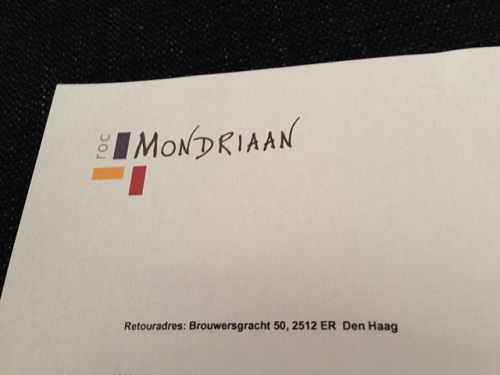
I received the letter I was waiting for on Friday afternoon.

letter from ROC Mondriaan

The purpose of the letter was to let me know that my next course – B2 – would be starting next week. This is the final class that I need before taking the NT2 exam. The class itself lasts 20 weeks and should be done sometime in June (after factoring in the Easter holiday and similar).

I’m looking forward to this course. While I had fun over the holidays it felt pretty weird not to have anything to study. While I do know what the textbook will be (but not the particular edition the class will be using) I’ve tried to stay away from peeking at the book too much over the holidays. That only leads to boredom during classes…

Categories: Courses | Tags: | 7 Comments

At the end (Or: Test day 2 of 2 at ROC Mondriaan)

Tonight I had my listening and reading tests for Dutch. The listening test started off pretty easy but definitely became harder by the end. Part 1 was about 20 short listening exercises, each with its own question. Part 2 was compromised over three longer listening exercises, each with 4-7 questions. In total there were 40 questions. Seven or eight of those were questions that I was less than 100% certain of. But it was kind of nice to hear all of the different scenarios, each with different people (and thus different accents).

The second test was reading, with 27 different questions. My nervousness about this test disappeared when the teacher said that it was a bit easy – and that her and another teacher kept meaning to make it harder but hadn’t found the time. This one was again different scenarios. The longest one was about grofvuil or the larger trash items that don’t fit into a trash bin — thus you have to ask the city to come take it away for you (couches, tables and similar). I had already read up on that when we had to get rid of the old couches, so the vocabulary wasn’t new. Out of the 27 questions I had 3 that I was not 100% sure of. So no problems there.

Between the two tests the teacher asked if anyone would like to know their grades for the listening test, but everyone seemed to content to wait until Thursday for the results. So after the reading test was done I very quietly asked and she said I had passed — which means that I am all but assured of passing B1 and going on to B2. Though of course it will be nice to hear it officially on Thursday!


Categories: Courses | Tags: | 1 Comment

Almost at the end (Or: Dutch class 26 by ROC Mondriaan)

Yesterday’s class was the final class before the two test days (tomorrow and next Tuesday). It was pretty relaxed though you could really tell who wanted to be there and who didn’t. Most people hadn’t done the homework. Just me (what else is new) and another woman who admitted doing it on the tram on the way over.

Tomorrow is the writing test as well as the speaking test. I am doing the speaking portion before the class itself begins, so luckily I can leave as soon as I am done with the writing component. That’s easily my strength thanks to all of the emails I sent to Marco while he was at work!

I was also able to find out what book we’ll be needing for the next course, B2. I was happy to find out that it was De Finale (The Final, or ‘The End’). I have seen that book before — it is a textbook that helps prepare you for the NT2-II exam. From what I have seen it does look look like a good book for that.

There’s a slight chance my B2 course might start in the first week of January. My teacher said that a B2 course started this week (since the school receives money from government of The Hague they probably wanted to get additional money on the 2013 books) so it will only run for two weeks before the holidays start. I wouldn’t mind joining in week 3. But even if that doesn’t pan out, there’s probably another B2 course starting next month as well.

We’ll see how it goes…

Categories: Courses | Tags: | 2 Comments

Somewhat the same (Or: Dutch class 25 by ROC Mondriaan)

NOTE: If you’re noticing the falling snow on my blog, it’s a WordPress feature that comes around every December for the holidays. 

On Tuesday I had my first lesson with the other B1 class. (I switched to this B1 class because they were almost ready to take the final test, and that gets me into B2 two months sooner. I hope.)

Some impressions that I had: the class size was a bit smaller, with about 8 or 9 people. Half of those people liked to come 15-20 minutes late, though there was also the same problem in the other B1 class. In preparation for the switch I had pretty much finished the textbook, but this class didn’t get to the last two chapters . Although I did skip a handful of exercises each chapter that were predominantly speaking or writing. I don’t have much trouble with writing, so that is no big deal for me.

(Tip for learning a foreign language: force yourself to write whenever you can. For me, writing daily work emails to Marco has helped me writing skills tremendously. Though being fascinated with grammar is also a good motivation.)

The class is the same as the other one in other ways as well: most of the students are just as unmotivated. They do not do their homework, for instance. They don’t really try when answering a question. Everything is funny to them. A few times the teacher made mention of the fact that I had already done this listening exercise or that writing exercise but 1) I didn’t know how far they had gotten. 2) I wasn’t exactly sure what the test would be about, so I wanted to study everything.

So, I’m stuck hoping B2 is more challenging. Though my teacher did warn me that most people don’t do their homework in B2 either. But it should be more challenging in general — there’s a gap between B1 (normal job level of Dutch) and B2 (required for university level jobs). B2 isn’t for everyone – and here I am doing it for fun. I am weird!

Categories: Courses | Tags: | Leave a comment

Changing things up (Or: Dutch class 24 by ROC Mondriaan)

The last few days have been pretty intense in terms of studying. I have hinted on this blog that the B1 course is too easy, although I am the weird nut that likes grammar. A few weeks ago my teacher asked if I would like to do the final exam for the class a few months early – so I would finish B1 just before Christmas, about two months earlier than expected. This just requires switching into a class that is almost done.

Of course I agreed, since 1) the class is too easy 2) if I can get into the B2 class a bit earlier, I might finish before the summer break. One can hope… Regardless, after B2 comes the NT2-II exam (for fun – the horror) so there is still a lot more work to do.

Officially I switch into the other class tomorrow, so I now go to class on Tuesdays and Thursdays (only). Thursday is a free day due to the Sinterklaas holiday, so tomorrow and the following Tuesday are the two class days before the tests begin. The tests are given on the 12th and 17th, with an individual speaking test given at some other time. We receive the results on the 19th.

Tonight’s class was a bit shorter – we had a test for chapters 4 through 6, though due to the craziness mentioned above I have finished the book (through chapter 12). Doing 5 chapters in under a week is a bit insane… but I did the same thing to able to skip the A1 class, way back when.

And the test over chapters 4 through 6? Just might be another 100%! But I have a feeling the final exam will be harder… But I’m ready for it.

Categories: Courses | Tags: | 3 Comments

Baby animals and more (Or: Dutch class 23 by ROC Mondriaan)

My class on Wednesday was a bit lighter on content it seems – I only have one page of notes!

Usually the first topic in class is randomly chosen. This one actually came from the textbook – this chapter talked about farmers, greenhouses, and similar subjects. One of the things we discussed was the names for baby animals:

koe – kalf (cow – calf)
kip – kuiken (chicken – chick)
varken – big (pig – piglet)
schaap – lamb (sheep – lamb)
paard – veulen (horse – foal)
hond – puppy (dog – puppy)

As you can see, puppy was definitely borrowed from English. Which language had ‘lamb’ first is debatable (and probably Googleable).  

The grammar that we discussed was a theme that seems to come back week after week – using dat (or similar words to connect two sentence clauses together) almost always results in the verb in the subordinate clause going to the end. This week was “saying something using the indirect route, versus the direct route”. The direct route could also be considered what was actually said in the beginning, or a quote.

Het examen is moeilijk. -> Zij zegt dat het examan moeilijk is. She said that the exam is difficult.

Morgen gaat het regenen. -> De broer zegt dat het morgen gaat regenen. The brother said that tomorrow it would rain. (Unconjugated verbs like ‘regenen’ end up after the conjugated ‘gaat’ verb.)

And finally, one for your amusement… (what the heck? this was in the textbook).

Ik zoek een vrouw. -> De enzame boer zegt tegen de vrouw van de tv dat hij een vrouw zoekt. The lonely farmer said to the woman from the television (a reporter?) that he is looking for a woman. Presumably as a wife.

Since this was pretty light in class talk, I’ll leave you with a random photo from the local Hema:

escalator coffee display at Hema

What do you do when you have piles and piles of extra bags of coffee? Why, put it between the escalators of course! (Actually it is a pretty smart use of space. I’m just used to that space being empty.)

Categories: Courses | Tags: , | Leave a comment

Compare and constrast (Or: Dutch class 22 by ROC Mondriaan)

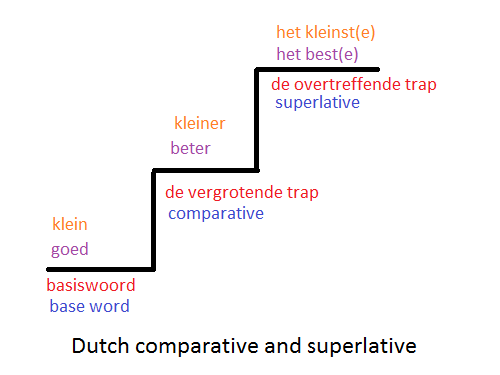
The main grammar that we had this week was de vergrotende trap (comparative) and de overtreffende trap (superlative).

English: good, better, best
Dutch: goed, beter, het best(e)

Dutch comparative and superlative

trap in Dutch means stairs. Officially this chapter only comparatives, although we’ve had both a few times in the last week. For me it’s one of those things where I just “use it”, but don’t exactly know the rules behind it in either language.

Comparative –

bijvoeglijk naamwoord + er:
groot -> groter (big, bigger)
klein -> kleiner (small, smaller)

As you can see, English has the same basic rule – add -er. Sometimes you have to add -der, though – when the noun ends in r.

bijvoeglijk naamwoord + der:
donker -> donkerder (dark, darker)
lekker -> lekkerder (tasty, tastier)

And then the words that don’t fit the pattern at all, just make kids and students crazy:

veel -> meer              (much -> more)
weinig -> minder        (little -> less)
graag -> liever           (like -> prefer)
goed -> beter            (good -> better)

Patat is lekkerder dan spaghetti. Fries are tastier than spaghetti.

Een auto is kleiner dan een vliegtuig. A car is smaller than an airplane.

If you want to say the two objects are the same, you have a few choices:

even … als (or: evenveel … als)
net zo … als
English (just as … as)

De blauwe sjaal is even mooi als de rode sjaal. The blue scarf is just as pretty as the red scarf.

And there you have it – comparatives or de vergrotende trap. Perhaps I can cover superlatives and de overtreffende trap.

Categories: Courses | Tags: | Leave a comment

A question of pronunciation (Or: Dutch class 21 by ROC Mondriaan)

In every language it seems you have a word that must be pronounced perfectly, lest the native speakers laugh at you mercilessly for saying a much, much different word.

Somehow we randomly got on this example last night – a student said she had trouble pronouncing huur, or rent in English. (This is understandable as the double uu sound is not a natural sound in English, though it is similar to pronouncing tu in Spanish or French.) She mentioned that her coworkers laugh good naturedly when she tries. And why is that?

huur = rent

hoer = a woman who earns her money in bed. ;p ‘Whore’ in English. The w is silent. But oe in Dutch is much easier to pronounce and what usually comes out when you are trying to pronounce uu.

Ik moet de hoer betalan. I must pay the… whore? Hmm.

The same issues exist with the words buur (neighbor) and boer (farmer). Usually when trying to pronounce buur it comes out as boer partially due to not knowing the pronunciation and partially due to your mouth not being able to do the uu sound well.

————————–

During the class we mainly finished off chapter 7 and looked again at the time words mentioned in my last blog post (toen, als, wanneer, sinds, and similar).

One thing I did (randomly) learn was that you can mix some verb tenses. The rule for complicated sentences (with a main clause and additional sub clauses) is that the tense always stays the same in past or present.

Toen ik naar de dokter ging, zag ik haar. When I went to the doctor, I saw her. Both in the past tense (required).

Wanneer ik naar de dokter ga, zie ik haar. When I go to the doctor, I see her. Both in the present tense (required).

But you can use the present perfect (Ik heb gezien  / I have seen) and mix it with past or present tenses.

Soms wanneer ik naar de dokter ga, heb ik haar gezien. Sometimes when I go to the doctor, I have seen her. Though it does sound a bit better to add the ‘soms’, or some other element, to the sentence when using the present perfect.


Categories: Courses | Tags: | Leave a comment

Blog at WordPress.com.