Posts Tagged With: Dutch language

ROC Mondriaan (Or: A new class for me)

Today I received a letter from ROC Mondriaan (a school) — I was officially accepted into the B1 Dutch language course! It feels like ages since I have been in a Dutch course, but it’s really only been 2 and a half months…

Since I live in The Hague, the lessons are mostly subsidized by the city and I only have to pay €30 and also the cost of the textbooks (and that covers 14-16 weeks or so).

The classes are on Monday and Wednesday nights (!) from 6:45 until 10:00PM. That is double what I had for the A2 course. Should be interesting!

Categories: Courses | Tags: | Leave a comment

B1 (Or: Courses at ROC Mondriaan)

On Monday night I went to an open house at ROC Mondriaan in The Hague to look into a different option for continuing my Dutch language lessons at level B1 (pdf). The nice thing is that this school receives a subsidy from the city’s government, so it doesn’t cost the student nearly as much. €20 if you registered that day, €30 otherwise, plus the cost of textbooks. I decided that I would continue with B1 rather than trying to skip ahead to B2 after doing some crazy amount of studying over the summer. Probably for the best.

The open house went pretty well. There was actually a line of people waiting, but perhaps they were here for a lower level as I ended up getting taken before I even sat down. There was a bit of confusion when I said I was American (for a few minutes I thought I didn’t qualify for a subsidy) but it seems to have just been a case of the person not knowing what the rules were for Americans. My intake person asked another colleague, and he asked me for my education level. When I said Master’s that seemed to satisfy him.

All I know is that the course will likely start in September and that it will last for 20 weeks. I did say my preference was for a night course. The intake person also mentioned that I would probably take a test before the class started, to gauge my learning level so that students who learn faster (or slower) are put together.

Lastly, I’ll still be doing self-study over the summer with the other B1 course textbooks that I bought (Contact 2) so hopefully this class is also a breeze.

Categories: Courses | Tags: | 13 Comments

New books (Or: Contact 2 Textbook and workbook)

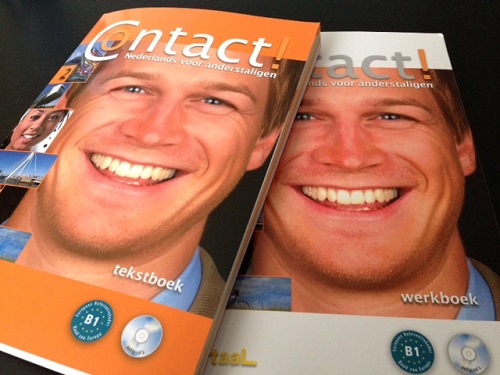
Yesterday I went to Paagman’s in The Hague and picked up my new textbooks. It’s a continuation of the previous ones that I had, Contact 1. While they are intended for classroom use, I’ll be using them while I do self study over the summer. It is easier now that I am used to the book format. Hopefully it all goes well.

Here are some images:

Contact 2 Tekstboek en Werkboek

the two books. The textbook is orange, and the workbook is white.

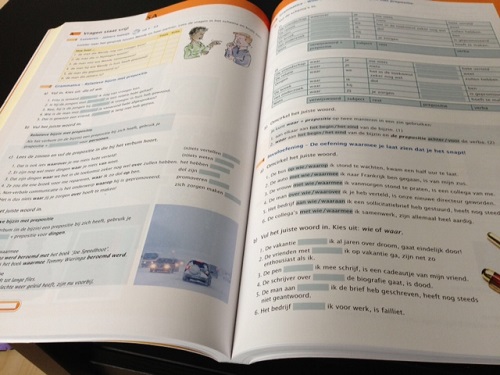
inside Contact 2 tekstboek

inside the textbook

inside Contact 2 werkboek

inside the workbook

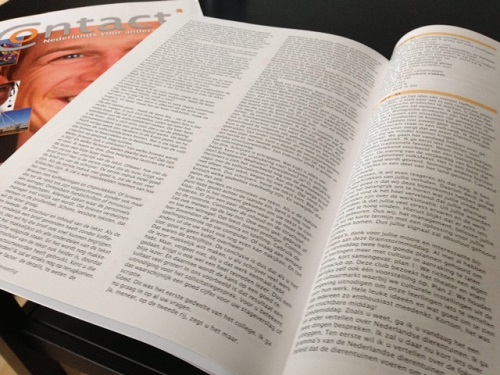
dialogue in Contact 2 tekstboek

one really long dialogue exercise…

Now, if I had thought the exercise near the end of Contact 1 was long, this one is really long. The left page is all one dialogue. (It’s actually a listening exercise and you need to listen to the track on the CD. This is the back of the book which gives you the dialogue in written form.)

So, back to studying! Though today I will hopefully be visiting the National Library of the Netherlands.

Categories: Learning Dutch | Tags: | 2 Comments

Learning Dutch (Or: What is it like to speak and listen?)

A few days ago, I went to SamenSpraak, hosted by Gilde Den Haag. It is a group that meets the first Wednesday night of every month to speak Dutch. You have both native speakers and buitenlanders (foreigners) intermixed. The event lasts from 5:30 to 7:30PM. I’ve been there a few times already, but this was the first time that I was coming there after finishing up my volunteer job at 5PM. I was tired. Still, what I say below has been my feelings since moving here.

1. Context, context, context. If I can figure out what the main idea of what you’re saying is, I can usually figure out most of the other smaller ideas from the previously figured out context. Of course, this makes it more funny if I am actually wrong about what is the context. This happens sometimes, and usually results in me replying wrongly when you ask me a question about what you just said.

2. My body language gives a lot away sometimes. When I talk with strangers, you can tell when I am nervous about not understanding what you’re saying. I fidget, I cross my arms in front of me defensively, I play with my engagement ring, and I lightly dig my nails into the side of my other arm.

3. Sometimes I pretend to know what people are saying. I laugh when everyone else does.  This mostly happens in groups, rather than with one to one conversations. But I mimic the reactions of the people around me (like laughter or looking concerned) even when I don’t have a clue what was just said. Mostly while thinking: Oh boy, what if they realize I have no idea what is going on?

Continue reading

Categories: Speaking | Tags: | Leave a comment

Test scores (Or: Dutch lesson 14 of 14)

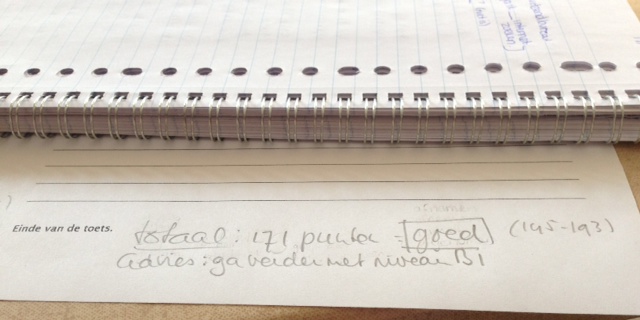
Yesterday was the last lesson for the A2 Dutch course. We also got our test results back. I scored a 171/193 points. That’s pretty good.

Score on Dutch A2 test

Total points: 171 (goed/good). Good range: 145-193. Advice: Go further with level B1.

I did of course make a few stupid mistakes. 😉 Two mistakes with the perfectum (example: I have gone) and two with the imperfectum (example: I went). And my Achilles heel is prepositions … I think I missed 5 out of 22 or something similar! But otherwise, it was good.

The rest of the class went pretty well. We didn’t look at the textbook or the workbook to do the last chapter, but rather did some more fun things. First she mentioned some good books to look at:

Nederlandse Grammatica voor Anderstalingen; ISBN 90 5517 014 3. She said this grammar book was rather comprehensive.

Nederlands in actie: Methode NT2 voor hoogopgeleide anderstaligenISBN: 978 90 469 0298 1. Apparently this is a good replacement for Contact 2, which is the textbook that we would be using in the next class.

Then we took turns doing voorlezen (reading aloud) from a 1973 children’s book called Floddertje. We read two of the short stories — “Opgesloten” and “Allemaal kaal” (which are ‘locked’ and ‘totally bald’). In the first story, she gets locked in her room so she won’t get dirty before guests come over. Doesn’t work. In the second story, she goes to the hair salon but due to a misunderstanding between her and her mom, ends up totally bald.

After that, we finished up by playing a vocabulary game: Pim Pam Pet. You have a stack of cards with vocabulary questions and one player spins to see what letter the answer must start with.

For example, I won these two cards:

een transport middel -> R -> Randstad Rail

Wat zie je op een boederij? -> K -> Koe

*

Method of transport -> R -> Randstad Rail (name of a Dutch train service)

What do you see on a farm? -> K-> Cow

And that was the end!

Categories: Courses | Tags: | 3 Comments

Dutch reading (Or: Learning some new vocabulary)

The Dutch word for vocabulary is woordenschat, which translates to word treasure (woorden = word, schat = treasure).

Dutch has some ridiculously long words, just like German…

verontschuldigingen = apologies

(zo) nauwlettend = (so) close

dichtstbijzijnde = nearest (try saying that three times fast…)

*

The Dutch language does also have some short words (compared to English):

zuinig = economical

toeval = coincedence

*

And some words that I find are very literal with their translation:

zonsopgang = sunrise (literally: “sun’s entrance”)

bakstenen  = brick (literally: “bake stones”)

*

And finally some amusing words:

piepkleine = tiny (amusing because it starts with a word that is pronounced like “peep” and then ends with “kleine” or “small”)

vanuit haar ooghoeken = from the corner of her eye (but literally: “from her eye corners”)

*

All of that was from the first chapter of Harry Potter – about 12 pages. On to chapter 2! (Wednesday maybe…tomorrow looks a bit crazy as is.)

Categories: Reading | Tags: | 2 Comments

Harry Potter (Or: Reading for vocabulary in Dutch)

Since I finished the Dutch test earlier this week, I decided to treat myself on Wednesday morning and head off to the library to pick up the first Harry Potter book (Sorcerer’s Stone) in Dutch, along with the accompanying audio version. The latter I immediately transferred to my iPhone. While I have an external CD drive to plug into my netbook, it is cumbersome at best.

This actually continues the same tradition that I still had when I lived at home with my parents – I have two or three of the Harry Potter books in Spanish as well. While my Spanish speaking skills were horrible at best, my reading skills were decent at that level. It still took about 5-7 minutes to read each page, though.

Part of the reason I seem to choose Harry Potter is because I have read the books and seen the movies in English. (Now that I am reading the first book over again in Dutch, I’m wondering if I need to brush up on what actually happens in the books. I don’t remember x y and z happening.)

The main goal of this project is to learn more vocabulary, while also hearing the spoken word. While my spoken Dutch is miles ahead of my what my Spanish was, my vocabulary and pronunciation definitely need to improve. So it is slower going then it was with the Spanish version.

One thing I have quickly learned – listen to at least a few paragraphs of Dutch before you pause the chapter to write down some vocabulary. Otherwise, you will never get into the flow of things!

Harry Potter and the Sorcerers Stone in Dutch

I suspect this will take me the rest of the year …

Categories: Reading | Tags: | 6 Comments

Mijn toets (Or: Dutch lesson 13 of 14)

So last night was our toets (test). It went pretty well. There were definitely some things that I got wrong, but not that many I think (or hope). We received 70 minutes, though she gave us an extra 10 minutes. And let me tell you, those 70 minutes went fast…

The test was 11 pages I believe. Though of course some pages were quicker than others. It was more writing sentences than filling in the blank. I and a few others agree that sometimes it is hard to have enough imagination for these tests. For example, you are told you are asking your friend something, and are given the first few words of a possible question. You must complete the question. Sometimes you spend more time thinking about what question to ask then how to actually write the question in Dutch.

The last page was a bit of a doozy – you get a chart in Dutch which you must describe in 6 to 12 sentences. (This year the total was this, and then the following year the total decreased to this, etc.) While I had studied all of the vocabulary, I’m not sure that I used them completely correctly. But again, not so many points off there.

And of course, the other annoying factor was just how much I was using my pencil eraser, getting little bits everywhere! At least we had more room to move around, because we didn’t sit right next to each other this week.

After the test we had a break of about 15 minutes and then went back in. Some of the students left at that point, but most stayed. We talked about what we wanted to do next week, the final week of the class, in addition to going over the tests themselves. Things like games, or just conversing, or cultural things. She did say she would also bring in some stroopwafels…

We did have a little bit of grammar after the test, die and dat. In English, it is similar to using “who” in sentences where you give more information about someone or something.

die = words with “de” and all plural words

dat = singular words with “het”

De man die daar staat… (the man who stands there)

Zij is het meisje dat ik heb gevonden. (She is the girl that I have found)

Marco told me about this one some months ago. Mainly because every time I make a mistake he corrects me! (that’s a good thing)

me: Mensen dat …

Marco: die

me: Oh. Mensen die …


Oh, and of case you’re wondering, die is pronounced like the the letter “d” in the English alphabet, not like… well… die.
Categories: Courses | Tags: | Leave a comment

Studying (Or: Dutch lesson 12 of 14)

Almost at the end! Next week is the big test. We spent about an hour going over what what would be on it. The problem is that we are slightly behind (4 more sections to go) so she had to quickly cover what was on the test that we hadn’t learned yet. “Study this exercise! Study that exercise!” and similar. It was a bit of whirlwind.

The class sized remained about the same – maybe 10 people or so. While the teacher was pretty helpful about what to study, it also included broader things such as “study all of the chapter summaries” or “study all of the grammar exercises in the workbook”. Not a big deal, though. This class also had some little things that I didn’t know. Like “wat” is the same as “iets” (something).

Here is one thing we learned – how to express a wish. The construction of the sentence changes depending on whether you are wishing for an object (like a new tv) or wishing for an action (like the bus not being late)

Ik zou (graag) een nieuwe tv willen. (object)

It doesn’t literally translate well to English – I wish (really) a new tv want (? yikes). But in English it is: I (really) want a new tv.

Ik zou (graag) willen dat mijn toets makkelijk is. (action)

I (really) wish that my test is easy. This one translates a bit better to English, except that “is” moves to the end because that part of the sentence (my test is easy) is a sub clause.

I can’t believe there are only two weeks to go. The plan is to keep studying over the summer, even if I can’t find a class that runs over the summer itself. But this week there will be a lot of studying…

And here’s a picture from last month:

Oude Kerk in Delft

The leaning Oude Kerk (old church) in Delft, which we visited with friends. Look at it lean!

Categories: Courses, Delft | Tags: | Leave a comment

Slaapkop! (Or: Dutch lesson 11 of 14)

Slaapkop = a person who is sleepy. Or as we say in English, “sleepy head”. (My teacher called one of my classmates a slaapkop.)

Today’s class had about the same number of students. There were more people there at the start of the class (6 students and the teacher) and we ended up with 11. This chapter was more interesting than the last ones have been. The theme was het nieuws (the news) and included a poll about whether or not foreigners should be required to speak Dutch when outside on the street. It turns out that this section of the book is from an actual poll conducted in 2006 (Dutch).

The reactions that they used in the textbook were made up, however.

Contact 1 text 1

12 = José: I totally agree [that foreigners should speak Dutch outside on the street]. I find it disrespectful for our language and culture if people speak another language on our street. I find it terrible if I walk on the street in my own country and the people can’t understand [Dutch].

I will say that I would find it pretty difficult to speak Dutch outside on the street, because it still requires a level of concentration. Noisy places tend to make concentrating a bit more difficult! There have been a few times on the street when I have been glad someone switched to English (like the time Marco and I stumbled across some friends on Koninginnenacht a few weeks ago).

I can see where they are coming from though. If I heard 25% Spanish everywhere I went in America I’d probably get pretty tired of it too. And then sign up for Spanish lessons (again)…

You of course have the other side of the argument – most Dutch people seem okay with talking to you in English. I don’t really have the problem of random strangers switching to English with me, thankfully. However, I am not saying the conversations that I do have are long and detailed. Usually they are not.

Contact 1 text 2

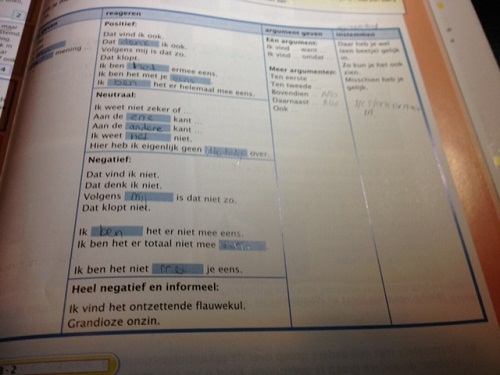
Possible reactions you can say (positive, neutral, or negative) to give your opinions

Above is one of the many charts included in the book. They write in most of the words for you, and you just have to fill in the blanks. Pretty interesting.

Three classes to go! And then I must find another class.

Categories: Courses | Tags: | 2 Comments

Blog at WordPress.com.