Author Archives: Niki

Unknown's avatar

About Niki

I run the blog http://www.lifeinthehague.com

Colorful chalkboards (Or: At the Cheesecake Company)

On Sunday Marco and I visited the Cheesecake Company in The Hague, over on Torenstraat. This is also what we had at our wedding – two strawberry cheesecakes, one chocolate cheesecake, and a smaller white chocolate cappuccino cake for Marco and I (the one that we symbolically cut together).

This time we had their stroopwafel cheesecake. It was delicious.

cheesecake at the Cheesecake Company in The Hague

stroopwafel cheesecake

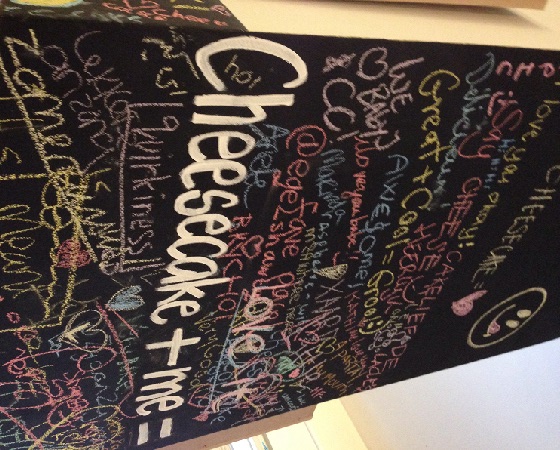
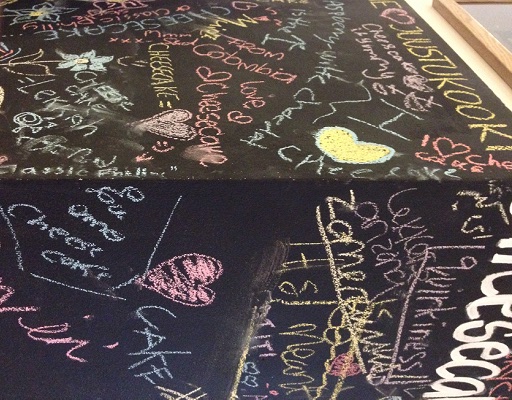
Near where we were sitting is also a board you can write on with chalk:

wall at the Cheesecake Company in The Hague 2

And another picture:

wall at the Cheesecake Company in The Hague

Of course, once we were done we asked for some razma-limey (raspberry and lime) cheesecake to go, for later. That is definitely one of my favorites.

Categories: Food | Tags: , | 2 Comments

A Comparison of Weather (Or: Dutch class 18 by ROC Mondriaan)

NOTE: There will be no class postings next week (#19 and #20) as Marco and I off are off on our honeymoon. Yay!

This lesson covered two things – weather (a short, spontaneous topic at the beginning) and comparisons. Of course, weather was the topic of the day because it was raining again. This year is the 5th wettest autumn so far (link in Dutch) and it seems to have no signs of stopping. We covered the various forms of weather, much like we did last month:

Het miezert = It rains (just a little bit).

Het regent = It rains.

Het giet OR Het stortregent = It rains (a lot).

Het sneeuwt = It snows. Did I mention the -eeu(w) vowel group doesn’t really exist in English? It is pronounced something like s-nay-out, but quicker: snayout.

Het waait = It is windy.

Het vriest = It freezes.

Het stormt = It is (very) windy.

De zon schijnt = The sun shines. Note the exception in grammatical construction.

The other thing of note was comparison, with two different models:

verschillend: is … …er dan …

hetzelfde: … is even … als …

difference: is … …er than …

the same: … is just as …. as ….

Jumbo is goedkoeper dan Albert Heijn. (Jumbo is cheaper than Albert Heijn – both are grocery stores.)

De morgen is even lang als de middag. (The morning is just as long as the afternoon.)

And there you have it – weather and comparisons!

Categories: Courses | Tags: | 1 Comment

Turning sentences around (Or: Dutch class 17 by ROC Mondriaan)z

One of the grammatical things that we covered in last night’s class was the placement of the verb in main clauses (I did not go to school) and subordinate clauses (because I was sick). In Dutch they are called the hoofdzin and the bijzin, respectively.

In Dutch (and German) the verb in the bijzin goes to the end of the clause in most cases. You have some special conjugations that do not affect the placement of the verb, but there are only a few. They are en (and), of (or), want (because), maar (but), and dus (thus). The rest of the conjunctions affect the placement of the verb.

Ik ga niet naar school want ik was ziek. I did not go to school because I was sick. (“want” does not require the verb “was” to go to the end of the sentence.)

Ik ga niet naar school omdat ik ziek was. I did not go to school because I was sick. (“omdat”, another way to say because, forces the verb “was” to the end of the clause.)

Zij gaat direct werken nadat ze voor de opleiding geslaagd is. She will work after she has passed her education (course).

If you use one of the special connectors that affect the placement of the verb, you can also begin with the subordinate clause and end with the main clause. You then need to have inversion of the subject and the verb in the main clause. This has the awesome effect (if you like grammar like I do) of placing the two conjugated verbs next to each other with only a comma in the middle.

Omdat ik ziek was, ga ik niet naar school. Move the subordinate clause in front, and invert ‘ik’ and ‘ga’ (subject and verb). Then you have the two conjugated verbs (‘was’, ‘ga’) next to each other with only a comma in between.

Nadat ze voor de opleiding geslaagd is, gaat zij direct werken. 

The normal connectors — en (and), of (or), want (because), maar (but), and dus (thus) — cannot be put at the front of the sentence.

While it is annoying in the beginning to change verbs around like this, it does get easier with a lot of practice. I definitely have Marco to thank for that as he has helped correct a lot of my mistakes! But practice, practice, practice.
Categories: Courses | Tags: | Leave a comment

Kleine Klaas (Or: Children’s TV)

When I turned the television on this morning I switched to Nick, Jr. For most of the summer I used to watch only children’s tv programming when I was alone, though these days I only watch one program: Timmy Tijd (Wiki: English) on that channel. What can I say – the animation is for this little preschool sheep is cute. It uses the same animation as Wallace & Gromit.  I don’t even watch it for the language as there are no words! After watching Timmy Tijd I switch over to Comedy Central for episodes of Sam Sam, Het Zoonetje in Huis, and Kees & Co – all Dutch comedy shows.

But I noticed this morning that the show after Timmy Tijd was something different – a show by the name of Kleine Klaas. The description reads:

Deze oude, wijze man die elk jaar op 5 december cadeautjes uitdeelt, was ooit natuurlijk een kleine jongen. This wise, old man who gives out gifts every year on December 5 was also of course once a small boy.

Van wie heeft hij eigenlijk die stoomboot gekregen? Waarom kan hij zo goed gedichten schrijven? En waarom stopt hij zomaar cadeautjes in je schoen? Kortom, hoe werd hij Sinterklaas? Je ontdekt het door het kijken van deze leuke filmpjes. Who did he actually receive the steamboat from? Why can he write such good poems? And why does he put gifts in your shoe? How did he become Sinterklaas? You can discover this by looking at these fun videos.

Sinterklaas arrives in the Netherlands on November 17 this year (usually he arrives on a Saturday). There will be a parade in The Hague. And of course he does not arrive alone – Zwarte Piet (black Pete) comes along as well. This year the discussions of racism seem to have intensified, with even the United Nations briefly involved before retreating and dropping the case. The controversy with the character is that the actor uses “black face” as decoration, although this is used regardless of your skin tone.

Of course, Sinterklaas (celebrated on December 5) is not the same as Santa Clause (celebrated on December 25 in America and other countries). Sinterklaas leaves gifts in your shoe and is real in a child’s mind. Santa Clause is not celebrated as such in the Netherlands – the gifts you get on December 25 (and 26!) are known to be from your parents. The idea of Santa Clause actually originated from Sinterklaas – which I found a bit odd as an American!

Categories: Holidays | Tags: , | 3 Comments

Muiswerk (Or: A Dutch dictionary app)

Muiswerk is a Dutch dictionary app (Apple | Android). I remember downloading this in the beginning of the year but not finding much use for it. The reason – I wasn’t ready yet. This app is completely in Dutch with no English to be found. In the beginning I found that pretty discouraging, but now it is exactly what I need.

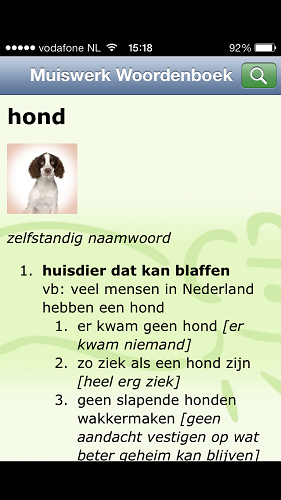
The app contains about 40,000 common Dutch words. Each word has a definition and at least one example sentence. Afterwards, some words include uitdrukkings, or phrases, which are used within the Dutch language. For example, you can see below “geen slapende honden wakkermaken” — don’t wake a sleeping dog — with the definition [geen aandacht vestigen op wat beter geheim kan blijven]. This saying is similar to the English saying ‘let sleeping dogs lie’.

Muiswerk Dutch dictionary app

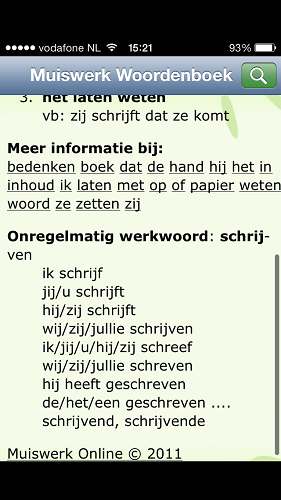
In addition, verbs include the conjugations (ik schrijf, hij schrijft) and each page includes links to words used on that page (meer informatie bij…). For example, if you did not know what aandacht was you could click the link and be taken to the aandancht page.

Muiswerk Dutch dictionary app 2

If you are somewhat comfortable with reading Dutch you should definitely give this app a try!


Categories: Apps | Tags: | 2 Comments

Vandaag, nu, hier (Or: Dutch class 16 by ROC Mondriaan)

Last night was the 16th class by ROC Mondriaan. We did something that we have done almost every Wednesday (as we have different teachers on Monday and Wednesday). It is an exercise called Vandaag – nu – hier or Today – now – here. I think it’s an exercise the teacher himself made.  It covers about 20 very simple sentences like:

Het lokaal is… The classroom is… [#106]

Het seizoen is… The season is… [herfst/fall]

De lesdagen zijn… The class days are… [maandag & woensdag/Monday and Wednesday].

Usually he goes through the exercise once and then tries to put a spin on it. This time when he asked the temperature questions he began a discussion about freezing, melting, ice, hail, and similar things.

Then we moved on to the book. We started chapter 5, Leren en Werken or Learning and Working. Instead of starting with the introduction page on the right side, he first asked us to look at the photo on the left side. It showed a woman helping a male teenager using the computer – presumably she was his mother or teacher. He asked us to describe the photo and then he asked us to guess her age. He then launched into a discussion about guessing and uncertainty:

een raden = iets dat je niet weet maar je zegt het toch. Something you don’t know [for sure] but you say it anyway. ‘a guess’

Ik raad dat zijn leeftijd 15 is. I guess that his age is 15.

Ik geloof dat… I believe that…

We then talked about the education system in the Netherlands which you can read about on Wikipedia. First you have onderwijs (education) and then you have opleiding (university or job training). The interesting thing about Dutch education is that around age 12 you take the Cito test which helps your teacher and parents determine what track you should be on in high school.  It is of course possible to step sideways to another track (higher or lower), although if you going to a higher track you might need to start at a slightly lower year than you otherwise would have if you had stayed in your own track.

The highest track (gymnasium – nothing to do with physical education!) also teaches ancient Latin and Greek. That sounds pretty cool if you ask me…

And here I was just happy that I was able to pick from German, French and Spanish in high school. (I ended up with 4 years Spanish and 2 years French although only 2 years in one language are required.)

Categories: Courses | Tags: | 3 Comments

Up and down progress (Or: Dutch class 15 by ROC Mondriaan)

Back to hitting the books!

Last night our Dutch teacher had a pretty good explanation for what happens when you learn Dutch – or any other language for that matter. The progress isn’t always as fast as it was in the beginning…

The Progress of Learning Dutch

The above photo is quite true. Sometimes at work I have “bad days” (nothing that comes out of my mouth seems to make sense to the library customer!) and then there are “good days” (when I am actually able to articulate myself “on the fly” as it were – or quickly and effortlessly). Work is the hardest place to speak Dutch, because I never know what the other person is going to want or ask. In other situations with family and friends it is much more relaxed.

We also learned a few new vocabulary words (in a section about parents buying mobile phones for their children):

gloednieuw – pas gekocht, helemaal nieuw. Something you just bought, completely new.

peperduur = vroeger kwam peper van Azië en het was heel duur. In the past pepper came from Asia at a terribly expensive price. Now something can be not just duur (expensive) but can also be peperduur.

We also looked at writing a formal letter, something I learned in my last class at Volksuniversiteit, though practice never hurt anyone. One thing I did learn though is this phrase:

Bij voorbaat dank voor uw … Thanks in advance for your…

antwoord / reactie / medewerking … answer, reaction, consideration/participation

Or a few other ways to say you’re waiting for their reply:

Ik hoor het graag van u. I hear it gladly from you.

Kunt u mij snel een reactie sturen? Can you send a reaction quickly?

Ik wacht op uw antwoord/reactie. I wait for your answer/reaction.


Categories: Courses | Tags: | 1 Comment

Odd Sculpture (Or: A different library)

A few days ago I took a walk to a different library in The Hague — Transvaalkwartier library in Hobbemaplein. I needed to check out a audio book (luisterboek) that was not available in the Central Library. It was recommended to me by a friend. Of course, I downloaded the tracks onto my computer but still need to put them into iTunes and transfer them to my iPhone. I always need to take that extra step due to not having a CD drive in my netbook. So I can’t tell you how interesting the story is quite yet.

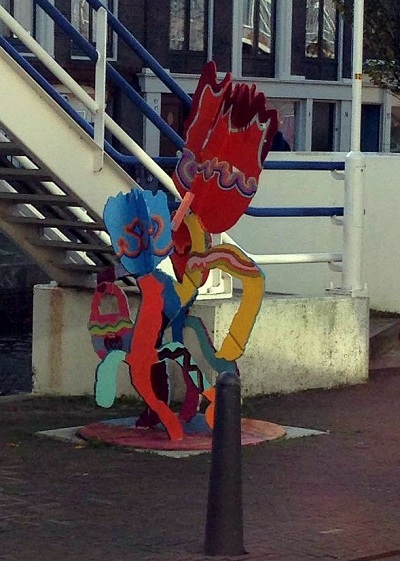
But on the way there I did come across an odd looking sculpture. I am not quite sure what the meaning is behind it but it was colorful enough.

sculpture in The Hague

Things have been going well since my last blog post. It’s only a few more weeks until Marco and I’s honeymoon (yay) and it is almost time to start planning holiday events and dinners. And of course we have to figure out when we are going to watch the new Thor movie coming out (cool), although I am definitely more excited for the next Hobbit movie in December.

I enjoyed my week off school (due to herfstvakantie/fall vacation) but tomorrow it is back to a normal week. The best part about not having classes was not having to quickly make dinner and then rush off.  But now it’s back to the grind, it seems! Just kidding.

Categories: The Hague | Tags: , | Leave a comment

Graffiti (Or: Futurama in The Hague)

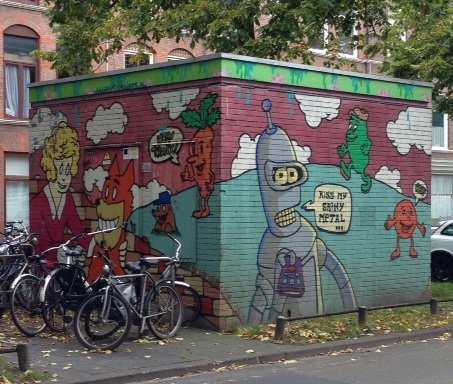
Futurama is an American animated TV show which also appears on Comedy Central in the Netherlands (and Pirate Bay, but I digress…). Someone in The Hague is apparently a big fan of Bender, a robot character on the show.

Futurama grafitti in The Hague

That’s Bender on the right, holding a TV remote saying his trademark phrase: “Kiss my shiny metal …”, with the … included. I’m not sure who the other characters are, but they are not from the same TV show.

Categories: The Hague | Tags: | Leave a comment

Laziness (Or: Pigeons who refuse to move)

A few days ago I had to make a trip to Albert Heijn to get some groceries. On the way there I saw a flock of pigeons just lounging around listlessly. One of them was even lying down, not caring at all that people were walking only a few feet away from it.

lazy pigeons in The Hague

The birds have a pretty good life in this city. Plenty of food and not many predators. We also have a lot of seagulls that hang around in The Hague. At first I thought they come over from the nearby beach in Scheveningen but they seem to hang around in The Hague year-round. I once saw 20-30 seagulls screeching loudly at some point across the street and dive bombing the area, only to realize after a few seconds that some woman had dumped a lot of old stale bread over the railing down to the street below. That bread was completely gone, with the exception of crumbs, in less than 30 seconds.

Of course, on the way back, the same pigeon pictured above was there, still not moving…

Categories: The Hague | Tags: | Leave a comment

Blog at WordPress.com.