Author Archives: Niki

Unknown's avatar

About Niki

I run the blog http://www.lifeinthehague.com

A sudden switch (Or: New Albert Heijn bonus cards)

Today I unexpectedly had to give up my now old Albert Heijn bonus card (bonuskaart). They have been announcing for a month or so that new bonus cards were coming, though at the top of my Albert Heijn app it said ‘fill in your new bonus card number before January 6’ so I thought I had a bit more time. Perhaps it was a language barrier issue – I said yes to a packet with the new card in it (so I could look it over) and then all the sudden the cashier was taking the bonus card off my key chain and throwing it out. Opps. Maybe if I had said no, I would have been able to keep my old one for a bit longer.

The biggest controversy with these cards is that they also offer personal deals beyond what is offered to everyone else. Nice, huh? Well, of course to get those deals you have to activate your card and give up more personal information about yourself. (For the record this does not bug me THAT much, except for giving out my phone number.)

new Albert Heijn bonus card packet

At first I was concerned because I didn’t want to activate my new card right away – I thought I had more time. But after getting home and reading through the instructions, it does say that the card can be used right away. It says: Deze nieuwe kaart vervangt uw oude Bonuskaart. Uiteraard kunt u met uw nieuwe Bonuskaart gebruik blijven maken van al onze Bonusaabiedingen. Daarvoor heeft u niets te doen. U kunt deze nieuwe Bonuskaart meteen gebruiken aan de kassa. 

Exception: if you want to see previous purchases you need to make an online account and register your card. I can no longer see previous purchases on the Albert Heijn app (newest version, iOS7). As soon as you update the app you are required to do this, whether or not you have an old or new card. It ‘forgets’ your old card.

nieuwe bonuskaart bij Albert Heijn

the card itself (with option to cut off the blue part and use it on your key chain/”sleutelhanger”), as mentioned at the bottom in Dutch)

I’m not quite sure how it works in this country – previously I was using a copy of Marco’s card – but perhaps it is not as common to require personal information for grocery cards as it is in America. Perhaps the old cards had no personal information on them at all and only collected anonymous data about shopping patterns. Whereas in America you usually have to give your address, phone number, and email. Whether or not they were actually valid was up to you…

Of course, like anything new, there are issues to address: there is no pin-code or password needed to see prior purchases online, and almost all of the bonus card number is displayed on the receipt (only a few standard numbers are missing). Though that article is from September so perhaps it has been fixed already.
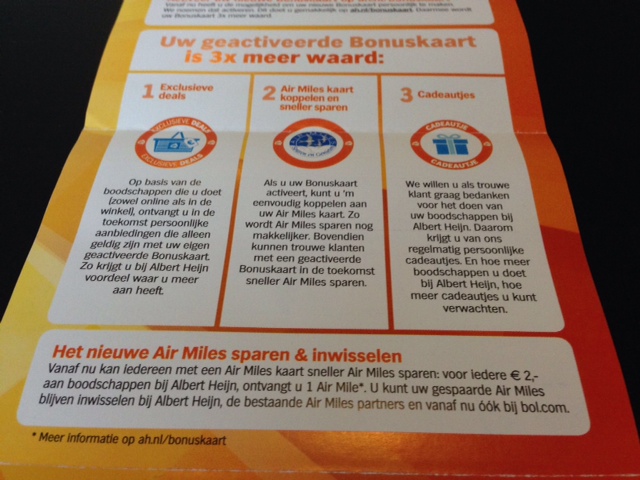
new Albert Heijn bonus card info

what you get if you activate. 1: exclusive deals. 2. faster air miles (note these is not the same as airport air miles!) 3. gifts.
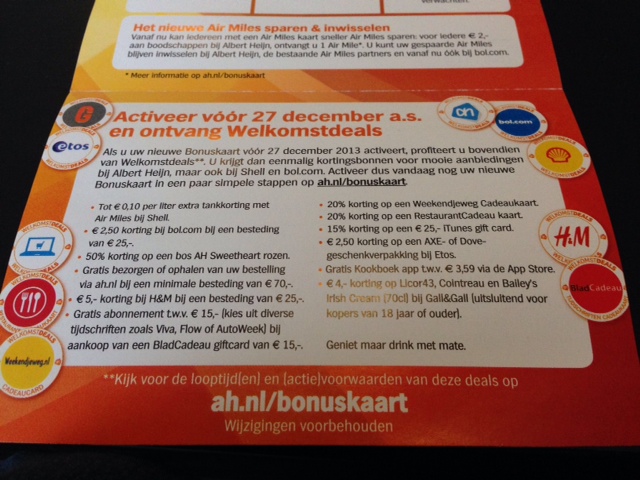
new Albert Heijn bonus card offer

various coupons you can receive if you activate before the 27th of December. ‘Welkomstdeals’ -> Welcome deals

Categories: Everyday purchases | Tags: | Leave a comment

Advertisements and drawings (Or: McDonald’s and Starbucks)

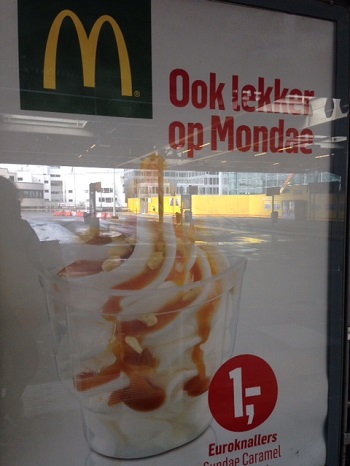
Yesterday Marco and I took a bus from Central Station in The Hague to Wassenaar, a nearby suburb of The Hague, for the birthday party of a friend’s kid. While we were waiting at the bus platform I decided to take a picture of a McDonald’s advertisement that seems to have sprung up everywhere in the last few days. (In actuality, most advertising spaces seem to go to the same advertisement, and the advertisements change every week. So you are usually bombarded by the same advertisement over and over.)

McDonalds advertisement in The Netherlands

It’s a picture of a sundae (available in chocolate or caramel) with the tagline “ook lekker op Mondae”. Also tasty on Monday. While most of the tagline is in Dutch, they did not change the name of the day from the English Monday to the Dutch maandag for the joke, as that would kill the joke a bit.

Starbucks drawing in The Hague Centraal Station
Of course we did not stop at McDonald’s before going to Wassenaar, but we did stop at Starbucks in Central Station and split a vanilla latte. Yum. I can still vividly remember how excited Marco was when the first Starbucks arrived in Schiphol airport. Of course that worked well for him because he was constantly visiting America for the yearly Wrestlemania trip or the other 3-4 trips to see me.

It wasn’t much longer after that (a year or so) before the Starbucks opened in The Hague in the Central Station. But then it wasn’t as special, because you could just walk there to get a good coffee. You no longer needed to hop on a plane. ;p

Categories: Everyday purchases, The Hague | Tags: , , | Leave a comment

English pronunciation (Or: Dutch class 14 by ROC Mondriaan)

NOTE: Next week is herfstvakantie (fall vacation), so there will be no class related blog posts.

Like all languages, Dutch steals from other languages. Sometimes they prefer to use English words in place of Dutch words, especially with newer technology (internet, websites, and etc). They tend to pronounce these words with an English pronunciation. I should be happy right? English is my native language – sounds easy for me!

Except that it’s not that easy. I find it quite difficult to switch pronunciations mid-sentence. Things like journalist do not take the usual Dutch pronunciation for the j (making it sound more like yer-na-list) but rather keep the English j. We had the word journalist as one of our vocabulary words in Wednesday’s class. Case in point: today is Friday so when I went to the Albert Heijn I told the cashier Fijne weekend! (happy weekend) however I said weekend with a Dutch accent and then corrected myself. We had a good laugh.

In Dutch the work week is spelled the same but pronunciation is closer to the English word ‘wake’, just with a bit more English ‘v’ than ‘w’. (Plural: weken, pronounced like vay-ken). But for some bizarre reason the Dutch like to pronounce weekend as … the English word ‘weekend’. Hmm.

Other things we discussed in class: ooit / nooit. Ever / never. The two usual uses:

Ik wil nooit een konijn hebben. (I never want to have a rabbit.)
Heb je ooit chinees gegeten? (Have you ever eaten Chinese?)

Not too unexpected there. In this case ooit translates to ‘ever’. But it can also translate to ‘once’ (although you can generally use other Dutch words like vroeger.)

Deze deur was ooit blauw. (This door was once blue.)
Deze deur was vroeger blauw. (This door was earlier blue.)

Finally, you can also use ooit a third way, which I learned in class. The Dutch also use ooit to point to the future – though the point is not known.

Ooit zal ik naar Duitsland gaan. (‘Sometime in the future’ I will go to Germany.)

Or the slightly more depressing Ooit zal ik je weer zien, which is apparently a Dutch song. Sometime I will see you again.

Categories: Courses | Tags: | Leave a comment

Voorzetsels, my nemesis (Or: Dutch class 13 by ROC Mondriaan)

You might be able to guess what voorzetsels are if I use the other common Dutch word for them: preposities. 

That’s right. It’s time to talk about the evil prepositions that lurk within any language. Obviously they are not that evil in English, because it’s my moedertaal (literally: mother language). But in Dutch… oh no. Run!

It’s also made more fun by the fact that you have vaste or fixed prepositions. That means that some verbs/expressions always take the same preposition. My first memorable experience with prepositions after moving here was which one to use after wachten, or ‘to wait’. In English the expression is ‘to wait for’. So naturally one would assume you can say Ik wacht voor de bus.

But that means that you will see this coming at you:

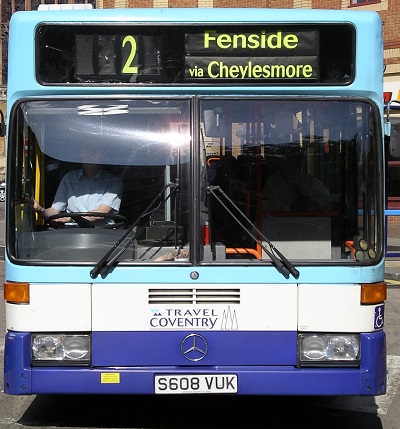
front of bus

That’s right… it means you’re waiting (literally) before the bus, in the street. Hmph. Whereas English has two words – ‘before’ and ‘for’ – there is only voor in Dutch.

(While I was looking for a good image, I can across this article about a woman who missed a bus and decided to catch up with it at the next red traffic light. She lay down in front of it until the driver let her on…)

If you want a rather exhaustive list of fixed prepositions, you can look at Dutch Grammar (it also includes English translations).

Some important ones include:

kijken naar (to look at)
luister naar (to listen to)
bang zijn voor (to be afraid of – zijn is ‘to be’)
denken aan (to think about)
houden van (to love – ik hou van jou – I love you!)
praten over (to talk about)
praten tegen (to talk to [someone])
praten met (to talk with [someone])
wachten op (to wait for *wink*)

Categories: Courses | Tags: | 2 Comments

Apps (Or: Get it spelled NL)

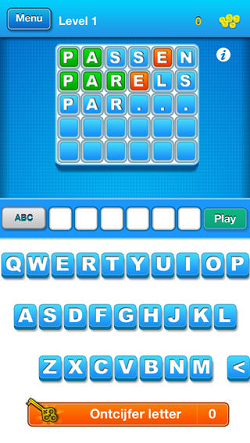
This weekend a family member introduced me to another Dutch app. It is a spelling app which for the moment seems to only be available for iOS6+ (iPhone, iPad, and iTouch). it is called Get it Spelled NL.

So far I have only played with the free version, which lets you oefenen (practice) without any timer. You can also play online against random other players. That is most definitely not my thing! Not even with an English app. If you upgrade to the Pro version it looks like you can also play with a timer at easy, medium or hard levels. I’m perfectly happy with the practice level, of course. It takes long enough as is…

Get it Spelled NL app screen

For those of you who already live in the Netherlands it is pretty similar to a basic version of Lingo. You need to guess what the 6 letter word is, and are always given the first letter (annoyingly, you always need to start your guesses with that letter). Green means that you have found the correct letter for that space. Red means that you have found a correct letter but it should go somewhere else. (Be warned – if you have two identical red letters, it sometimes means the letter appears in one other space in the word and sometimes it means the letter appears in two other spaces.)

All in all it seems like a pretty decent game. It is harder than it looks, especially for buitenlanders (non Dutchies), but without a timer it allows you to play at a more leisurely pace and thus look up any answers that you didn’t know existed before!

Categories: Apps | Tags: | 3 Comments

even, effe, ff (Or: Dutch class 12 by ROC Mondriaan)

Two days ago Wednesday was the 12th class by ROC Mondriaan. I must admit that that is another example of something that is simpler to say in Dutch – eergisteren means ‘the day before yesterday’ and overmorgen means ‘the day after tomorrow’. Just like the movie…

Anyway, one random thing we learned on Wednesday was the difference between even, effe, en ff.

Even = (a-ven, with a hard a) is hard to translate at times. It’s generally used to make commands or statements softer/politer. And probably other usages I don’t know yet. It’s harder for non-Dutchies to grasp.

Effe = street version of the same word. Pronounced f-fa (short a).

ff = even shorter version used for texting. Yep, they abbreviate a four letter word into a two letter word. (And English is just as guilty of that.)

We had another writing exercise. This time about the sports that we like or don’t like, and whether we participate in sports as well. (I like to watch sports on tv. But I definitely don’t participate in any.)

Amusingly this chapter was called media en comunicatie (media and communication) and the chapter opened with a brief story from a librarian. Because of my background in libraries, the teacher asked me to talk a little bit about libraries in general and also read the brief story. I did pretty well with the pronunciation – luckily there were not too many annoying words in the text.

We found out that we have a test for synonyms on Wednesday. Couple that with the test on Monday and I suddenly have something to study for. Should be fun… But it is getting a bit more interesting now, as we get random information that isn’t found in the textbook itself. So it is going well.

Categories: Courses | Tags: | Leave a comment

AVI niveaus (Or: Reading levels for kids)

I finally sat down and tried to figure out how a certain set of books we own in our neighborhood library works. I knew that they correspond to reading levels for the kids, but I didn’t quite know how. To the untrained eye the system would definitely look out of order – for instance the books in our library are in order by M3, E3, M4, E4, M5, and E5. (It’s quite possible that they could have been out of order, as I ended up putting all of the comic books in order when I arrived.) But no, it’s quite intended.

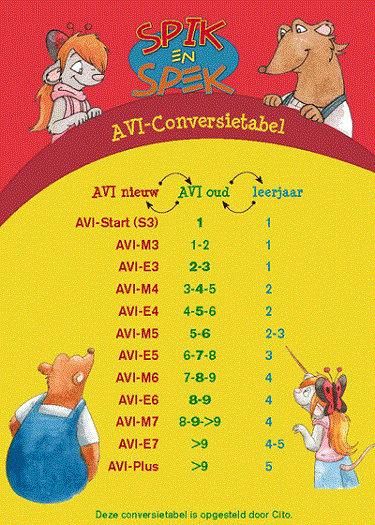
I looked up the reading system (AVI niveau) on the internet. The number refers to the groep (grade) that the student is in, with groep 1 being 4 or 5 years old. The ‘M’ refers to them being in the  middel/middle of their reading level and the ‘E’ refers to einde/end of the reading level. Thus on average a groep 4 student might be reading E3, M4, or E4 books.

avi conversietabel

AVI conversion table from the old (oud) system to the new (nieuw) system, with the leerjaar/groep number on the side.

Categories: Working & Volunteering | Tags: , | Leave a comment

ij to ee to e (Or: Dutch class 11 by ROC Mondriaan)

In this Dutch class we randomly looked at the vowel changes that occur in Dutch when a verb changes from the present tense to the simple past and to the present perfect. Some groups of irregular verbs can be studied as groups because their vowels change in a predictable pattern. For example, ij in the present tense, ee in the simple past, and e in the present perfect.

(to receive) krijgen -> kreeg -> gekregen

(to write) schrijven -> schreef -> geschreven

(to stay) blijven -> bleef -> gebleven

(to iron) strijken -> streek -> gestreken

(to drive) rijden -> reed -> gereden

At some point earlier this year I was reading something that made me realize the exact same phenomenon occurs in the English language as well. Of course, these examples are listed as the “craziest verb changes” on the linked page.

i -> a -> u

beginnen  to begin -> began -> begun
drinken  to drink -> drank -> drunk
bellen  to ring -> rang -> rung
zingen  to sing -> sang -> sung
springen to spring -> sprang -> sprung
zwemmen to swim -> swam -> swum

In other news, on Monday we have a test for chapters 1 through 3. Nothing major – it’s mainly for us to see where we are at and the teacher to see where we are at.

Here are the notes that I had taken:

notes for Dutch text chapters 1 through 3

I kept the photo a bit larger so my crazy handwriting could actually be deciphered. One nice thing I have noticed is that I tend to write most of my notes in Dutch these days, with the exception of word definitions. I try to write those in Dutch, but sometimes English is much simpler and quicker.

The one thing I haven’t quite got the hand of is the abbreviation for page. While Dutch use both pagina and bladzijde to mean ‘page’, they tend to use the latter more often and thus use ‘blz’ for the abbreviation. My English habits of ‘pg. #’ die hard, it seems.

Until next time!

Categories: Courses | Tags: | 1 Comment

Kruidnoten (Or: Christmas comes earlier every year)

Just like many cultures, the Netherlands has this crazy thing where the Christmas displays and food related items appear earlier and earlier every few years. This year it seems the agreed-upon date for all of the supermarkets was September 1 for Sinterklaas sweets, especially kruidnoten (yum) and gevulde speculaas (double yum – thanks Roger for showing me that one). I made sure my parents went home with a package of that, as it’s a seasonal treat.

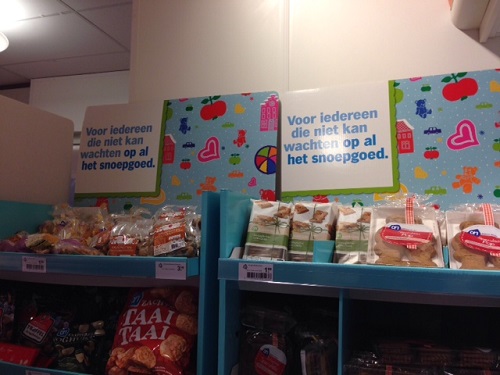
At least Albert Heijn realizes that the treats are ending up on the shelves earlier and earlier. Above the seasonal area they had this message:

cant wait for Christmas treats at Albert Heijn

Voor iedereen die kan niet wachten op al het snoopgoed.

For everyone who cannot wait for all of the treats/candy. 🙂

Categories: Culture, Food, Holidays | Tags: , , | Leave a comment

Expensive imports (Or: Twinkies for 15 euros)

When Marco and I dropped my family off at Schiphol airport, we stopped at a shop next to the Starbucks. This shop is known for having a small selection of imported American items, including candy, barbecue sauce, and other less than healthy snacks. Imagine my surprise when I found a 15 euro box of twinkies:

15 euro box of twinkies

Granted, it is a box of 10 twinkies but that still works out to €1.50 per twinkie, or $2. I have also found similar price increases for pop-tarts (English | Dutch) which I have fond memories of being able to get 2 for $5 in America. Here it is €5.50 for one box, although we recently found a €4.50 deal at an Asian supermarket of all places.

The only import place I have visited in The Hague is Kelly’s expat shop which had some interesting stuff with about the prices you expect. Unfortunately sometimes it is easier and cheaper to shop on Amazon UK and have it delivered to the Netherlands. But it’s more fun to go to the stores directly.

Categories: Food | Tags: , | 8 Comments

Create a free website or blog at WordPress.com.