Learning Dutch

Mijn toets (Or: Dutch lesson 13 of 14)

So last night was our toets (test). It went pretty well. There were definitely some things that I got wrong, but not that many I think (or hope). We received 70 minutes, though she gave us an extra 10 minutes. And let me tell you, those 70 minutes went fast…

The test was 11 pages I believe. Though of course some pages were quicker than others. It was more writing sentences than filling in the blank. I and a few others agree that sometimes it is hard to have enough imagination for these tests. For example, you are told you are asking your friend something, and are given the first few words of a possible question. You must complete the question. Sometimes you spend more time thinking about what question to ask then how to actually write the question in Dutch.

The last page was a bit of a doozy – you get a chart in Dutch which you must describe in 6 to 12 sentences. (This year the total was this, and then the following year the total decreased to this, etc.) While I had studied all of the vocabulary, I’m not sure that I used them completely correctly. But again, not so many points off there.

And of course, the other annoying factor was just how much I was using my pencil eraser, getting little bits everywhere! At least we had more room to move around, because we didn’t sit right next to each other this week.

After the test we had a break of about 15 minutes and then went back in. Some of the students left at that point, but most stayed. We talked about what we wanted to do next week, the final week of the class, in addition to going over the tests themselves. Things like games, or just conversing, or cultural things. She did say she would also bring in some stroopwafels…

We did have a little bit of grammar after the test, die and dat. In English, it is similar to using “who” in sentences where you give more information about someone or something.

die = words with “de” and all plural words

dat = singular words with “het”

De man die daar staat… (the man who stands there)

Zij is het meisje dat ik heb gevonden. (She is the girl that I have found)

Marco told me about this one some months ago. Mainly because every time I make a mistake he corrects me! (that’s a good thing)

me: Mensen dat …

Marco: die

me: Oh. Mensen die …


Oh, and of case you’re wondering, die is pronounced like the the letter “d” in the English alphabet, not like… well… die.

Categories: Courses | Tags: | Leave a comment

Studying (Or: Dutch lesson 12 of 14)

Almost at the end! Next week is the big test. We spent about an hour going over what what would be on it. The problem is that we are slightly behind (4 more sections to go) so she had to quickly cover what was on the test that we hadn’t learned yet. “Study this exercise! Study that exercise!” and similar. It was a bit of whirlwind.

The class sized remained about the same – maybe 10 people or so. While the teacher was pretty helpful about what to study, it also included broader things such as “study all of the chapter summaries” or “study all of the grammar exercises in the workbook”. Not a big deal, though. This class also had some little things that I didn’t know. Like “wat” is the same as “iets” (something).

Here is one thing we learned – how to express a wish. The construction of the sentence changes depending on whether you are wishing for an object (like a new tv) or wishing for an action (like the bus not being late)

Ik zou (graag) een nieuwe tv willen. (object)

It doesn’t literally translate well to English – I wish (really) a new tv want (? yikes). But in English it is: I (really) want a new tv.

Ik zou (graag) willen dat mijn toets makkelijk is. (action)

I (really) wish that my test is easy. This one translates a bit better to English, except that “is” moves to the end because that part of the sentence (my test is easy) is a sub clause.

I can’t believe there are only two weeks to go. The plan is to keep studying over the summer, even if I can’t find a class that runs over the summer itself. But this week there will be a lot of studying…

And here’s a picture from last month:

Oude Kerk in Delft

The leaning Oude Kerk (old church) in Delft, which we visited with friends. Look at it lean!

Categories: Courses, Delft | Tags: | Leave a comment

Slaapkop! (Or: Dutch lesson 11 of 14)

Slaapkop = a person who is sleepy. Or as we say in English, “sleepy head”. (My teacher called one of my classmates a slaapkop.)

Today’s class had about the same number of students. There were more people there at the start of the class (6 students and the teacher) and we ended up with 11. This chapter was more interesting than the last ones have been. The theme was het nieuws (the news) and included a poll about whether or not foreigners should be required to speak Dutch when outside on the street. It turns out that this section of the book is from an actual poll conducted in 2006 (Dutch).

The reactions that they used in the textbook were made up, however.

Contact 1 text 1

12 = José: I totally agree [that foreigners should speak Dutch outside on the street]. I find it disrespectful for our language and culture if people speak another language on our street. I find it terrible if I walk on the street in my own country and the people can’t understand [Dutch].

I will say that I would find it pretty difficult to speak Dutch outside on the street, because it still requires a level of concentration. Noisy places tend to make concentrating a bit more difficult! There have been a few times on the street when I have been glad someone switched to English (like the time Marco and I stumbled across some friends on Koninginnenacht a few weeks ago).

I can see where they are coming from though. If I heard 25% Spanish everywhere I went in America I’d probably get pretty tired of it too. And then sign up for Spanish lessons (again)…

You of course have the other side of the argument – most Dutch people seem okay with talking to you in English. I don’t really have the problem of random strangers switching to English with me, thankfully. However, I am not saying the conversations that I do have are long and detailed. Usually they are not.

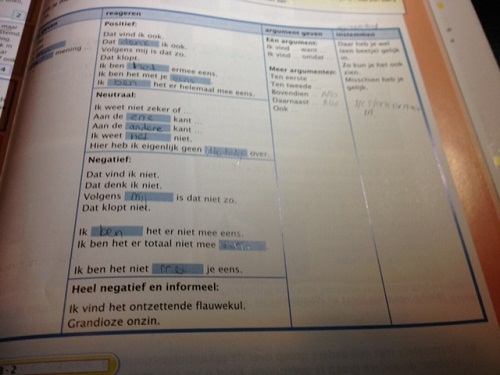
Contact 1 text 2

Possible reactions you can say (positive, neutral, or negative) to give your opinions

Above is one of the many charts included in the book. They write in most of the words for you, and you just have to fill in the blanks. Pretty interesting.

Three classes to go! And then I must find another class.

Categories: Courses | Tags: | 2 Comments

Ghost town (Or: Dutch lesson 10 of 14)

“Ghost town” betekent ‘Er is niemand hier. Iedereen weg is.’ Soms is de plaats een dorpje, maar niet alttijd.

I knew it was going to be a weird night when the other student who usually rides the bus (from Centraal Station) wasn’t there. There was a lot of traffic (verkeer) and it seemed to take forever for the bus to arrive at the school. We were really only 3 or 4 minutes late, though.

At the start of class (7PM) there was only three students including me, and the teacher. I think traffic played a part in it though, because by 7:05 there were 9 students. We even had one student who arrived after 9PM for some reason. That was strange.

We have officially moved into the first part of chapter 11 (11A) which means that I am only caught up on my homework through this week. I haven’t started 11B yet. I had a few good moments. We split up into groups of 2 and made up our own fairy tale using the imperfectum (simple past tense). While the fairy tale didn’t make much sense – you can ask Marco, he’ll confirm that after I told him it later – I could tell that my grasp on that tense was improving quickly.

The last two or three weeks have shown an improvement in speaking. While I still only know the main tenses (present, present perfect, simple past, and some future using ‘to go’/gaan) the main thing that is holding me back is the vocabulary. I must learn more of it! Time to break out the themed dictionary that Roger got me a few years ago.

Oh, and apparently I am 1.58 meters tall. I had no clue how to convert feet & inches into meters, but that was one of the random questions the teacher asked during the class. Thankfully she didn’t ask me so I could look it up later.

A few more weeks to go before we have our test (week 13). I am not worried. The only thing I want is to be the best in the class, or maybe 2nd best. Maybe I will settle for that. Maybe… 😉

Categories: Courses | Tags: | 2 Comments

Springtime distractions (Or: Dutch lesson 9 of 14)

The class seems to be shrinking again. Last night we only had 11, and one of those left at the break due to a headache. The weather is getting good – light jacket weather, but you didn’t even have to close it at night while waiting for the bus. It is definitely “spring fever” – no one seems to be able to concentrate on much. I heard a lot of English thrown in by the other students – Hoe is het met de transport? (How is it with the transport?, complete with “Hoe” pronounced as the English “how”) You could say instead: Hoe is het openbaar vervoer? or How is the public transportation?)

One of the students brought in the A1 test (she had the same teacher for that class as well) and the format didn’t seem that no annoying. No speaking, which is in theory good for me but not in reality. Ik moet meer Nederlands praten! (I must speak more Dutch).

We covered almost two sections yesterday (10B and 10C), so I am now only a week ahead (11A). That’s fine with me.  A few things that we learned today included materials (leer = leather, plastic = plastic, hout = wood, and etc).

muur van steen = a wall (made) of stone
een stenen muur = a stone wall

So when you put the material before the object (acting as an adjective), than you add -en to the word. (The number of e’s change to keep the pronunciation the same.) Leer = leren (leather), hout = houten (wood, wooden), wol = wollen (wool, woolen. The l doubles to keep the pronunciation of the ‘o’ the same.)

Another thing we learned was afmeting, or dimensions. Admittedly I complained to Marco that I don’t even care about this in English, much less a different language. The most important thing to keep in mind is meter (meter) usually stays singular, and is pronounced differently than English (may-ter) due to the first e not being enclosed by a consonant (me-ter, as there’s no doubling of the t… met-ter). But that’s boring for most folks!

Afmeting =

3m bij 5m = 15 vierkante meter (3 meters by 5 meters equals 15 square meters)

Also, where we usually use a period, they use a comma, and vice versa.

2,5m bij 4m = 12 vierkante meter

6.200 = zesduizend tweehonderd (six thousand and two hundred)

6,47%

I am not sure if I will ever get used to writing commas and periods properly!

Next week there is no class due to Koninginnedag. The next class is May 7th.

Tot dan!

(until then)

Categories: Courses | Tags: | Leave a comment

Studying (Or: A level of difficulty)

So a few days ago I started chapter 11, section A in Contact 1. The class is about 1-2 lessons behind. It’s hard to describe, but I think this 12 chapter book (3 sections each) finally got hard enough for me to pay attention. Note: I still need lots of help with speaking. Nothing’s changed there!

Here’s an example:

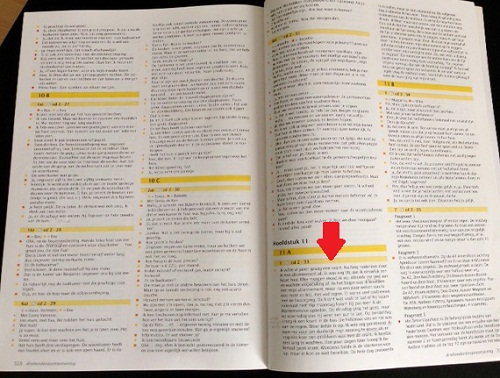
Contact 1 Nederlands voor anderstaligen

The highlighted section with the red arrow is the first real dialogue which is only a wall of text. Until this point, it’s usually two or more people talking to each other in simple sentences.

The section’s theme is “what a blunder”, or, the embarrassing things you’ve done in your life. The dialogue is simply a man telling a story (using the imperfectum/past tense) over how happy he was to finally get a newspaper subscription, and he looked forward to it every day because he always read the paper over breakfast. But helaas (unfortunately), the paper doesn’t come on time that often and sometimes doesn’t arrive at all.

So one day he calls up, but there’s no answer. Angry, he calls back the next day and finds out (after talking for 10 minutes straight and not letting the worker answer his questions), that the paper wasn’t delivered yesterday because it was Sunday and he doesn’t have a subscription for that day. He says: ik kon wel door de grond van schaamte (he cringed in shame – “fell to the ground from shame”) and quickly hung up.

But then you have to ignore the fact that he had a legitimate complaint with the newspaper arriving an hour or two late the other days… oh well. Crazy textbook!

Categories: Learning Dutch | Tags: | 1 Comment

Paying attention to homework (Or: Dutch lesson 8 of 14)

Last night I had my 8th Dutch lesson at the Volkuniversiteit (A2 level). This lesson seemed a bit “off” — as in, it wasn’t that good. Neither the person to my right nor the person to my left did their homework and it seemed to be the same for most of the people in the class. Technically I am a few lessons ahead already, as we did 9C and 10A today, and I’ve already finished the homework through 10B.

Perhaps it is the warmer weather – it is harder to concentrate on the homework and during the class itself. I can definitely tell that it stays lighter outside longer. We didn’t turn the classroom lights on until almost 9PM due to ample light from outside.

The main grammatical thing that we learned was Er, in its simplest form. (There are many uses of Er that are a lot harder to explain. I don’t know all of them.) This version simply translates to “there”. So:

Er is een… There is a...

Er zijn… There are…

Er is geen zolder. There is no attic.

Er zijn geen winkels in de buurt. There are no shops in the neighborhood.

So it follows English pretty closely. The most surprising thing is that it didn’t appear in the textbook until now — I’ve been using it in Dutch speech for some months already, and I suspect most of my classmates have as well.

One random thing I heard the professor mutter quietly under her breath was Waarom zijn bananen krom? (Why are bananas curved?) Unfortunately I forget why she said it. I asked Marco and he said this is a rhetorical question you ask when there really isn’t an answer that can be given. She definitely seemed a bit more exasperated with the class in general this week.

One thing that was mentioned a lot in today’s chapter was the song A beetje verliefd (A little love) by Andre Hazes, a Dutch singer who passed away in 2004. It’s one of those songs that almost everyone in the country knows, even if they don’t care for it. It’s classified as a Smartlap (tearjerker). YouTube with Dutch Lyrics. Marco hates the music but wanted to tell you that that singer has an Amsterdam accent, as does 90% of the Smartlappen singers.

Another thing that was mentioned randomly was Koetjes en kalfjes (literal translation = cows and calfs, actual translation = small talk). Perhaps back in the day when there was even more farmland than there is now,  small talk did refer to how the animals were doing. Maybe!

Categories: Courses | Tags: | 3 Comments

Adventures (Or: Hair salons, libraries, and birthdays)

So it has been a cool last few days. Today’s Friday! And tomorrow is my birthday with some nice things planned for the day. 30th birthday to be exact. I’ll definitely miss my 20s. But I do already feel older when I have to get up or move quickly. ;p

Yesterday around lunch time I went to the Brainwash hair salon in Leyweg to get my hair cut. My bangs (pony in Dutch!) were definitely too long and getting in the way. The wait was a bit long, but for a price of only €16.50 it was worth it. I didn’t speak a word of English while I was there (a new personal record!), although there were a few sentences the stylist said where I did not understand. nod and smile = the life of an expat.

Today I went to the library as my books were due on Monday and I didn’t want to renew them again. I figured I had them long enough as is. It was a  book with 800 words to study and a book about Dutch word order (sadly – not as good as I hoped as I knew most of it already but still have problems with that grammar area).

But anyway. This meant using the book return system for the first time. I knew where to take them, but I wasn’t sure how to use it. Basically you walk up to it and put in your item (Let op! Één item per keer – caution, one item at a time) on the conveyor belt inside. Before you put the item on the belt, the area is lit from above by a green light. Once you put in the item, a wall of plastic descends and the light changes to red. (Yes, I wasn’t paying 100% attention and tried to put in the 2nd item too quickly, but it only hit the wall of plastic). The items you return are automatically scanned and displayed on the computer screen above.

That’s where I ran in trouble – I stood there for a second waiting for it to do something else or acknowledge I was done. One of the workers came over and kept saying something (in Dutch of course) about ‘the receipt’. I was a bit confused, but it’s hard to remember exactly what he said. I understood the first few lines (press the receipt button) but not why I had to do so. He said some more stuff in Dutch and I felt pretty lost. But on the second try he used different vocabulary and it got through to my brain. You HAVE to ask for the receipt, but if you don’t want it you put it in the mini trash basket on the left. The person after you will get your items on their receipt if you don’t (=the transaction only ends when you print it). “Oohhh, dankuwel, ik begrip je!” (Oh, thank you very much, I understand you!)

After that, I went upstairs to find another book or two and study some Dutch. I found a nice book with present perfect/past exercises (perfectum/imperfectum) which I decided to check out after doing some exercises in it. Checkout computer (fully automated):

Checkout computer at The Hague library

Another cool service. The screen basically just says to place the material on the desk. It will automatically scan it from beneath. After that, it asks you to scan your card, and then it prints your receipt when you’re done (automatically this time!).

So, a fun day (or two) at the hair salon and the library. Who would have thought!

Categories: Speaking | Tags: , | 2 Comments

Speech! Speech! (Or: Dutch lesson 7 of 14)

The blog title refers to the tradition (at least in America) of a person being in front of a group of friends or family during an event (like receiving a surprise award). The audience then requests the person say something about the event/award by shouting “Speech! Speech!” (toespraak in het Nederlands?)

Last night was my 7th Dutch lesson. Halfway there! It was a pretty good lesson – this time I learned a lot of little things, rather than anyone one big thing.

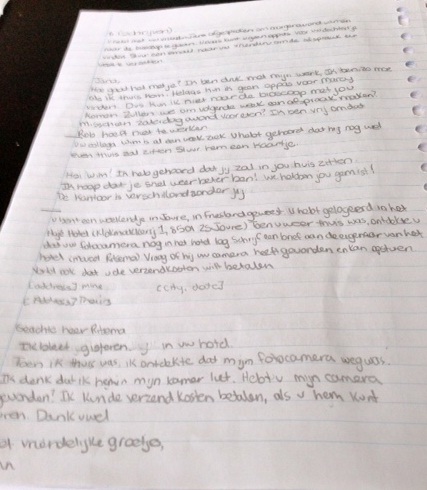
In the previous class the teacher asked that we write about something (anything we wanted) and speak for not more than two minutes. I had no idea what to write about (in English or in Dutch!) so I asked Marco for help. You can see what it looked like below. I still had some errors of my own, like where I said “a” when I should have said “een” in the first line.

Dutch writing homework

Before I came to the Netherlands, I lived in a little town called “Pearl River” in New York. Nothing happened in the town. The craziest day was St. Patrick’s Day because most of the people were Irish. Pearl River had a big parade for that day  – the second biggest in all of New York. The parade draws about 70,000 visitors or more. There are also many bars where people could drink – the main street had four bars in a hundred meters. My fiance said that Queen’s Day is the same – there are many drunk people.

And that’s what you write about when you do not know what to write about!

Some other things I learned in the class included “little” words that changed based on whether the situation was formal or informal. (Are you close to the person you are talking to? Then you can be more informal.)

niets (formal) / niks (informal) = nothing

nou (informal) = well (also used as a “stall for more time” word.) Nou, ja

****

If the question contains al, you’ll probably answer with nog niet. If the question contains the word nog, you’ll probably answer with meer and a denial word (nietgeen).

Ben je al vrij? Nee, ik ben nog niet vrij.
Heb je nog vakantie? Nee, ik heb geen vakantie meer.

Are you free already? No, I am not yet free.
Do you have vacation still? No, I have no more vacation.

Categories: Courses | Tags: | Leave a comment

Dutch homework (Or: Talking about the past…)

If Marco’s wondering why he hasn’t received an email yet from me, here’s why…

Dutch homework 1 of 2

Two pages of Dutch writing…

Dutch homework 2 of 2

Wait, make that three pages of Dutch writing…

They are just random exercises using the perfect (I have gone) and the imperfectum (I went). It’s starting to make a little more sense at least…

Categories: Learning Dutch | Tags: | 4 Comments

Blog at WordPress.com.