Learning Dutch

Kinderboeken (Or: Dutch children’s books)

As mentioned in a previous post, on my last trip to the Netherlands I picked up a few kinderboeken (children’s books) from a secondhand shop.
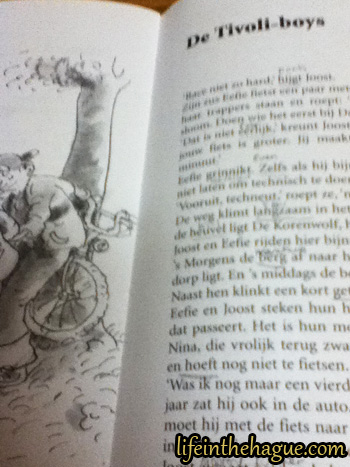
“Het geheim van de verliefde hulpkok” – some words that I don’t know are underlined. If I found the definition, I wrote it in. It was painful to write in the book (I think it’s heresy) but hopefully it is worth it!

I decided to try an additional tactic towards learning Dutch – we’ll see if this one sticks. While I have been studying verb forms over at dutchgrammar.com, I thought it might be helpful to do a bit of reading as well. One of my flaws is running all over the place and trying new things, so hopefully this is in addition to not instead of.

I checked on bol.com for information about the book. (Bol.com is like Amazon, but the Dutch version. If you have any questions about that website, feel free to ask Roger. He’s the expert on that site!) I was expecting to see a groep designation (like grades in the United States), but it just went with the direct age. The book is for children 7-9 years old. I guess I am a kid at heart, huh?

At the elementary level, there are 8 groepen, with groep 2 roughly translating to kindergarten (the first compulsary grade). After elementary school, the children move on to high school (there are three different types based on the education level of the child).

But here I am, jokingly still stuck in groep 4 or so (grade 4). For now!

Categories: Learning Dutch, Reading | Tags: , | 5 Comments

Aan het continuous (Or: Expanding Dutch grammar knowledge)

Number of days (straight) I have studied Dutch: 1.

Ha! Back to “1” from 0. Technically I guess it could be a 2, because I did stare at some things yesterday, but I didn’t get anywhere fast and gave up pretty quickly (wasn’t feeling that well). I had planned to try to make some digital flashcards to review all of the verb tenses that I have learned (see below for the summary) but ended up nixing that idea for now.

Today I looked at two sections at dutchgrammar.com.

1.) Summary of the 8 ‘basic’ Dutch tenses: present tense, past tense, present perfect, pluperfect [past perfect!], future, conditional, future perfect, and conditional perfect.

Continue reading

Categories: Learning Dutch | Tags: | 9 Comments

Verb tenses (Or: The pluperfect and future in Dutch)

I’ve decided that pluperfect is a very interesting English word. English might have been my major in college, but even I admit it’s hard to remember what the pluperfect tense does exactly. I don’t recommend going to Wikipedia, since the language pages tend to be a bit too much.

So I looked up some other random websites and determined that it is an action which occurred before a point in the past. I had already gone outside when he came home. I think this tense would be a lot easier to remember if it was always called ‘past perfect’ rather than ‘pluperfect’ – you see it mentioned both ways.

For the Dutch version I looked at Dutchgrammar. It didn’t seem that different after all – you also use the pluperfect in Dutch when you want to refer to an event that occurred before another past event. Most verbs use the past tense of hebben (to have) with the verb’s past participle. – ik had gewerkt. I had worked. Occasionally you use zijn (to be) instead – ik was gevallen – I had fallen.

Final verdict: Think of it as ‘past perfect’ rather than ‘pluperfect’.

The pluperfect was last night. Tonight was the (simple) future. As this tense doesn’t need participles, it already seemed easier! There are generally two verbs which are used – zullen (i.e. ik zal or I shall) and gaan (to go). Generally if you are promising something, or you give the probability something will happen, or you use it within an if-then conditional…

If you give a mouse a cookie, then he will want a glass of milk. If you give a mouse a glass of milk… Als je een muis een koekje geeft, wil hij ook een glas melk. (Google says this might be a Dutch proverb?) Regardless, one of my favorite if-then books.

…then you use zullen. Otherwise, if you’re not promising anything, or giving a specific frame of reference when it will happen (today, tomorrow, next month), or you aren’t using an if/then startement, you can use gaan (to go – so ‘I am going to go to the club’).

Verdict: Makes sense to me. Now let’s see if it sticks . . .

There’s more mentioned at the Dutchgrammar pages, but I’ll leave that for you to find!

Categories: Learning Dutch | Tags: | Leave a comment

Zondag (Or: Not enough sports)

Eek. It’s Sunday, and there’s a Monday staring right at us! But it’s still miles above winter and darkness falling at 5pm.

I added two more apps to the Dutch apps page based on some suggestions that I received. Feel free to keep them coming! It’s always a bit interesting to search for apps, since the Dutch iTunes page doesn’t filter out English results. And since English is spoken by a lot of people in the Netherlands, most of the results on the page seem to be apps written for English speaking persons. (Which is why any suggestions you have are definitely helpful.)

Yesterday was definitely a sports filled day — but for some reason, all of the teams I hoped would win did not. (The Netherlands, and then hoping for a tie in Germany-Portugal and not getting one, and then the Miami Heat won in basketball, and the New Jersey Devils won in hockey… you get the idea!)

On the other side, there wasn’t that much sports on tv today, although I did find the Italy-Croatia game Euro 2012 game interesting. I wasn’t rooting for any particular team, so that probably helped! Usually it’s dead in the summer after the basketball and hockey seasons end. But at least we have Euro 2012 and the Olympics. Of course, I can’t really mention Tour de France since they never show it live on on American tv anymore, since Lance Armstrong retired.

But tomorrow it is back to work… My alarm will be going off very early in the morning, I fear.

Categories: Apps, Sports | Tags: | 2 Comments

Dutch apps (Or: Building blocks for the blog)

Today I added a new page for the blog: Dutch apps. It has always been my goal to create different pages across the top of the screen (look in the upper right near ‘About’) that talk about different Dutch things – language, moving, daily living, etc.

These are the apps that I use on my iTouch, mainly to help me learn the Dutch language. Here’s a sample:

DutchWord (Apple) –

This app gives you 1 new word per day. They give you that word in an example sentence (English and Dutch).

They also have a game where you are asked how to spell a word (random words it seems). For example, you might see on your screen:

decent
f-ts–nl-jk

And you have four letters beneath. i, e, a, o. You have to fill in the blanks from left to right. Once you start getting used to Dutch spelling rules, you will start to see patterns. For example, the end of the word is probably -lijk, so you don’t want to click on the i just yet.

With some trial and error you click the a (clicking the wrong letter just says ‘Opps’). So now you have fats–nl-jk with i, e, o left. ‘oe’ is more likely to be a letter combination in Dutch than ‘eo’, so try the o next then the e. Finally put in the i – fatsoenlijk. Sometimes the game is hard (you have to fill in all of the letters) and sometimes it is easy (you only have to fill in two letters, and both happen to be o!) but at least you see the word again.

* * * * * * * *

Feel free to post your favorite Dutch apps in the comment area! Anything related to the Netherlands – it does not have to be about learning the language only.

Categories: Apps, Learning Dutch | Tags: | 3 Comments

Translation errors (Or: Mixing up languages)

I had a weird experience today. I had to go to the mall (3rd time in 3 weeks, but thankfully for the last time) to pick up my annual supply of contact lens. On the way home, I decided to take a different type of bus since a bus driver had given me a free ticket for it. It’s a longer ride but it came earlier. And it was free, of course.

Inside the bus, like most things, all of the information was both in English and Spanish. There was an advertisement for Rockland county’s public library system. The Spanish read something like descubrir todo en la biblioteca en Rockland. I was very confused. “Discover everything and the library and Rockland?” I kept reading it over and over again, feeling lost.

And then I glanced at the English version, which was a bit further away. My mistake quickly became apparent.

I was reading “en” as and — which is the Dutch translation.

However, in Spanish, “en” means in. Discover everything in the library in Rockland.

Mind you, my Spanish was never that good considering how long I studied it in school, but I could read it fairly decently. But this was the first time that the Dutch has taken precedence over Spanish in my mind. And it was a great feeling!


Categories: Learning Dutch | Tags: | 4 Comments

‘t fokschaap (Or: Why do sheep breed verbs?)

A few days ago I was looking at the past tense in Dutch — something that I do not really have much experience with as that is about where my verb studying stopped. So far I have just barely gotten into the basics of it, but I did remember hearing about ‘t fokschaap, or the phrase you need to remember for the past tense of Dutch verbs.

In the past tense, there are two types of verbs. the -d verbs and the -t verbs. All of the -t verbs are contained within the consonants of ‘t fokschaap, or t, f, k, s, c, h, and p. If the crude stem of the verb ends in one of those consonants, it is a -t verb. For the English speaking among us, you could also memorize pocket fish as suggested by the writers over at dutchgrammar.com, but I find the vowels harder to ignore within that phrase.

Note that above I said crude stem. That is basically taking the infinitive of a verb (to sleep = slapen) and removing the -en from the verb to get slaap (a double “a” pattern to keep the syllable long). Thus the crude stem ends in p, so it is a -t verb. For more on the crude stem versus final stem, look at this link.

In other news, the weather is lovely on this side of the ocean, although we are looking at rain tomorrow and this coming week, along with cooler temperatures for a while. I think I only had to wear my jacket on one of the mornings this past week so I really cannot complain!

I had a half productive half lazy Saturday. Errands took about 5 hours (laundry, grocery shopping, and grabbing rent) but the rest of the afternoon was spent watching golf and Tiger Woods retaining his #1 lead and watching the March Madness basketball tournament.

Lazy Saturdays. I approve.

Categories: Learning Dutch | Tags: | 4 Comments

Dutch spelling (Or: I can spell goed nu?)

Back to the Monday drag! Though Tuesday is almost here already.

A little milestone was reached yesterday. Emphasis on minor, but it still made my day! I realized that I had finished the Spelling & Pronunciation section over at dutchgrammar.com. Of course it had a lot of components within it, so it took about 2 months to get through (or perhaps a bit less).

Amusingly, the “summary” page at the end of the entire section was inexplicably only one page long. I am not quite sure how the writer(s) condensed it that far but somehow they did. Of course it was only the major highlights.

The next section is Verbs… which should be very interesting considering I really never got past the present and present perfect tenses when I was learning Dutch for the first go around. But now it moves into past tense, future tense, future perfect, the conditional… you get the idea. And if that wasn’t enough, after that is the irregular verbs which don’t follow any sane rule. The verbs section is about twice as long as the spelling section, so I figure I will finish it sometime around June at this rate. This would be easier if I I had more hours in the day!

The nice thing about this type of studying is I am trying to take a lot of notes (in an old college-ruled notebook I bought during my time at Rutgers). I have found that it really helps me remember things when I write them down.

Of course I can’t hold a conversation in Dutch for the life of me (so far) but hopefully this will start sticking soon. I think things will get a bit easier over the summer. Work tends to be a lot less hectic so I don’t come home automatically drained. Here’s hoping!

Categories: Learning Dutch | Tags: | 1 Comment

Kids books (Or: I am a librarian after all)

Today was the first day that I did not need to wear a jacket in the morning. Mind you, it was a bit cold and rainy, but it was worth it to not have to lug it home in the warm afternoon! And any day is a plus when you bring een paraplu (an umbrella) and end up not needing it.

One of the things I did on the last trip to the Netherlands was finding a nice old bookshop in the Hague. Unfortunately I did not take any pictures of it. Roger and I found it first while we were wandering around (Roger even showed me his and Marco’s old high school on that trip). I then dragged Marco back to the bookshop a few days later.

One of the books I got there was a kids book from the “De Korenwolf” series which was the name of a fictional hotel that a family lived in. Here was the book I found (with an obligatory Google translated link). I’ll admit that I am still stuck somewhere in the 3rd chapter, but at least it’s more interesting than picture books. I’ll always treasure the Dikkie Dik books you give me, however, Marco!

It is definitely a challenge – I am by no means saying that I understand most of what is going on without pulling out a dictionary every three words – but it is at least a fun challenge.

However the REAL challenge is finding the time to sit down and hammer out a few pages after getting home from work!

Categories: Learning Dutch | Tags: , | 2 Comments

Rules (Or: Learning Dutch is fun… for an English major)

I have discovered over the last few months that my favorite part of Dutch is the grammar rules. Weird, I know, but I suppose that is the English major in me. I will admit to taking a sort of sick pleasure in making Marco’s eyes glaze over.

For example, take the noun bazen – bosses. To get the singular you technically have to do the following:

1. Subtract the -en, leaving just the stem.You are left with baz.

2. Since bazen included a long vowel (ba-zen), where a vowel is at the of a syllable, than the vowel should be kept long in the singular form as well. However, baz is short (since the vowel is surrounded by consonants).

3. To make the vowel long we add an extra a: baaz.

4. Finally, no Dutch word ends in -z, so you need to change the z to an s – baas. (Like a boss!)

The nice thing for learners of Dutch is that the language has a lot of clear cut rules for spelling. Of course it means that it takes a few extra seconds to remember the rule, but it does help. And then you get used to seeing the word in such a way and any other way looks wrong. At that point you can mostly ditch the spelling rules and go from your gut.

The nice thing for Dutch speakers is that they don’t really need to know any of this.

…Unless they have an American girlfriend about to move there.

Cheese market in Madurodam, within the Hague

And now for something completely different – a kaas (cheese) market in Madurodam, the miniature town set up in a 1:25 scale. Look close – some of the figurines look quite drunk on the cheese already!


Categories: Learning Dutch, The Hague | Tags: | 4 Comments

Blog at WordPress.com.