Author Archives: Niki

Unknown's avatar

About Niki

I run the blog http://www.lifeinthehague.com

Speaking reflexively (Or: Dutch B2 course #27

Vacation is over and it’s back to the studying grind. (Well, I did my homework over vacation, so there was some studying involved.)

Yesterday’s lesson we had a refresher course (or een herhaling) for reflexive verbs and how they are conjugated. Things like I shave myself or Don’t kid yourself – the subject of the sense is the same as the object of the sentence. Of course, English tends leave off the reflexive part for someone words. Consider I bathe versus I bathe myself. The first is more likely.

There are not many reflexive pronouns in Dutch. Only me, je (u)zich, and ons. Take the verb scheren (to shave):

ik scheer me
jij scheert je
u scheert zich / u
hij / zij scheert zich
wij scheren ons
jullie scheren je
zij scheren zich

Unfortunately there is no rule to determine which verbs are reflexive – it is just something dat je uit je hoofd moet leren (that you have to learn out of your head / memorize).

There are three rules regarding the placement of a reflexive pronoun:

In the main clause after the conjugated verb
– Ik douche me elke morgen.
– Hij verbaast zich regelmatig over Nederlanders.

In cases of inversion, after the subject
– Gisteren meldde hij zich ziek.
– Regelmatie verbaast hij zich over Nederlands.

In a subordinate clause after the subject
– Hij zegt dat hij zich bij die belissing heeft neergelegd.
– Ik denk dat hij zich regelmatie over Nederlanders verbaast.

And finally, a fun example of how crazy things can get when you add in reflexive pronouns:

Herinner je je je oma?

je = subject, then je = reflexive pronoun, finally je = your

Do you remember your grandmother? Though you can ask that question without using a reflexive verb as well.


Categories: Courses | Tags: | Leave a comment

Onze Taal (Or: App for the advanced Dutch crowd)

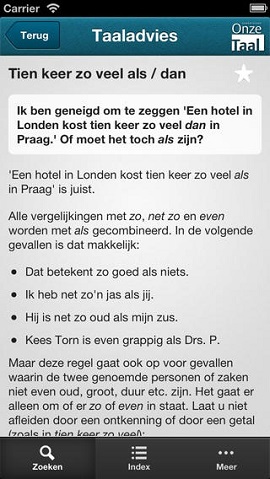
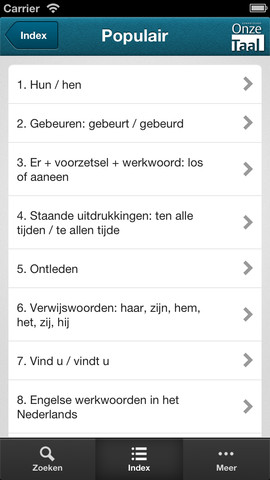
A few weeks ago I re-downloaded an app that I had previously downloaded last year sometime. Originally when I downloaded it I was pretty lost – because it is all in Dutch and actually designed for a native Dutch speaker. The app is Onze Taal (Apple | Android), which translates into ‘Our Language’. It makes a lot more sense now, for the record.

The app is actually an extension of a website that appears frequently in Google results when searching for a Dutch grammar question. The site answers a lot of questions, popular or obscure, like How do I properly conjugate the English verb ‘to email’/say ‘I have emailed you’? Ik heb jou ge-e-maild. Yes, two hyphens. No – seriously. Originally it was geë-maild, because:

1. ge = a prefix that goes in front of a lot of verbs when conjugated in the perfectum (present perfect)

2. ë = two dots over a vowel signify that it is the beginning of a new syllable

3. – = a hyphen because in English you can also write it as e-mail

3. maild = this is actually a typical Dutch conjugation. The verb is e-mailen, so -en is removed and -d added.

But in 2005 the rule changed; letters that stood apart (like the ‘e’ in e-mail) should instead be preceded by a hyphen. Thus: ge-e-maild.

Better to use the verb sturen, or to send…

The website gets the rules from the “Green Book”, which is a publication through the Dutch Language Union.

Screenshots:

Oneze Taal app screenshot


Oneze Taal app screenshot 2


Categories: Apps | Tags: , | Leave a comment

Canals and flowers (Or: Visiting Utrecht)

A few weeks ago Marco and I visited Utrecht. For various reasons it ended up not being quite what I expected but that can be chalked up to two things: the weather wasn’t that great and we went on a Monday, when a lot of things ended up being closed. We mostly stayed in the center of the city and looked at stores (board game stores, comic book stores and similar) rather than doing too many cultural things. I do wish we could have stayed until it got dark, though, as I would have been able to see the Trajectum Lumen. At night certain areas of the city are artistically lit, with guided tours provided on Saturdays.

I did get some good pictures, though. Here are a couple:

canal in Utrecht

Utrecht canal, typical Dutch bike in the photo frame

stairs down a canal in Utrecht

stares down to the canal level on Oudegracht (a main street in the central area). A lot of restaurants are at canal level, so you take the stairs down to reach them.

flowers in Utrecht

close up of some flowers in Utrecht

Its a present store in Utrecht

Items at “It’s a Present” gift store

It’s a present” was actually a pretty cool gift shop even though we didn’t buy anything. It had some really random items for sale, including what you see above. The only negative was that the shop was small, so they had to expand vertically – there’s technically three small floors, but sometimes the stairs can be a bit tricky to navigate.

Categories: Utrecht | Tags: , | 7 Comments

Gardens of The Hague (Or: Hidden places)

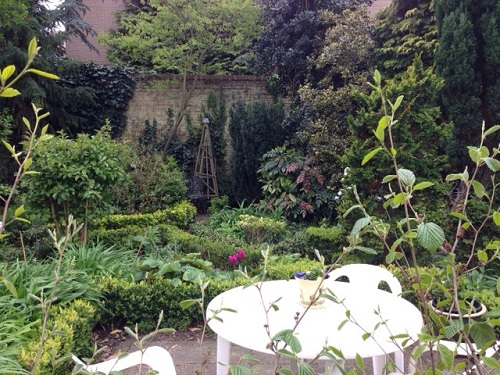
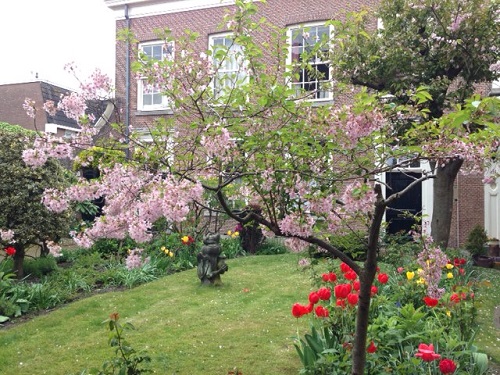
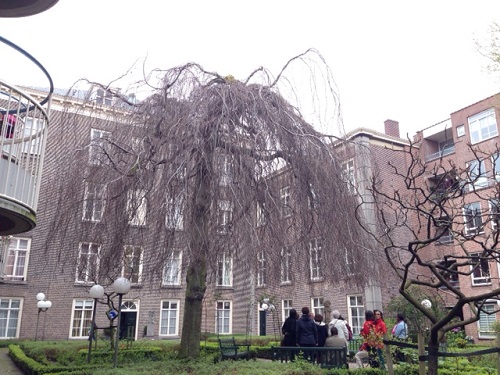
A few weeks ago I went on a tour of The Hague which was organized by Gilde Den Haag’s SamenSpraak program. It was pretty cool – I think we hit about 10-12 spots in The Hague which weren’t that well known. Here are some random pictures from the gardens:

garden in The Hague

A bit chaotic, but a pretty garden none the less.

small garden and statue in The Hague

This sort of reminds me of a typical American background (well, typical for those who like to do some landscaping).

tree in The Hague

A cool tree – though to me it looks more like an old man who is having trouble staying upright. Or me on a wild hair day…


Categories: The Hague | Tags: | Leave a comment

Chip and dips bowl (Or: Curves appreciation)

I spotted this a few weeks ago at a cooking store nearby work and I just had to take a picture of it. Some of the comments are in Dutch but you can assume they all follow the same theme that is shown on the right side: “Love my curves”.

chips and dip bowl The Netherlands

For example, the top comment is “Heb ik een dikke kont in deze broek?” and “Lekker kontje”. Or “Do I have a fat butt in these pants?” with the reply “It’s a nice butt.” Yeah.

Categories: Everyday purchases | Leave a comment

Almost that time again (Or: Dutch world cup)

The Netherlands got a little taste of “orange mania” this week as Saturday was Koningsdag (English: King’s Day) in The Netherlands. Of course you see some wacky items that come about this time of year – both for the previously mentioned holiday but also for the FIFA World Cup in June.

Pringles can Dutch world cup

See at Albert Heijn. “Hup Holland Hup” translates to “Go Holland Go”

Don’t forget to check out the title on the can. See also this previous post, Hup Holland.

Categories: Culture, Everyday purchases | Tags: | Leave a comment

d, t, or dt? (Or: B2 Dutch course #25)

I did not take many notes for last night’s course, although I did take a picture of one of the exercise sheets we were given:

conjugating Dutch verbs T or D exercise

It looks pretty simple but there are some tricky parts to these. The point of the exercise is to determine if the verb ends in -t (present tense), -d (present perfect tense) or -dt (could be either).

1. Ik hoop maar dat hij alles vertelt.

The trick with this one is realizing that the dependent clause (dat hij alles vertelt) is in the present tense, so you cannot use the kofschip rule. If you are not sure which it is, you can always try replacing the verb (vertellen) with a simpler verb like doen and see how you would conjugate that.

2. Je moet wel doen wat je belooft.

Again, the dependent clause is in the present tense so it is a simple -t.

3. Ik hoorde dat hij een vermogen verdient. (Same as above – present tense.)

4. Met haar heb ik heel veel beleefd.

Here is a trick – the original verb is beleven, but the v turns into an f in some tenses. However, since it is in the perfectum you can use the kofschip rule linked to above. In that case, you still need to use the v to determine what the ending is, not the f. Because of this, the verb ends in -d (since there is no ‘v’ in kofschip). If that does not make sense to you because you don’t live in the Netherlands, please forgive me. ;p

5. Is de post nu weer verkeerd bezorgd?

The tense is perfectum (present perfect) so you look at the last letter of the root verb (g). Since ‘g’ is not in kofschip, the verb ends with a -d.

The exercise is harder than it looks… apparently even native Dutch speakers can have trouble with the d/t/dt conundrum.

Just for fun, here is a random picture from a garden in The Hague, taken a few weeks ago:

bare tree in April, The Hague

And now Marco and I are off to check out the Life I Live festival in The Hague. Seeya!

Categories: Courses | Tags: | 2 Comments

Building on the passive tense (Or: B2 Dutch course #25)

This post is a continuation of the post last week, Actively Passive, which covered the basics of the passive form. There is only one other thing to cover – using the modal verbs with the passive form.

What are the modal verbs again?

1. willen – to want. He wants…

2. kunnen – can (to be able to) He can…

3. mogen – may (to be allowed to) He may…

4. moeten – must. He must…

5. zullen – will. He will go to… / He will do this…

How are they used with the passive form?

Method #1: modal verb + worden (in the infinitive form) + participle

Method #2: modal verb + participle + worden (in the infinitive form)

Thus the two methods only differ in the word order of ‘worden’ and the participle (examples of participles include gewerkt, gehaald, gedanst).

Can you give some examples?

Sure – these are from the textbook, De Finale. The examples use method #1, but of course the order of ‘worden’ and the participum can also be switched, i.e. geopereerd worden.

zullen – Hij zal volgende week vrijdag worden geopereerd. He is going to be operated on next week.

kunnen – Het voorstel kan nog worden verworpen. The proposal can still be rejected.

mogen  – Deze opdracht mag ook morgen worden ingeleverd. This assignment can also be turned in tomorrow.

******

And here’s a random photo from Lebkov’s serving area, a café near Central Station:

Lebkov - coffee in The Hague

You can also see the various types of sugar they had available – including chocolate flavored sugar, vanilla flavored sugar and cinnamon flavored sugar.

It’s still our favorite place to go and scheme, as they don’t mind if you sit there for 2-3 hours and do your work.

Categories: Courses | Tags: , | Leave a comment

De Haagsche Bluf (Or: Coffee and music)

Marco and I went shopping this afternoon — I needed a new pair of sneakers as mine had seen better days. We knew we wanted to go somewhere for coffee afterwards but we weren’t sure where. We were going to try Hometown Coffee (the last time we tried there were no free tables and it was a bit too cold to sit outside) but we ended up elsewhere.

More specifically, in De Haagsche Bluf (English), a luxury shopping area in the middle of centrumWe decided to have coffee at Kaldi (English). I had my usual coffee and Marco his cappuccino, and we split an American cookie with white chocolate chips (American = large, soft cookie). Yum.

But unexpectedly we also had some musical entertainment:

band by the Haagsche Bluf 2

It was pretty cool, as the “stage” was actually the front part of the building, simply pulled down like a drawbridge. Here is a close-up.

band by the Haagsche Bluf

Great music! Sort of jazzy, with the drums and clarinet alongside.

Categories: Daily Dutch living | Tags: , , | Leave a comment

Easter and… furniture (Or: Dutch B2 course #24)

Here is a random thing that I learned yesterday during Dutch class: on Easter Monday, some Dutch go to a meubelboulevard, or a furniture store shopping mall. At least for the last few decades. Part of this is because furniture stores are open on Mondays although these days more stores are open on Mondays than just furniture stores. They also lure you in with irresistible discounts.

A local mall in The Hague (with mostly furniture stores) by the name of Mega Stores also has a chocoladefestival (chocolate festival) on Monday to celebrate the holiday. They have two chocolate fountains and children can also make bunny ears crafts.

I also found an old article (unfortunately in Dutch) from 2008 about the traffic around Ikea in Delft. The traffic was so bad that by the afternoon Ikea was asking visitors to stay away from the area and not come on that day in an attempt to lessen the traffic headaches people were experiencing on highway A13. Of  course, Ikea seemed to be a hot place to be back then – they also closed a few exit ramps (afritten) leading to Ikea due to the traffic nightmares it was causing.

Of course this just reminds me of when Sonic restaurants opened in northern New Jersey, causing such bad traffic jams on the highway exit ramp that the police were called in for the first few weeks.

Categories: Courses, Holidays | Tags: | Leave a comment

Create a free website or blog at WordPress.com.