Learning Dutch

Voorzetsels, my nemesis (Or: Dutch class 13 by ROC Mondriaan)

You might be able to guess what voorzetsels are if I use the other common Dutch word for them: preposities. 

That’s right. It’s time to talk about the evil prepositions that lurk within any language. Obviously they are not that evil in English, because it’s my moedertaal (literally: mother language). But in Dutch… oh no. Run!

It’s also made more fun by the fact that you have vaste or fixed prepositions. That means that some verbs/expressions always take the same preposition. My first memorable experience with prepositions after moving here was which one to use after wachten, or ‘to wait’. In English the expression is ‘to wait for’. So naturally one would assume you can say Ik wacht voor de bus.

But that means that you will see this coming at you:
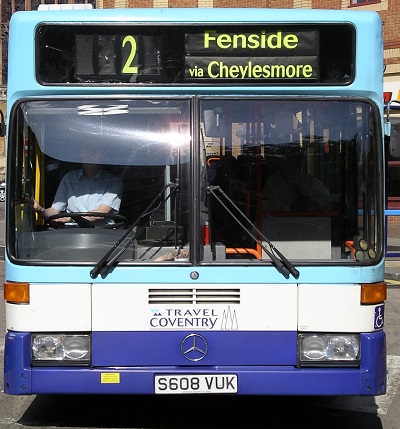
front of bus

That’s right… it means you’re waiting (literally) before the bus, in the street. Hmph. Whereas English has two words – ‘before’ and ‘for’ – there is only voor in Dutch.

(While I was looking for a good image, I can across this article about a woman who missed a bus and decided to catch up with it at the next red traffic light. She lay down in front of it until the driver let her on…)

If you want a rather exhaustive list of fixed prepositions, you can look at Dutch Grammar (it also includes English translations).

Some important ones include:

kijken naar (to look at)
luister naar (to listen to)
bang zijn voor (to be afraid of – zijn is ‘to be’)
denken aan (to think about)
houden van (to love – ik hou van jou – I love you!)
praten over (to talk about)
praten tegen (to talk to [someone])
praten met (to talk with [someone])
wachten op (to wait for *wink*)
Categories: Courses | Tags: | 2 Comments

Apps (Or: Get it spelled NL)

This weekend a family member introduced me to another Dutch app. It is a spelling app which for the moment seems to only be available for iOS6+ (iPhone, iPad, and iTouch). it is called Get it Spelled NL.

So far I have only played with the free version, which lets you oefenen (practice) without any timer. You can also play online against random other players. That is most definitely not my thing! Not even with an English app. If you upgrade to the Pro version it looks like you can also play with a timer at easy, medium or hard levels. I’m perfectly happy with the practice level, of course. It takes long enough as is…

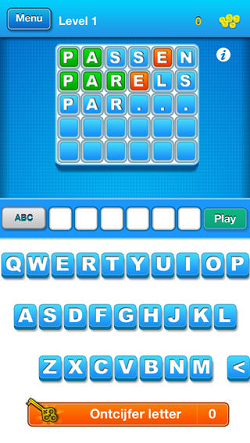
Get it Spelled NL app screen

For those of you who already live in the Netherlands it is pretty similar to a basic version of Lingo. You need to guess what the 6 letter word is, and are always given the first letter (annoyingly, you always need to start your guesses with that letter). Green means that you have found the correct letter for that space. Red means that you have found a correct letter but it should go somewhere else. (Be warned – if you have two identical red letters, it sometimes means the letter appears in one other space in the word and sometimes it means the letter appears in two other spaces.)

All in all it seems like a pretty decent game. It is harder than it looks, especially for buitenlanders (non Dutchies), but without a timer it allows you to play at a more leisurely pace and thus look up any answers that you didn’t know existed before!

Categories: Apps | Tags: | 3 Comments

even, effe, ff (Or: Dutch class 12 by ROC Mondriaan)

Two days ago Wednesday was the 12th class by ROC Mondriaan. I must admit that that is another example of something that is simpler to say in Dutch – eergisteren means ‘the day before yesterday’ and overmorgen means ‘the day after tomorrow’. Just like the movie…

Anyway, one random thing we learned on Wednesday was the difference between eveneffe, en ff.

Even = (a-ven, with a hard a) is hard to translate at times. It’s generally used to make commands or statements softer/politer. And probably other usages I don’t know yet. It’s harder for non-Dutchies to grasp.

Effe = street version of the same word. Pronounced f-fa (short a).

ff = even shorter version used for texting. Yep, they abbreviate a four letter word into a two letter word. (And English is just as guilty of that.)

We had another writing exercise. This time about the sports that we like or don’t like, and whether we participate in sports as well. (I like to watch sports on tv. But I definitely don’t participate in any.)

Amusingly this chapter was called media en comunicatie (media and communication) and the chapter opened with a brief story from a librarian. Because of my background in libraries, the teacher asked me to talk a little bit about libraries in general and also read the brief story. I did pretty well with the pronunciation – luckily there were not too many annoying words in the text.

We found out that we have a test for synonyms on Wednesday. Couple that with the test on Monday and I suddenly have something to study for. Should be fun… But it is getting a bit more interesting now, as we get random information that isn’t found in the textbook itself. So it is going well.

Categories: Courses | Tags: | Leave a comment

ij to ee to e (Or: Dutch class 11 by ROC Mondriaan)

In this Dutch class we randomly looked at the vowel changes that occur in Dutch when a verb changes from the present tense to the simple past and to the present perfect. Some groups of irregular verbs can be studied as groups because their vowels change in a predictable pattern. For example, ij in the present tense, ee in the simple past, and in the present perfect.

(to receive) krijgen -> kreeg -> gekregen

(to write) schrijven -> schreef -> geschreven

(to stay) blijven -> bleef -> gebleven

(to iron) strijken -> streek -> gestreken

(to drive) rijden -> reed -> gereden

At some point earlier this year I was reading something that made me realize the exact same phenomenon occurs in the English language as well. Of course, these examples are listed as the “craziest verb changes” on the linked page.

i -> a -> u

beginnen  to begin -> began -> begun
drinken  to drink -> drank -> drunk
bellen  to ring -> rang -> rung
zingen  to sing -> sang -> sung
springen to spring -> sprang -> sprung
zwemmen to swim -> swam -> swum

In other news, on Monday we have a test for chapters 1 through 3. Nothing major – it’s mainly for us to see where we are at and the teacher to see where we are at.

Here are the notes that I had taken:

notes for Dutch text chapters 1 through 3

I kept the photo a bit larger so my crazy handwriting could actually be deciphered. One nice thing I have noticed is that I tend to write most of my notes in Dutch these days, with the exception of word definitions. I try to write those in Dutch, but sometimes English is much simpler and quicker.

The one thing I haven’t quite got the hand of is the abbreviation for page. While Dutch use both pagina and bladzijde to mean ‘page’, they tend to use the latter more often and thus use ‘blz’ for the abbreviation. My English habits of ‘pg. #’ die hard, it seems.

Until next time!

Categories: Courses | Tags: | 1 Comment

Leuk? Gezellig? (Or: Dutch class 10 by ROC Mondriaan)

One of the random things we learned in class last night was the difference between leuk and gezellig. While leak can translate to ‘fun’, gezellig is a bit harder to translate. The usual translation given is ‘cozy’, especially in terms of warm feelings.

He said the difference between leuk and gezellig is that something gezellig can only be done with another person, not by yourself. Leuk is generally something you yourself find fun, though it can also be said of a group.

Another nice thing about the Wednesday night class is sometimes we do the exercises more than one time. While I don’t really need the help (I’m not kidding – this class is basically 95% review for me), it is nice for the other students. For example, last night we repeated the same exercise three times. The first time was just to state the answers. The second time was to find the verbs and circle them, and explain that if the verb was plural, the subject also needed to be plural (which for some students is a helpful trick to find the subject). The third and last time was to switch both the subject and the verb into plural or single – the opposite of what the sentence was originally.

Another interesting side note that he had was over the word nogal which translates to ‘rather’ in English. He then compared that to other, similar words.

Het is een beetje duur. Ik koop het. It’s a little expensive. I (will) buy it.

Het is nogal duur. Misschien koop ik het. It’s rather expensive. I might buy it.

Het is heel (erg) duur. Ik koop ik niet. It’s very expensive. I will not buy it.

He is also a fan of synonyms  (just ask Marco who had to look over my homework ;)).  The teacher mentioned that a synonym for ‘nogal’ is ‘tamelijk’.

So although the classes are mostly review, I do learn a lot of random things, and I do think it is helping improve my vocabulary.


Categories: Courses | Tags: | Leave a comment

Into the unknown (Or: Dutch class 9 by ROC Mondriaan)

Yesterday’s class was interesting to say the least. The main grammatical thing discussed was “Er”, a small little word that usually doesn’t translate that well. In the simplest sense, however, it is translatable. Er is  or Er zijn translates to There is or There are. It is used with subjects that are considered onbepaald/undetermined, that is, the subject of the sentence is something not that well known. While it isn’t something that you think a lot about in English, it has the same basic rules in both languages.

For instance – De vrouw stat voor de deur, or The woman stood before the door. In English and Dutch, the use of “The” and “De” implies that the woman is known, likely that she was referred to in a previous sentence.

But if the woman isn’t known yet, or is “undetermined”, than in Dutch you can use Er is. Example: Er is een vrouw voor de deur. There is a woman before the door.

Er loopt niemand op straat. (There walks no one in the street, or less awkwardly – No one walks in the street.)

Er ligt een boek op tafel.  (There lies a book on the table, or less awkwardly – There is a book on the table.)

Of course, the above two examples provide translation frustration because they use the “positional” verbs to describe an object. liggen = to lie, zitten = to sit, staan = to stand, and lopen = to walk. There’s a fifth one that is less used hangen = to hang. These five verbs are used to describe the position of someone or something. It’s something that I don’t quite have the hang of yet and need to practice more. A lot more!

The fourth post in this link explains things a bit better than I could, although they don’t always translate the Dutch. If needed, open two copies of the url and translate one of them but not the other. Or use Google translate as needed. ;p

Categories: Courses | Tags: | Leave a comment

Woordenschat (Or: Dutch class 8 by ROC Mondriaan)

The theme of this lesson was synonyms (synoniemen) and vocabulary (woordenschat). The latter is a fun word, as it literally translates to word treasure.

Here were some of the words we had:

lui – je wil niks doen (lazy – you don’t want to do anything)

plezierig – iets leuk  (pleasurable – something fun)

ergernis – je vind het niet leuk (irritation, you find it not fun)

hekel – ik vind het helemaal niet leuk (hatred – you find it completely not fun)

Although this class is definitely slower than my last class, one nice thing is there is absolutely no English spoken in the class (mainly because there’s only a few people here where English is their native language!). Spoken Dutch and pronunciation are much better as well.

Another thing that was discussed was bijvoeglijk naamwoord (or adjectives). This was one thing that I did not understand for the longest time. The first thing you need to look at is whether the adjective comes before or after the noun. If it comes after, it’s pretty simple.

Het huis is groot. (The house is big.)

De auto is rood. (The car is red.)

De tafel is zwart. (The table is black.)

If the adjective comes before the noun, you usually add an e (and possibly alter the spelling a bit):

Het grote huis

De rode auto

De zwarte tafel

If you use een (or ‘a’) instead of de/het (or ‘the’) then the -e is dropped before ‘het’ words only:

Een groot huis (groot instead of grote)

Een rode auto (rode stays the same)

Een zwarte tafel (zwarte stays the same)

We also discussed the differences between words that might translate the same:

benieuwd = curious (you want information in general)

nieuwsgierig = curious (you want information over private things, a bit nosy)

Crazy vocabulary!

Categories: Courses | Tags: | Leave a comment

Fierljeppen (Or: Dutch class 7 by ROC Mondriaan)

Note: I was not at class 6 due to the wedding (!) so there was not a blog post last week Wednesday.

Today was an interesting class as the chapter was “Sport”. We learned about a sport that is mostly in the Dutch province Friesland. The name of the sport is Fierljeppen (Wikipedia: Dutch | English). The sport originated in Friesland in the 1700s where there are lots of canals but not a lot of bridges to get across. Facing a lack of bridges in the area they used long poles to spring across.

The goal of the sport is to run towards the pole (which is already in the water) and climb up it as fast as possible while also maneuvering your body forward to reach the other side of the water. As the stick falls towards the other side you jump into the sand. The person who lands the farthest in the sand wins the competition.

And if that was not confusing enough, here is a YouTube video of it. :p

The wedding was good by the way. Afterwards we then spent a few days touring The Hague and Delft with my parents, brother, and sister-in-law. 🙂

Categories: Courses | Tags: | 2 Comments

Schrijven is blijven (Or: Dutch class 4 by ROC Mondriaan)

Fourth lesson by ROC Mondriaan. I’m starting to make some stupid mistakes, which of course I find really annoying. With this type of endeavor I want to be perfect. Oh, and did I mention that the wedding vows we are telling each other will be in Dutch? Yeah, I’m crazy. But I’ll come armed with note cards! (Thankfully I have pretty understanding parents who are willing to listen and consult the translation we provide as needed…)

There were a few choices quotes from the teacher today:

Schrijven is blijven. Niet schrijven is vergeten.

Loosely translated: Writing is remembering (lit: staying). Not writing is forgetting.

Als je het niet weet, kies de.

Translated: If you don’t know it [whether to use ‘het’ or ‘de’ before nouns], choose ‘de’. 80% of Dutch nouns take ‘de’, whereas only 20% take het.

Interestingly, ‘de’ is for both masculine and feminine nouns. Back in the day there was a 3rd form for feminine nouns, but they were since consolidated into the same category as masculine. ‘het’ is actually for neutral nouns like professions, diminutives, metals, and other various things.

We then did some exercises where we switched around the word order, similar to Monday’s class:

Morgen ga ik met mijn kinderen voor het eerst naar de kinderopvang.

Tomorrow go I (:p) with my kids voor the first [time] to [the] daycare.

Ik ga morgen met mijn kinderen voor het eerst naar de kinderopvang.

I go tomorrow with my kids for the first [time[ to [the] daycare.

The main thing is that the verb stays in the first or second position… morgen ik ga is wrong as ‘ga’ is in the third position, but it’s a common mistake.

You can actually put phrases into the first position (thus, it is not limited to just one word). It mainly just changes the emphasis of the sentence.

Met mijn kinderen ga ik morgen voor het eerst naar de kinderopvang.

The subject and the verb always stick together (in simple sentences anyway). If the time element (morgen, tomorrow) is not in the first position it usually follows right after the subject, as it did in the last example.

One week to go until the wedding… Crazy times ahead!

Categories: Courses | Tags: | 2 Comments

Vowels and consonants (Or: Dutch class 3 by ROC Mondriaan)

Last night was another class by ROC Mondriaan. The good news is hopefully we figured out what classroom(s) we are going to be in permanently – one classroom for Monday and another for Wednesday. We had the same teacher as last Monday and she did not mention us having a different teacher next Monday so perhaps she is permanently our teacher for that day.

I think one of the more amusing things about this class is everyone wants to answer, even if the teacher calls on one person. They seem pretty adamant about answering.

The course itself is still a bit sluggish – it starts at 6:45 but we really didn’t begin until 7:05PM. In the end there were 15 people there, +1 for the mother who brought her 10 year old son. He was cute, quiet and respectful though. One thing he said (as we were in the family chapter…):

verliefd (in love)

verloofd (engaged)

getrouwd (married)

The main thing that we covered in the lesson was spelling for a few different instances. Amusingly, the 10 year old boy said he learned that last year when he was in groep vijf (group 5/age 9). Two rules we learned are:

If you have one vowel between two consonants for a singular noun, then in the plural you double the consonant before adding the traditional -en ending.

de bom -> de bommen (the bomb)

de kat -> de katten (the cat)

de kip -> de kippen (the chicken)

If you have two vowels between two consonants for a singular noun, then in the plural you remove one vowel.

de muur -> de muren (the wall)

het haar -> de haren (the hare)

de peer -> de peren (the pear)

Of course, there are always exceptions! Although I am a fan of grammar, it seems like I never stared at these rules too much, instead relying on memorizing and going by what ‘looks right’. But it’s interesting to have the rules somewhere in the back of my head now.

After that, we covered the word order of sentences — where do the subject and verb go in various situations — although that is old news to me.  That is thanks to the previous class and Marco’s hard work constantly saying “word order” “word order” “word order!” these last months.

Categories: Courses | Tags: | Leave a comment

Create a free website or blog at WordPress.com.