Author Archives: Niki

Unknown's avatar

About Niki

I run the blog http://www.lifeinthehague.com

Bagels & Beans (Or: More cheesecake and coffee)

A few weekends ago we took a trip to Bagels & Beans, primarily known for their coffee and bagels (as if you couldn’t guess from the name!) They do have really nice bagels – examples include plain, cinnamon raisin, and everything. If you want cream cheese, you’ll get a generous portion as well. Always way more than I need, though I don’t like as much as most people do.

But we were there long enough that we decided to order round two… this time I went for an iced coffee and we shared a cheesecake.

cheesecake at Bagels & Beans

It wasn’t as good as the Cheesecake Company, but cheesecake isn’t Bagels & Beans speciality, either. Don’t get me wrong – it was perfectly decent cheesecake. 🙂 The iced coffee was pretty nice though. It’s funny, I never really drank coffee when I lived in America (until the last year I was there), but now I am quite used to the nightly ritual of coffee after dinner, or coffee after I get back from my Dutch lesson at 10PM. It doesn’t really ever keep me awake, so I don’t have to worry about that!

Categories: Food | Tags: , | 5 Comments

Sunshine (Or: Wandering through The Hague)

This past weekend the weather was quite beautiful in The Hague – 15/16C or around 60F. Yesterday Marco and I went for a short walk in the city, past the restaurants which seem to have exploded overnight in terms of outdoor seating, the Grote Kerk (below) and around the Buitenhof before heading back to the Grote Markt street to finish up our grocery shopping at Albert Heijn and charge my OV-chip card – something I do weekly thanks to needing the tram to get to work.

Here is one of the photos I took:

Grote Kerk in Den Haag

Grote Ker, Den Haag

Beautiful blue skies. Good times! And how nice for it to actually happen over the weekend for a change.

Categories: The Hague | Tags: | 2 Comments

Sour lemon cake (Or: Surprises at Marks & Spencer)

So as I mentioned in previous blog posts, Marks & Spencer has been open since February 20th in The Hague. I’ve been there three times now and still haven’t stopped to look at the clothes… I guess it really revolves around the British food offerings.

Marco and I decided to head over there at lunchtime for some coffee. I staked out a table (a requirement usually, as it’s still pretty busy) while he went to get coffee for me and a cappuccino for him. He also came back with lemon cake. (Side note: they had a lot of different cakes and more hearty foods like the British fish & chips and the Dutch toasties, but less things in the middle like croissants).

coffee at Marks & Spencer Den Haag

coffee and cappuccino (the lemon cake is hiding in the shadows to the right)

The lemon cake was definitely a surprise in terms of sourness. I love sour candy, so for me that is a pleasant surprise. The top was covered in icing which was definitely the highlight for sourness, but even the cake itself was still pretty sour. I still pucker my lips just thinking about it!

The cafe itself is on the top floor. All of the tables are by the window, although it might have been better to make the seating area a bit bigger to get more tables in there as it is usually pretty busy. Due to the way the building is constructed you don’t have the best of views outside (Hema is still the best for people watching) so here it is mostly to sit and bask in the sun while the time of day is right.

Categories: Food | Tags: , | Leave a comment

Some things don’t separate (Or: B2 Dutch course #13)

Note: we don’t have class tonight, so the next class-related post won’t be until after Tuesday’s lesson.

I’m still alive! I have a short funny story from work, but first you need to know a bit of Dutch. In Dutch one can say “een … of <number>” to reference a length of time. For example, een jaar of tien. A year or ten. The one thing to remember is that een translates to ‘a’ not ‘one’ (it is the same word in Dutch). But you are expressing a bit of uncertainty with the answer. In English we would usually say “10 years or so”. You also have to know that where I work the working language is English, although you’ll hear some Dutch or similar occasionally.

When I came in this morning, there was a few people already in the kitchen/cafeteria area. A coworker as well as someone fixing the coffee machine – i.e. someone from the coffee company. My coworker asked how long it would be until the coffee machine was fixed. He replied (in English) “a minute or 10”. Heh.

In other news, here is some grammar (actually from the lesson before). I’ve already covered separable verbs, but in Dutch you can also have non-separable verbs. These are verbs that have a prefix on the front of the word, but it never separates from the verb. Examples are mislukken, voorspellen, ondertekenen (to fail, to predict, to sign). Unlike seperable verbs where the accent falls on the prefix, here the accent always falls on the first syllable after the prefix (mislukken, voorspellen, onderteken).

Mijn moeder was een getuige voor mijn bruiloft. Zij heeft de trouwakte ondertekend. My mother was a witness for my wedding. She signed the marriage license. Hi Mom!

Further examples:

Voor mijn verjaardag heeft mijn man mij met een etentje verrast. For my birthday my husband surprised me with a dinner.

Dit kan de overvaller niet zijn. Hij werd als een jongensachtig type omschreven. This cannot be the robber. He was described as a youngish type.

Mijn appeltaart mislukt altijd want mijn oven werkt niet goed. My apple pies always fail because my oven doesn’t work well.


Categories: Courses | Tags: | 1 Comment

Marks & Spencer is back (Or: Time for cake)

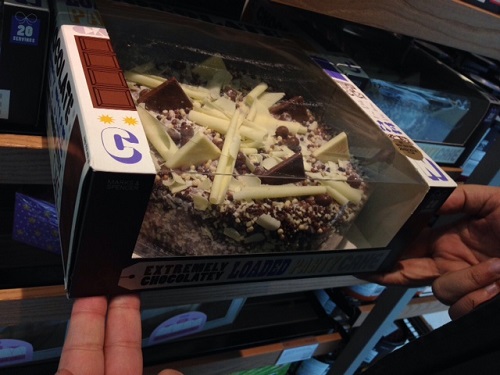
Last Thursday, Marks & Spencer opened its doors in the heart of The Hague. It is a British retail chain that used to have a few stores in the Netherlands (including in The Hague and Amsterdam) though it closed its doors years ago. Unfortunately (or fortunately, due to the crowds) I was at work so I did not check it out until this past weekend. Marco and I went on Sunday, right when they opened at 12PM. The crowds, geez! We checked out the food section, but it was pretty hard to move around. We did spy this crazy cake, however:

Marks and Spencer cake

The box reads “extremely chocolatey loaded party cake”

Looks pretty delicious, but I suspect anyone who eats it would be instantly diagnosed with diabetes afterwards. We didn’t have much time to take any other photos – it really was quite crowded and we did not stay that long. Perhaps next time. I am interested in going there to have a cup of coffee – though it might be a few months before the place calms down a bit. The chain does seem to have a bit of a cult following…

Categories: Food | Tags: , | 1 Comment

The changing of the bikes (Or: Relocation)

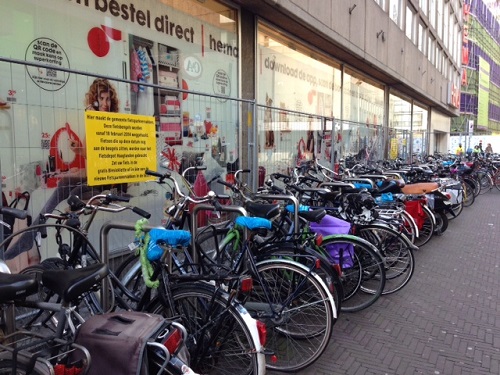
It seems that The Hague has been working on the areas where people park their bikes. A lot of places had a sign on them (example below) stating that bikes could only be parked here until Tuesday, February 18. Any bikes left there after that time would be removed. You could then go to the central bike storage in the city and pay a fee to get it back – 25 euros! link in Dutch.

too many bikes in The Hagues

It seems that – according to some Dutch articles – that the bike stands are being permanently removed as they can cause damage to the bike when it is knocked over. Their solution?

temporary biking situation The Hague

Chalk lines showing you where to park your bike. Not the most elegant solution, of course. We came back a few hours later after taking this second photo and the entire space was full, and people also placed their bikes against the building just like before – making it even more crowded for pedestrians to pass.

Weird.

Categories: The Hague | Tags: | Leave a comment

Back in the work grind (Or: 9-5 or thereabouts)

As of last week I am no longer unemployed! This is my first paid job since moving to the Netherlands in late 2012. I wanted to wait a bit on finding a job and instead spend my time learning Dutch, but the last few months I was feeling the itch to get back into the working game. Thankfully it was not a wasted goal – my Dutch is pretty good.

I won’t speak too much about the details of the job and where it is, or what happens on a day to day basis, as I like to keep work separate mostly. But I will say it’s an English-speaking job in The Hague with a short commute by tram. I guess you could call me a “content manager”, as one of my main responsibilities is going through old content that is shifting to a new portal and verifying that everything is working as it should be. Hint: it’s not. 😉 But thankfully my background in library sciences is perfectly suited for this bug-hunting task. It’s a temporary contract (through Unique Multilingual, a temp agency) but is shaping out to be a great experience. Also a great company to have on my CV! Here are random insights after the first week:

1. Holy crap, I’m tired. I mostly get there before 8:30am and leave around 5pm, but Tuesdays and Thursdays I also have a 3 hour Dutch class from 6:45-10:00pm. I was walking towards the tram to go home on Thursday afternoon and I realized I never would have been able to get my Dutch to the level it is now if I also held a full time job the first year.

2. I do miss the random things that I did during the day to help learn Dutch. Whether it was hanging out with folks to practice my Dutch or watching the TV (first Dutch cartoons and now the Comedy Central Network with Dutch sitcoms) I did find it helpful. Now I work with an organization whose working language is English but also has documents in French and Spanish. Almost every document has three language versions. Unfortunately my Spanish has eroded enough that I cannot read it that well anymore. Luckily I have found the ‘Dutch table’ at lunch, though it’s still a mix of speaking Dutch and English. (What else is new in this country?)

3. It’s really jarring to go outside after work and hear people speak Dutch again. I’m amused.

4. Trams are crowded. So very, very crowded. Excepts Fridays, where I can probably find a seat. Probably. But the other weekdays? Good luck. I’m back to using my purse again (it’s a good container for bringing along my lunch and backup glasses) but there’s nothing else important there. Beware zakkenrollers, or pickpockets.

5. It’s weird to actually have to plan the grocery shopping lists with Marco. I can’t just run off to Albert Heijn on a daily basis anymore… though he at least has an Albert Heijn and Hoogvliet by his work. Where I work seems to mostly be offices.

6. I like the kitchen at work. Free tea (Pickwick brand) and free soup (Cup-a-soup brand) along with the more normal free coffee. I have the tea on a daily basis but I haven’t tried the soup or coffee yet. It’s also a big office, so we have three half refridgerators, two dishwashers, etc. They also put a lot of effort into the atmosphere – pretty hard wood floors, colorful chairs, a bright dining area – you get the idea.

I think that’s enough for now… I hope you enjoyed my random comments about being back in the work force again. 🙂

Categories: Working & Volunteering | 8 Comments

Breaking apart verbs (Or: B2 Dutch course #12)

Note: no school related posts next week, as we are on vacation.

Well, not breaking them. Just pulling them apart. Last night we learned about separable and not-separable verbs, although this post will only cover the first kind. Somewhat similar to English I suppose, except that our prepositions tend to come after the verb (to bring with) and are not attached to the verb. In Dutch, the prepositions are actually prefixes attached to the verb.

Verbs classified as separable always have the accent on the first syllable! WEG-gaan (to go away). AF-was-sen (to wash dishes). UIT-leg-gen (to explain).

Here are some rules in the various tenses:

Present tense, main clause/hoofdzin: Ik was vanavond af. (I wash the dishes tonight – afwassen). Here the prefix separates and moves to the end of the clause.

Present tense, relative clause/bijzin: Ik beloof je dat ik vanavond afwas. (I promise you I will wash the dishes tonight). Since it’s a relative clause (introduced by dat) the verb must move to the end of the relative clause and conjugate itself based on the subject (ik/I). If it does, the prefix remains attached to the verb and comes before.

Past tense, main clause/hoofdzin: Mijn moeder stapte een halte te vroeg uit. (My mother got out a stop too early – uitstappen.) As present tense/main clause, you conjugate the verb and move the prefix to the end of the clause.

Past tense, relative clause/bijzin:  Toen mijn moeder uitstapte, regende het hard. (When my mother got out, it rained hard.) As the verb is already at the end of the clause (required for relative clauses), the prefix stays with it.

Modal auxiliary verbs (can, should, shall, may, must, etc), present or imperfect, with verb as infinitive: Ik wil jullie voor mijn verjaardag uitnodigen. (I want to invite you [all] for my birthday – uitnodigen.) As it is not the main verb, but just an infinitive, it goes to the end of the sentence and thus the prefix remains attached.

Present perfect (perfectum), main clause/hoofdzin: Hij heeft ons voor zijn verjardag uitgenodigd. (He has invited us for his party.) Again, the present perfect tense demands that the participum (genodigd) goes to the end of the clause, thus the prefix is allowed to attach itself to it. NOTE: ‘ge’ goes between the prefix and the verb. uitgenodigd.

Present perfect (perfectum), relative clause/bijzin: Weet je dat ik de grammatica al drie keer heb uitgelegd? (Did you know that I have already explained the grammar three times?) In this case since it is a relative clause the helper element (heb from ‘hebben’) also moves to the end of the clause, but otherwise it is the same as above. NOTE: the order of the helper element (hebben or zijn) and the participum (in this case uitleggen) does not matter. It’s a style choice.

Past perfect (plusquamperfectum), main clauses and relative clauses: The same rules as above for present perfect apply, including the order of the helper element and the participum. The only difference is that the helper element can only be had/hadden (from hebben) or was/waren (from zijn).

te + infinitief: Je hoeft me niet meer op te bellen. (You do not have to call me anymore – opbellen). Some verbs require the om … te construction (or in this case the te construction). If te is present it will go between the prefix and the rest of the verb, with spaces on either side. One of the semi rare times a prefix can still come before the verb but not be attached to it.

Imperatives (giving commands): Pas op! (Watch out – oppassen). Ga weg! (Go away – weggaan). Trek een jas aan! (Put a jacket on – aantrekken). It might not be obvious but this is of course another example of separable verbs, where the verb is conjugated and the prefix comes at the end of the clause (Note: Trek aan een jas is wrong – you must put the prefix all the way at the end of the clause).

I hope you found this informative. If you didn’t, sorry to be such a grammar geek!
Categories: Courses | Tags: | 2 Comments

Hunebedden (Or: B2 Dutch course #11)

No grammar today. Here are two random things we covered in Tuesday’s class, for fun:

1) hunebedden in the providence of Drenthe (Dutch wikipedia | Lijst). These are heavy, unwieldy ‘grave stones’. During the last ice age the northern half of the Netherlands was covered by ice. The boulders were brought over from Scandinavia on slow moving glaciers. When the ice melted, the stones remained. Around 4000 BC people moved the boulders into grave stone formation  – somehow.

File:Grootste hunebed van Nederl.jpg

2. Laan van Meerdervoort in The Hague follows an old shoreline (which was apparently very popular to live near). I’ve already mentioned this, but it’s also the longest street in the country.

Laan van Meerdervoort, Den Haag

Categories: Courses | Tags: | Leave a comment

Another tense in the past (Or: B2 Dutch course #10)

First, a minor thing I forgot to mention from the previous class (Tuesday) which I found amusing/useful. You have a few different ways to talk about the length of time, namely pas for a short length of time and al for a long length of time.

Therefore, you can get some emotion into your sentence just by using one of those words. Ik woon al 5 jaar in Nederland. (I have lived in the Netherlands for 5 years already.) Ik woon pas 5 jaar in Nederland. (I have lived in the Netherlands for just 5 years.)

Yesterday we learned the voltooid verleden tijd: Ik had gewerkt. (the past perfect in English – I had worked). It is pretty simple to the perfectum – the helper verbs are again either hebben or zijn but this time they are in the past. Luckily you only have two forms for each – singular or plural: had/hadden and was/waren. You then use the voltooid deelwoord (gewerkt, gehad, gedanst) without any changes from the perfectum.

First reason to use the voltooid verleden tijd: 

You are already talking about something in the past (using either the perfectum or imperfectum) but you also talk about something even farther in the past (past perfect). This is actually pretty similar to English.

Gisteren LAS ik in de krant dat er eergisteren een ongeluk WAS GEBEURD met twee vrachtwagens. Yesterday (gisteren) I read (las, imperfectum) in the paper that two days ago (eergisteren) an accident had occurred (was gebeurd, voltooid verleden tijd) with two trucks.

Warning: you can also start with the past perfect, as long as the first thing you talk about happened before the more recent thing.

Nadat mijn broer een nieuwe lcd-televisie HAD GEKOCHT, HEB ik er ook zo een GEKOCHT. Ik vond hem zo mooi! After (nadat) my brother had bought (had gekocht, voltooid verlede tijd) a new LCD television, I have also bought (heb … gekocht) one. I found it so nice!

Note, of course, that the Dutch doesn’t translate as cleanly – it sounds a bit forced to use ‘I have bought’ in English for that situation; the simple past is better. But you get the idea.

Second reason to use the voltooid verleden tijd: 

Something didn’t happen in the past but wonder what might have been if it had.

Helaas we hebben de trein gemist. Als we harder hadden gelopen, hadden we misschien de trein wel gehaald. Unfortunately we missed the train. If we had walked (hadden gelopen = voltooid veleden tijd) a bit harder, maybe we could have caught (hadden gehaald = same) the train. Again, English differs in what tense sounds best, but you get the idea.

Categories: Courses | Tags: | Leave a comment

Create a free website or blog at WordPress.com.