Author Archives: Niki

Unknown's avatar

About Niki

I run the blog http://www.lifeinthehague.com

Valentine’s Day (Or: PB&J sandwiches)

So Marco surprised me this morning with a Valentine’s Day themed peanut butter and jelly sandwich in bed.

Valentines Day pbj sandwich

Definitely a surprise since he came into the bedroom at the normal time he comes in (to give me a hug or two and then go to work). But as he has to work pretty late tonight, he surprised me by saying he wasn’t going into work until 10am. Yay.

It’s also the first time I had a pb&j sandwich since I left New York… I used to have them every work day for a few years, since they were easy and quick to make. Of course, I varied the other stuff I had. So yeah… it’s been a long time since pb&j!

Categories: Holidays, Marco&Niki | Tags: , | Leave a comment

Het ei van Columbus (Or: B2 Dutch course #9)

We had an interesting expression in class last night – het ei van Columbus / the egg of Columbus (English | Dutch Wikipedia). Apparently it exists in English as well even though I had not heard of it before.

Regardless, one story goes that after Columbus’ journey to the Americas, he returned and dined with Spanish nobles. They told him that it was easy to discover America, and anyone could have done it. He retorted by placing an egg on the table and saying that no one could make the egg stand on its own without help or assistance but he could. Everyone tried to do this and failed. Afterwards, Columbus gently tapped it on the table to break it slightly, which allowed it to stand on its own. (Meaning: things always look easier after you know how to do it.)

In this class we covered the perfectum (ik heb gewerkt, ik ben daar gegaan), although I have covered that before in this blog. You need to use a helper verb (hebben or zijn, depending) with a participle like gewerkt or gegaan. In a normal sentence the helper verb stays close to the subject while the participle moves to the end of the phrase. Ik ben nooit naar Spanje geweest (I have never been to Spain). In a subordinate clause the helper verb moves to the back of the clause – either before or after the participle. Whether it’s before or after sometimes depends on the situation, or the flow of the sentence, or lots of little things that you’ll eventually get the hang of. It is not that clear cut.

But sometimes you can break the rule of “participle or helper verb always comes at the end of the clause” when you have a prepositional phrase.

Hij vertelt over de reis die:
…hij naar India heeft gemaakt
…hij heeft gemaakt naar India

He talked about the trip that he did (“made”) to India. In Dutch ‘to India’ can either come before or after the participle. In this case I would probably use the first one, as it is a short prepositional phrase and thus the participle isn’t that far back. But sometimes you need to stick the prepositional phrase after to not disrupt the flow of the sentence – too many prepositions can cause the listener/reader to lose the logic of your sentence and hearing the participle quickly is more important than the prepositional phrase.

And one final note about prepositional phrases – the little word om marks a different sort of phrase (also known as the “om…te construction”). It’s hard to explain as it is not used in English anymore but it’s basically a short phrase which answers “why” the first part of the sentence happened.

Ik ga naar school om mijn huiswerk in te leveren.  I will go to school (why?) to turn in my homework.
Zij heeft met haar zusje gesproken om een goede oplossing te vinden. She has spoken with her little sister (why?) to find a good solution.

When you are using the om…te construction it always goes at the very end of the clause.

Hij vertelt over de reis die:
…hij naar India heeft gemaakt [om foto’s te maken]

but not: Hij vertelt over de reis die:
…hij naar India [om foto’s te maken] heeft gemaakt

Today’s “when to use de or het” lesson is for het words. You use het for:

– all singular diminutives or “small words”. het zusje (little sister), het hondje (little dog) and similar
– compass points: het noorden, het oosten, het zuiden, het westen
– all two syllable words that begin with ge normally (note: not participles)
het gebaar (the gesture), het gesprek (the meeting), het gevoel (the feeting)
Categories: Courses | Tags: | Leave a comment

More and more crowded (Or: Construction in The Hague Centrum)

Do you know what ‘construction’ is in Dutch? If you’re like me you might have said constructie (a lot of Dutch words seem to start the same and end with -ie) but alas, it is not. It’s verbouwing. Bouwen is ‘to build’ and the prefix ver ends up on a lot of Dutch words.

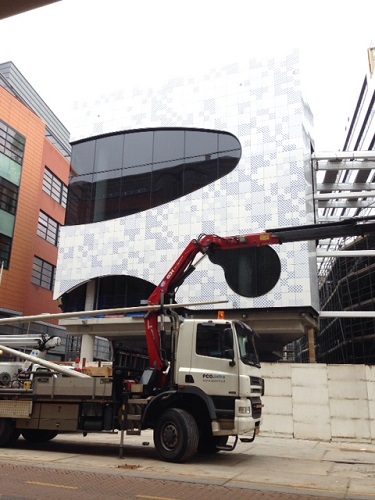
The Hague’s centrum area is a bit insane at the moment. Not only to you have them working on the Nieuwe Passage (a passage which links two main streets), and Marks & Spencer being built, you now have them tearing up the entire middle of the street, forcing voetgangers (pedestrians) to the left and fietsers (bicyclists) to the right. Crazy.

construction in The Hague CentrumIt’s getting to the point where I can’t quite remember what this place looked like when I was here on vacation a few years back, before any of this construction started!

Categories: The Hague | Tags: | Leave a comment

Nieuw woord: potloodventer (Or: B2 Dutch course #8)

Eerst, het verhaal in Nederlands:

Op donderdag had ik mijn les bij Mondriaan. We hadden een oefening met het liedje ‘Centraal Station’ bij Guus Meeuwis en Vagant. Eén van de regels was “een potloodventer in een donkere hoek”. De lerares heeft gevraagd: “Weet iemand wat potloodventer betekent?” Een student weet het al! Zij heeft het laten zien met haar handen (zij kon het niet met woorden uitleggen), maar iedereen was nog steeds een beetje in de war. Toen legde de lerares het uit – het is een exhibitionist – en de lerares heeft haar gevraagd: hoe weet je dat woord? De student heeft gezegd “van mijn schoonmoeder”. Een student vroeg, verbaasd, “Jouw schoonmoeder was een potloodventer?” “Nee!” Iedereen moest echt hard lachen. We hebben een beetje meer over het woord gepraat, misschien drie of vier minuten. Nadat heeft de lerares gezegd “Oké, dat is genoeg van dat thema.” Maar helaas heeft zij de volgende regels van het liedje gezegd – “Maar ik zie je nog voor me, als ik mijn ogen sluit” – toen moest iedereen weer om lachen.

And now in English:

On Thursday I had my lesson by Mondriaan. We had an exercise where we must listen to a song, “Centraal Station” by Guus Meeuwis and Vagant. One of the lines was “an exhibitionist in a dark corner”. The teacher asked if anyone knew what the word meant. One student actually knew it! She demonstrated with her hands (she couldn’t explain it in words), but everyone was still a bit confused. The teacher explained what it meant – exhibitionist / someone who exposes themselves – and after asked her how she knew the word. The student said “from my mother-in-law”. A student asked, surprised: “Your mother-in-law was an exhibitionist?” “No!” Everyone just had to laugh. We talked about the meaning of the word for a few more minutes, and afterwards the teacher said “Okay, enough from that theme.” Unfortunately she then said the next few lines from the song out loud, to go over them. They were “but I still see you before me, as I close my eyes”. Everyone laughed again… Good times.

That was the highlight of the lesson – otherwise we just reviewed grammar (the imperfect/simple past – zij danste – she danced) and did an exercise or two with that. I won’t cover that here (I have before) but here are three rules for when you can use the imperfect:

1. To describe special events in the past when the attention of the listener is already in the past. Het was afgelopen week erg druk in de stad. It was very busy last week in the city.

2. Routines / commonly done things in the past. Vroeger fietsten we altijd naar school. Back then we always biked together to school.

3. Actions that took place at the same time in the past. Erst namen we de trein naar Berlijn en daar namen we een taxi naar ons hotel. First we took a train to Berlin and there we took a taxi to our hotel.

If you’re talking about more recent events, as in something that happened in the last few days, it’s usually better to use the past perfect. (Ik heb gedanst – I have danced), at least, that’s what my textbook says. I’m guilty of breaking that rule… I am a bit shaky on when to use the simple past and past perfect.

Categories: Courses | Tags: | Leave a comment

This and that (Or: B2 Dutch course #7)

Last night’s lesson was a bit varied due to the various things that we worked on. First off, the teacher had us review the imperatief/gebiendende wijs (imperative in English – giving commands).

To use the imperative you generally use the stam or the ik vorm. The verb always comes first. Further, there is no subject (unless you are using the more polite u [you]). If you are using that form, than you have to conjugate the verb accordingly.

Ga zitten! Luister! Hou je mond! (Sit down! Listen! Stop talking!)
Gaat u zitten! Luistert u! Houdt uw mond! (Some of these seem a bit strange in the polite u form, of course). You can also use even and/or maar to make the command a bit more friendly. Luister even! sounds friendlier than Luister!

Due to a random exercise in the book we also briefly learned about the political parties in the Netherlands but a) I don’t know much about them b) I am definitely not into politics. Though I did find it funny that the teacher said she really didn’t discuss politics in class, and then got sucked into a discussion anyway until she broke it off again…

We also took a look at the differences in social class in The Hague. You have two different names for people who live in The Hague. The dividing line or border can be found in the Laan van Meerdervoort, which is the longest avenue in the Netherlands (and also by coincidence where I bought my wedding dress!). If you live “above” this street you live on the rich side of town and are called a Hagenaar. If you live “below” this street you live on the poor side of town and are called a Hagenees. If you believe in such a thing.

The last thing we learned was new to me – another way how to categorize things. Here is an example:

Min grootste ergernis is … (My biggest irritation is)

Mijn op een na grootste ergernis is … (My second biggest irritation is)

Mijn op twee na grootste ergernis is … (My third biggest irritation is)

I must admit it is kind of weird to use “op een na” (een = one) for something that actually translates as “second”. Hmmm.


Categories: Courses | Tags: | Leave a comment

Almost done (Or: Nieuwe Haagse Passage)

The new passageway (from Grote Markt to another shopping street) is making progress. You can see an artist’s drawing of what it will look like when finished.

Marks & Spencer construction in The Hague centrum

And another image:

Marks & Spencer construction in The Hague centrum 2

In other news, Marks & Spencer (a British retail store) will be finished on February 19. It’s also in the centrum of The Hague.

Categories: The Hague | Tags: | 1 Comment

It’s all relative (Or: B2 Dutch course #6)

Last night’s lesson covered relative pronouns. Some of which is easy (if you’re a native English speaker) and some of which is not nearly as easy unless you’re a native speaker of Dutch. Or German maybe. Quick and dirty summary: relative pronouns give extra information about a noun (person, place or thing).

Easy (just requires knowing whether the noun is de or het):

De man die daar loopt is mijn broer. The man that walks there is my brother. 1) man is ‘de’ 2) thus you use ‘die’. 3) extra information: that walks there. Technically it might be better to say ‘who walks there’, but that’s another topic.

Het huis dat daar staat is van mij. The house that stands there is mine. 1) huis is ‘het’ 2) thus you use ‘dat’ 3) extra information: that stands there.

Less than easy? When prepositions decide to get involved. Evil things. When that happens you have two different possible constructions — at least for now — waar + prepositie and prepositie + wie -> where + preposition (objects) and preposition + who (people).

Example with zien (to see) and kijken naar (to look at).

De televisie die ik zie is al 10 jaar oud. The television that I see is already 10 years old. There’s no preposition there, so you can use die.

But: De televisie waarnaar ik kijk is al 10 jaar oud. The television that I look at is already 10 years old. The preposition forces the use of waar rather than die. You can also split up waarnaar – it’s actually a bit more common to do so. De televisie waar ik naar kijk is al 10 jaar oud.

And finally: preposition + wie.

Hij is getrouwd met de vrouw van wie hij al tien jaar houdt. He is married to the woman that he (already) loved for 10 years. Dutch is a bit tricky here since the phrase for expressing love is “houden van”. See also: ik hou van jou, or I love you. So there is a preposition there that you would not have expected if you spoke English.

Of course, this little grammar exercise ignores one glaring problem: it’s fine to realize why something is the way it is but until you learn the rules for fixed prepositions or separable verbs (prepositions with verbs like opstaan — or ‘stand up’ — that can separate) you will not be able to do it naturally. So it really is a matter of practice, practice, practice…

I promise to write a non-grammar filled post next time. Hopefully!

Categories: Courses | Tags: | 7 Comments

Surprises (Or: White roses from Marco

Apparently I have already written a blog pot with a similar title (I had to add in “white” to this one). I guess I am just not creative enough…

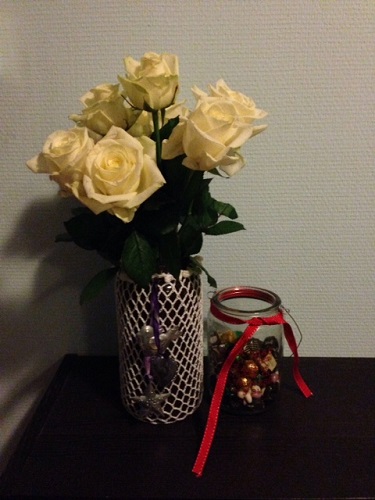
Marco randomly surprised me a few days ago with a bouquet of white roses:

white roses from Marco

Of course the other surprise is I haven’t managed to kill them yet. (I did manage to kill a different set of Dutch-themed orange roses within 36 hours last year. Sad.)

Categories: Marco&Niki | Tags: | 2 Comments

Back to the present (Or: B2 Dutch course #5)

There was not much new grammar for this lesson (so at least Marco can rejoice that he does not have to read yet another grammar-filled entry). One thing that the De Finale textbook has is a grammar section at the back of the book. The teacher decided to go through it step by step, which meant starting with the present tense. The review of the verb rules wasn’t that hard – and then after we had to do an exercise which seemed full of inversion (where the verb comes before the subject).

I found it a lot of fun, but then I never claimed to be anything less than a grammar geek…

You would see a sentence. Your task would be to re-write the sentence, filling in the provided verbs 1) in the right part of the sentence 2) in the right form. Example:

(verliezen, hebben) Hij vaak, maar gelukkig hij toch veel plezier in het voetballen.

Translating that gibberish into English, you get:
(to lose, to have) He often, but happily he still a lot of pleasure in soccer.

(verliezen, hebben) Hij verliest vaak, maar gelukkig heeft hij toch veel plezier in het voetballen.
He loses often, but happily he still takes a lot of pleasure in soccer. (though ‘heeft’ directly translated would be ‘has’).

I did make two mistakes – conjugated one verb wrong (simple mistake) and I didn’t know that veel (a lot) is singular.  Though it does seem to be a murky question in English as well.

We also learned a few more rules for de and het words. As already mentioned earlier in this blog, words ending in -tie, -ing, -heid and -teit are always de words. Today we learned that names of flowers, trees, and plants are always de words:

rose and lilac: de roos, de lila
oak tree: de eik boom

Categories: Courses | Tags: | Leave a comment

More than meets the eye (Or: Shop graffiti in The Hague)

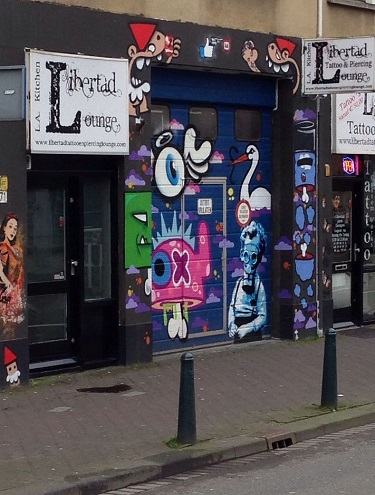
A few days ago Marco and I were walking through The Hague and I spotted this unusual graffiti on a shop barricade:

random shop graffiti in The Hague

At first glance it didn’t look that unusual (not that most of the graffiti here can be considered ‘normal’) – but it quickly went from ‘pretty colors’ to ‘Hmmm. What am I looking at again?’

Categories: The Hague | Tags: | Leave a comment

Create a free website or blog at WordPress.com.