Author Archives: Niki

Unknown's avatar

About Niki

I run the blog http://www.lifeinthehague.com

Zij zegt dat… (Or: Dutch lesson 5 of 14)

Last night I had my 5th lesson (of 14) for Dutch level A2. This week was more review for me (versus last week when we learned about object/subject forms of “it”). There were 16 students in the class – and 4 of them walked in late enough for it to be noticeable. People also talk a bit too much at times, which makes it hard to hear the teacher or the other students.

Both of the main grammer things we covered this week were things that Marco has already drilled into my head (I can just see him saying “Word order! Word order!” over and over…and over). The first is indirect speech – repeating what someone else has said.

Marcia: Ik ga in de zomer naar mijn vakantiehuisje in Zweden.
Marcia: I go in the summer to my vacation house in Sweden.

Simone: Marcia zegt dat zij in de zomer naar haar vakantiehuisje in Zweden gaat.
Simone: Marcia says that she goes in the summer to her vacation house in Sweden.

(Notice how ‘gaat’ moves to the end. This is typical of most complex Dutch sentence – inversion of the verb.)

Of course, it’s a rule used not just in indirect speech.

Ik hoop dat mijn Nederlands goed is.
[I hope that my Dutch is good.]

The other grammatical aspect that we learned was negating “moeten” or must. That verb gave me trouble for the longest time, because I would constantly ask Marco what the verb for “to need” was. But most of the time you use “must” instead. There is a way to talk about need, though. “hebben nodig”, although the nodig doesn’t usually stick with the verb “hebben” (to have). It roughly translates to the following “to have need”.

We hebben meer tijd nodig.
We need more time. (We have need for more time.)

But when you want to negate “moeten” you instead change the verb to “hoeven”. For some reason no one in the world will ever know, I suppose.

Ik moet vandaag werken, maar morgen hoef ik niet te werken.
I must work today, but tomorrow I don’t have to work.

—

It is official that the student I mentioned last week will drop the class – she decided to wait for the easier A1 class taught in September. On my end I (and Marco) are wondering if there’s anyway to skip any more levels… especially since there will probably be a break from June to September for the next set of classes to be taught. In theory this means more time to study and practice, but you know how that goes.

Looking over the Volksuniversiteit website, it states that there are another 3 sections to go (B1, B2, and C1) before I reach the level I want. At the C1 level is when they talk about the NT2 examen, program 2. Program 1 (B2) level is for lower level jobs, and program 2 (taught at the C1 level) is for higher level jobs, which complements the Master’s degree I already have. This means that down the road I can apply for higher level jobs.

Categories: Courses | Tags: | 5 Comments

La Lanterna (Or: An Italian restaurant in The Hague)

Last night Marco, his mother and I went to La Lanterna in The Hague, for an appetizer, entree, and dessert. His mother and I both had minestrone soup, while Marco went for “inferno soup”, so named for its spiciness. (Helaas [unfortunately], the soup wasn’t an inferno!)

For dinner, I had pizza primavera, with tomato, cheese, ham, salami, mushrooms, and green/red peppers. I just had to take a picture of it because it was so colorful…

Pizza Primavera in La Lantera in The Hague

My tastes lean a bit more towards thick pizzas (as I love the dough), but for a thin pizza this was great.

And then there was my dessert:

citroen ice cream in a hollowed lemon at La Lanterna

Yum! So sour. You have before you a lemon which has been hollowed out. They stuffed lemon ice cream inside, placed a bit of whipped cream on top, and then replaced the “top” to make it look like a hat.

a dessert at La Lanterna in The Hague

Marco’s mother’s dessert. More ice cream!

dessert at La Lanterna in The Hague

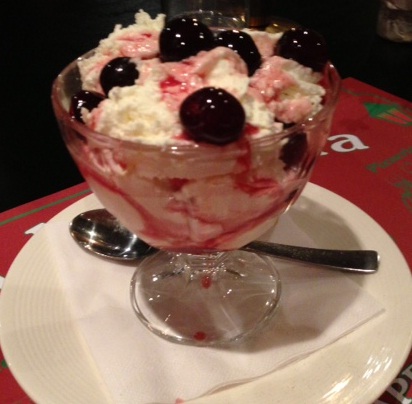
Marco’s dessert. Even before you took a bite, you were definitely drawn in by the plate. The bottom of the plate had a thin layer of glass covering the real bottom of the plate, with a tiny bit of space in between. This caused nifty looking shadows with all of the little pieces they threw around the dessert itself.

All of the dessert portions were big. Of course, I kept scraping on the inside of the lemon searching for more ice cream, but had to stop when I realized I was really just eating the innards of the lemon!

Categories: Food | Tags: , | 2 Comments

Moss-covered tree (Or: Near the Grote Kerk)

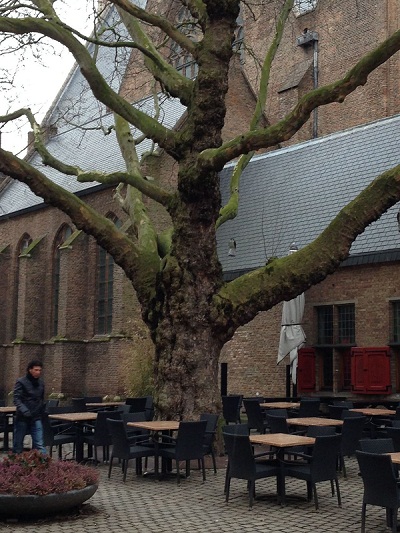
Last week when Marco and I went to an ING bank to open an account, we walked past the Grote Kerk. I was able to take a lovely shot of a rather majestic  tree.

magnificent tree near Grote Kerk in The Hague 2


magnificent tree near Grote Kerk in The Hague

This tree fits in rather well with the urban landscape – it’s in the middle of the city, but you still have cobblestone plaza and old trees growing through the cement.

Categories: The Hague | 1 Comment

Zebra rug (Or: The butt of a joke?)

The only thing that can be said when suddenly, unexpectedly encountering this:

“Whoa.”

half of a Zebra rug in the Netherlands

view from outside our kitchen window


I suppose it would have been a bit better if we hadn’t been treated to the butt. It even has a cute little tail.

Categories: Uncategorized | 1 Comment

Talking about objects (Or: Dutch lesson 4 of 14)

Tuesday’s class actually had an awesome moment. We had a speaking exercise where we were paired up with our buurvrouw (neighbor, female). We had to roleplay one of us being the one asking for employment (me) and the other being the receptionist from the company giving information (her). So all the groups practiced their speaking bits. I said I was looking for a preschool teacher job (peuterleidster), but that as partly because it was a vocabulary word we learned the page before.

For us, there was a section where my partner struggled a bit with what to ask – describing what would I do at the job. After a few seconds, I spoke up and just stated what I would do (play with the kids and teach them). And then the practice section was done, a bit before the rest of the students. I am not sure if the teacher noticed that, because we got called on…

So we recited our “phone conversation” to the entire class.  I was a bit nervous, as I am used to writing everything down so I don’t forget anything, but I hadn’t done that. As you know, I am definitely not one of the best speakers in the class. The nice thing during the exercise was that my partner switched it up a bit – she asked me what I could do for the job, rather than trying to describe it herself (where she got into trouble last time). So we rattled everything off…

…and after we were done a few people looked stunned and one even said “Whoa.” at what we had put together. Booyah! Niki looks smart when speaking for once.

(Of course, the teacher said it was good and then spent the next few minutes dissecting the conversation and telling us what the mistakes were. Ha.)

This time there were more students (18) than the last time (12). It seems like a handful of them were on vacation last week. It made it a bit harder for everyone to find a seat in the newly improvised “sit in a large square with our desks” seating arrangement, but it worked out. I am sure it was against fire code (people were technically blocked in on all sides), but otherwise okay.

During the break, one of the students went up to speak to the teacher. It seems that the student was finding the class a bit difficult and was hoping to go back down to level A1. The teacher told her to go to the register’s office at the front of the building and see if there was anything they could do. Unfortunately when she came back, she said that the next A1 class wasn’t until September. I am not sure what she is going to do – maybe she’ll stick around.

One of the grammar things that we learned this time was referring to an object as “it” or similar. Of course, Dutch has three variations – de, het, and plurals.

De words (most popular)

Subject form – hij

Object form – hem

* Waar is mijn brief? Waar is hij? (Where is it [my letter]?)

* Hij heeft je brief. Hij heeft hem. (He has it.)

—Yes, if you’re playing along, you’ll realize ‘hij’ is also the word for ‘he’!

Het words

Subject form – het

Object form – het

* Het paspoort ligt op de tafel. Het ligt op de tafel. (It lies on the table.)

* Heb jij mijn paspoort? Heb jij het? (Do you have it?)

Plurals

Subject form – ze

Object form – ze

* Mijn pasfoto’s zijn niet goed. Ze zijn niet goed. (They [passport photos] are not good.)

* Ik vind mijn pasfoto’s niet leuk. Ik vind ze niet leuk. (I don’t like them.)

Categories: Courses | Tags: | Leave a comment

Reading Dutch (Or: Comic inside the apartment foyer)

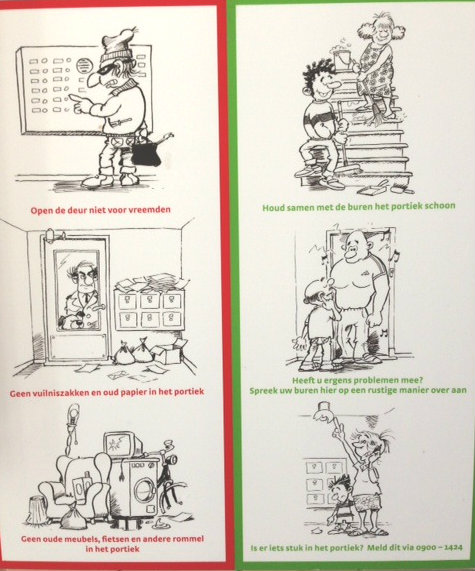
Inside the apartment Marco and I live in, there’s a comic mounted to the wall.

Dutch comic for apartment complex rules

The comic lists the various rules you should abide by when living in an apartment shared by many tenants. I remember the first time I visited the Netherlands, at some point I asked him what the comic said. He told me, but I forgot again. On the third trip, I wondered again but didn’t want to bug him again with the question (as it really doesn’t matter) so I started to ignore the comic altogether. I kept doing this after I moved here in December, as I only thought of the comic as something I couldn’t read.

Imagine my surprise last week when, after a trip to Albert Heijn, I actually stopped and stared at the comic, realizing that it was actually pretty easy to read now. First the red side, and then the green:

Open de deur niet voor vreemden

Don’t open the door for strangers.

Geen vuilniszakken en oud papier in het portiek

No trash or old paper in the foyer.

Geen oude meubels, fietsen, en andere rommel in het portiek

No old furniture, bikes, or other junk in the foyer.

Houd samen met de buren het portiek schoon

Clean the foyer with your neighbors.

Heeft u ergens problemen mee? Spreek uw buren hier op een rustige manier over aan

Do you have problems (with your neighbor)? Talk to your neighbor in a calm manner about it.

Is er iets stuk in het portiek? Meld dit via 0900-1434

Is there something broken in the foyer? Report it [call] 0900-1434.

Categories: Daily Dutch living | Leave a comment

ING (Or: New bank account)

Today Marco and I went to ING bank to set up a bank account for me. Previously I had just been withdrawing money from an ATM and using cash in stores like Albert Heijn, Hema and etc. but this can get annoying with all of the coins that begin to clutter your wallet, as the euro uses coins for 1 euro and 2 euros. The smallest bill is 5 euros. It also means I pay an ATM usage fee from Chase ($5) for using a foreign ATM. Not too bad, but if does add up.

The wait at ING was very long. It probably didn’t help that it was a Saturday afternoon… but the wait was about 25 minutes. When you enter you need to take a number from the automated machine, which is pretty common in this country it seems. There was only 4 numbers ahead of us, but both of the question & answer lines were moving rather slow. For now they have me a temporary card. In about a week a debit card with my name on it will arrive.

It is kind of funny, since my wallet has definitely started to fill up with cards. Debit card, official ID card, health insurance, library card, public transportation card, etc etc. Crazy!

Categories: Daily Dutch living | 1 Comment

Samenspraak (Or: Meetup in Den Haag Bibliotheek)

Yesterday I decided to try something new.  A few months ago I had heard about Samen Spraak (speaking together), which is sponsored by Gilde Den Haag. The first Wednesday of every month they have Samenspraak Café in The Hague’s centraal library. You can go there and speak with other people in Dutch – both with native Dutch speakers and with foreigners who are learning the language.

In addition, you have an intake meeting where they ask what your interests are. Based on that they pair you up with someone who can help you learn the language (and you both learn about each other’s culture). They suggest that you meet weekly but understand if that doesn’t work out. The two speakers need to schedule when they will meet. It’s a volunteer effort but requires some subsidy to keep it running – everyone pays 25 euros.

When I went there last night I lucked out because the same woman who had told me about it a few months ago was the person who spied me standing there looking a bit lost. Although you can arrive anytime between 5:30 – 7:30PM, it was already pretty crowded by 5:45 when I arrived. There weren’t many chairs left to be found, but she sat me next to a lovely gentleman who has been living in the Netherlands for almost 15 years. After a few minutes more people arrived and the table was full.

There was also a few ladies from Russia, a native Dutch speaker who works in parliament as a stenographer, and a gentleman who spoke mostly Arabic and was also keen to learn English. As I had moved pretty recently, my Dutch speaking skills were still pretty rusty. Everyone was patient though, and the woman I mentioned before also slipped in a few English words here and there when she realized I couldn’t exactly follow the subject of the conversation. I ended up staying for the full two hours, although I definitely had a slight headache after that due to the amount of concentration needed to listen to the Dutch. But I did pretty well!

Categories: Learning Dutch | Tags: , | 6 Comments

Seating arrangements (Or: Dutch lesson 3 of 14

Last night was the third Dutch lesson. I still have a pretty big fear of opening my mouth and actually talking Dutch (unless you’re a friend/family member) so it makes it interesting. As usual, I did my routine of finishing the homework before actually attending the class – it helps me pay attention a bit better.

Of course, it’s still possible to:

1. Not be paying attention when called on. Twice the teacher asked me a question or to do something, and both times I was distracted by an upcoming grammar section. (What can I say? I love grammar and rules.) But, how embarrassing!

It’s interesting – you never realize how much you can multitask and still listen to your native language, because things are stored in your short term memory. I was walking on the street. Since I am not yet fluent in Dutch, I still subconsciously tune out  language and ignore conversations around me. But I passed two women who ended up speaking in English. It was only after a few seconds and their sentence was half done that my brain realized it was English. So it automatically went back and replayed what it heard so I could know what they were saying.

But that isn’t possible yet in Dutch – the language doesn’t make enough sense to stick in my short term memory, and thus if I am not concentrating on listening I can’t go back and re-hear what was said.

2. It’s also possible to make a mistake on the one sentence you are called on to answer, even if you have the other 9 sentences correct. (The present perfect participle for komen [to come] is gekomen, not gekwam.) I mixed it up the with the straight past tense conjugation, which for the ‘I’ form is gekwam. Opps.

Continue reading →

Categories: Courses | Tags: | 2 Comments

Roti (Or: A Dutch variation)

Last night Marco and I went to his father’s house. I had roti for the first time. Of course, there are many different ways to make roti.

roti dish in the Netherlands

In this version, you have the wrap underneath, as well as small green beans, potatoes, and chicken that is so tender it falls off the bone. You cut off a triangle (like a pizza slice), and then pile some of the food on it. You then wrap over the edges. You can either spear it with a fork, or eat it with your hands.

Dessert was ice cream with fudge and pieces of mango. Yum.

Categories: Culture, Food | Leave a comment

Blog at WordPress.com.