Learning Dutch

Learning Dutch for adults (Or: At the library)

When an adult learns a new language they are at a disadvantage compared to children. Kids tend to learn languages much faster the younger they are. In addition, when kids move to the Netherlands they will likely attend a Dutch speaking school, or at least a bilingual school. Children also have the advantage of making less mistakes later – I have heard that even the best learners of Dutch will still make mistakes with de/het (the) even after 30-40 years. Some things you truly need to learn from a young age.

That’s where libraries come in – they can help close the gap between how fast children and adults learn languages, though it is not perfect.

The first thing to tell you yourself is that it is okay to make use of the children’s section for the first year. For instance, the Centraal Bibliotheek (Central Library) in The Hague allows adults to browse children’s books – the only rule is that the study desks are for children and adults are asked to study somewhere else.

I will now explain the book classification system in use in the Netherlands, which can be found on the spine of a book. Look for stickers with these letters:

AP – books for toddlers. These include board books (made of material that is more durable for toddlers who like to chew on books), “soft” books that feel nice to the touch, picture books, and the very beginning books. It will also include the most basic dictionaries like “Mijn Eerste Van Dale” (My First Van Dale; Van Dale is a very popular dictionary.) Be careful though – some picture books will still have a lot of words on the page because it is intended that the parent reads to the child.

AK – books for preschoolers. These books are a bit harder. Again, it is assumed that parents will be helping so sometimes the language is still hard.

******* Learning to Read

E/M books (avi-niveau) – these are the books to help children learn to read. They are usually very thin and can generally be read alone. They have their own system, largely based around what group you are in. In America you are in “grades”, here you are in “groups” (see also this Wikipedia article). In general the system is either M (for ‘middle of the group’ ) or E (for ‘end of the group’) followed by the group number. Google “avi niveau boeken” for more information.

Continue reading

Categories: Reading | Tags: , | 2 Comments

Study time! (Or: B2 Dutch course #33)

I am not sure the numbers in the course blog titles are completely accurate these days, but it works…

My, how times flies. It feels like just yesterday when I received the letter saying I could take part in this course. And next week is exams. Tuesday is reading and writing (my strong suit) and Thursday is speaking and listening. As usual, speaking is probably the one that concerns me a bit, mainly because I get nervous in situations like this. But if I can keep calm it should be fine – I definitely know the grammar.

Of course my favorite section is writing, whereas for most people it seems to be their least favorite. Though I must admit that my eraser gets a workout! Some of the things we will need to do next week are coming sentences (zinnen afmaken) and writing the beginning of the sentence, but also writing the middle – a common trick that they do on the staatsexamen is to give you the beginning and the end of the sentence, asking you to fill in the middle. But be careful – it has to be logical! Klopt dat? We will also have to write at least one letter, give our opinion with arguments, and work on something to do with an invitation (not sure what).

I do have some time to study in the coming week, thankfully. Tomorrow is a holiday in the Netherlands; Hemelvaart (Ascension Day), so I will probably end up doing at least one practice test for the Staatsexamen then. Hopefully!

Categories: Courses | Leave a comment

Helemaal uitgelezen (Of: De Brief voor de Koning)

English follows after.

Op vrijdagavond heb ik het boek De Brief voor de Koning uitgelezen. Eerlijk gezegd moet ik ‘helemaal uitgelezen’ gebruiken omdat het een dikke pil voor mij was – ongeeveer 450 paginas! Ik heb andere Nederlandse boeken gelezen, maar niets met zoveel paginas. Ik heb het van de Centraal Bibliotheek geleend and daar was het geclassificeerd als een ‘B’ boek – dus een boek geschikt voor een kind tussen 9 en 12 jaar.

De Brief voor de Koning
De Brief voor de Koning is een heel beroemd boek geschreven door een Nederlandse schrijver, Tonke Dragt, in 1962. Tiuri, de hoofdpersoon, zal ridder worden. Hij moest alleen in de kapel overnachten, zonder niets te doen of zeggen en wakker te blijven. Maar ineens hoorde Tiuri een klop op de deur – iemand vroeg voor hulp. Zou hij de deur openen (een ridder moet mensen helpen, toch?) of zou hij niets doen (en de regels volgen om een ridder te worden)? Uiteindelijk ging hij naar de deur en daar begon zijn verhaal en avontuur – hij moest een brief aan een andere koning geven, een koning in een heel ver weg rijk. Maar de vijand was niet ver achter hem…
Ik weet niet meer hoe lang ik bezig was met het lezen van het boek – sinds september? oktober? Maar nu is het helemaal uitgelezen. Ik heb al het vervolg geleend – Geheimen van het Wilde Woud. Dit heeft misschien 465 paginas. Hmmm…

(Bedankt aan mijn SamenSpraak taalcoach – hij heeft me met het boek geholpen).

De Brief voor de Koning binnen

On Friday evening I finished reading De Brief voor de Koning (The Letter for the King, English wikipedia).  If I am honest I must say ‘finally finished’ because it was a very thick book – about 450 pages. I have read other Dutch books but nothing with so many pages. I borrowed it from the Centraal Bibliotheek (Central Library) and they classified it as a ‘B’ book – a book for 9-12 year olds.
De Brief voor de Koning is a very famous book written by a Dutch writer, Tonke Dragt, in 1962. Tiuri, the main character, is about to become a knight. He must only stay in the chapel overnight, without doing or saying anything, and stay awake. But suddenly he hears a knock on the door – someone asked for help. Should he open the door (a knight must help the people, right?) or should he do nothing (and follow the rules to become a knight?). In the end he went to the door. From there his story and adventure begins – he must deliver a letter to a King in a different kingdom. But enemies weren’t far behind…
I don’t know how long I was busy with reading this book – since September? October? But now I have read it cover to cover. I also borrowed the sequel – Geheimen van het Wilde Woud (Secrets from the Wild Forest). This one has about 465 pages. Hmmm.

Thanks to my SamenSpraak coach – he helped me with reading the book.

Categories: Reading | Tags: , , | 4 Comments

Using ‘te’ in Dutch (Or: B2 Dutch course #30)

In today’s blog post we are going to learn about a small word called te in the present tense, sometimes part of a phrase  om … te. It usually gives the listener a bit more information about why you said something in your sentence – try making the first part a statement and then inserting a question word (why, what, when, etc)  in the middle of sentence and it will become a bit clearer that what follows after is more information and/or an answer.

It also sometimes be translated as “in order to” in English (old English had something similar which was dropped in modern English).

De kat ligt op de tafel om te slapen. The cat lies on the table to sleep.

De kat ligt op de tafel. Waarom? Om te slapen. The cat lies on the table. Why? To sleep.

De was hangt buiten om te drogen. The laundry hangs outside to dry.

De was hangt buiten. Waarom? Om te drogen. The laundry hangs outside. Why? To dry.

Note: Om and te are not always next to each other in the sentence. But the one rule you can follow is that om begins the phrase and te comes right before the last infinitive in the sentence (although we will not get into double infinitive construction here, which happens in the present perfect and past perfect).

Het is leuk om jou weer te zien. It is nice to see you again. (Literally: It is nice to you again see.)

There are a few lists of verbs which take te in the present tense. I will split them up into two groups because they have different rules in other tenses.

verb + te + infinitive (verb group 1)

1. staan to stand
2. zitten – to sit
3. liggen – to lie / lay
4. lopen – to walk – Ik loop de hele dag aan het examen te denken. I thought about the exam all day.
5. hangen – to hang
6. durven – to dare
7. hoeven – to need (usually used in negative sentences, i.e. Ik hoef geen jas. I don’t need a jacket.)

The astute student will realize that the first five in orange are part of a group in and of itself – these five verbs are frequently used to describe a more continuous action and the physical state of the subject while the action occurs.  Thus the example above about thinking about the exam all day – most people are still going about their normal business and walking around while doing so.

 verb + te + infinitive (verb group 2)

Again, these two groups are only split because the rule for other tenses, not covered here, are different. Thus it is better to learn them separately.

1. beginning – to begin Ik begin Nederlands te leren. I begin to learn Dutch.
2. beloven – to promise Ik beloof om eerder thuis te zijn. I promise to be home earlier. (see how ‘eerder thuis’ gets put in between om … te
3. besluiten – to decide
4. beweren – to claim
5. dreigen – to threaten
6. proberen – to try
7. hopen – to hope
8. weigeren – to refuse
9. vergeten – to forget

verbs that do not use te (in any tense)

There is also a special list of verbs that do not use te at all (at least within the same clause). These include some very common verbs.

The five auxiliary/helper verbs:  mogen, moeten, zullen, kunnen, willen

And other well known verbs: laten, gaan, komen, blijven, zien

Mag ik hier roken? May I smoke here?

Mijn buurman wil een nieuwe auto kopen. My neighbor wants to buy a new car.

Categories: Courses | Tags: | Leave a comment

Rearranging sentences (Or: B2 Dutch course #29

Another Dutch lesson tonight. I believe that I posted about something similar last month, but it can’t hurt to have another example. Our teacher reviewed how to dissect a sentence again – and more specifically, figure out the various ways to move around the sentence parts to change where the emphasis lies. Take this sentence for example:

Naar alle waarschijnlijkheid gaat mijn oudste dochter komend weekend met de trein naar haar oom en tante in Limburg. With all likelihood my oldest daughter will take the train this weekend to (visit/see) her aunt and uncle in Limburg.

Now break up the sentence into parts that logically “go” together (and cannot be separated), or die zinsdelen die bij elkaar horen.

Naar alle waarschijnlijkheid || gaat || mijn oudste dochter || komend weekend || met de trein || naar haar oom en tante in Limburg. 

Now label (as much as possible) what the various parts of the sentence are. gaat is the verb, mijn oudste dochter is the subject, komend weekend is an expression of time, met de trein is a manner of how to do something, naar haar oom en tante in Limburg and also naar alle waarschijnlijkheid are prepositional phrases which give extra information.

Now attempt to rewrite the sentence, with other elements besides “naar alle waarschijnlijkheid” beginning the sentence. (This will be possible with all of them except the last one, as beginning with Naar <plaats> is a bit clunky.)

The biggest rule to remember: the subject (mijn oudste dochter) can be in the first position, the second position (with a question) or the third position right after the verb in the second position (when another phrase starts the sentence, like above). In simple sentences the subject and verb are always next to each other.

1.  Mijn oudste dochter || gaat || naar alle waarschijnlijkheid  || komend weekend || met de trein || naar haar oom en tante in Limburg. (Emphasis: who goes?)

2. Komend weekend || gaat || mijn oudste dochter  || naar alle waarschijnlijkheid  ||  met de trein || naar haar oom en tante in Limburg. (Emphasis: when do you go?)

3. Met de trein || gaat || mijn oudste dochter || naar alle waarschijnlijkheid  || komend weekend  || naar haar oom en tante in Limburg. (Emphasis: how do you go?) This is more clunky – for the simple fact that if someone asked you how went somewhere, you are much more likely to say simply “Met de trein.” and not state all of the information above; you’ve probably already told them everything.

Thus in total you have four decent ways to manipulate the sentence to change the emphasis.

I suggest trying this trick on a few sentences you pull out of the newspaper, especially if you are still learning about proper word order for Dutch sentences. 😉

Categories: Courses | Tags: | Leave a comment

End of the year exams (Or: Time to complain?)

Technically I had another Dutch lesson last night but there was no new grammar so it is harder to figure out blog post themes. So let’s write about something different – tests!

Final exams for Dutch school children started on Monday.These tests are administrated for children 12 years and older. You can see this year’s schedule (in Dutch).

Of course we had the same sort of tests in America, although the concept of taking the same test as everyone in the country is a bit foreign to me. Our end-of-year exams were generally written by the teacher. However, during the school year itself we would sometimes have to take standardized tests, where everyone in the state and in the same grade level would take the test on the same day. These tests would be used to measure achievement levels within the state. Standardized testing became even more prevalent after 2002 when the No Child Left Behind Act was passed.

Imagine my surprise when I heard that another feature of the Dutch eindexamens (final exams) was the ability to call a number and complain! They received over 7,000 complaints the first day (in Dutch). At times it was over 100 complaints per minute. Generally the complaints are that the test is too difficult or the student did not have enough time to finish the test – if enough people complain, they look at the test and decide whether they need to adjust it and give higher marks. The service also receives complaints for things like too much noise from construction outside; the complaint is then forwarded to the school.

It just seems so strange. Maybe we had the option to call a number and complain when I was a kid – but I never heard about it.

And one of the weirder complaints so far this week – a student complained when he had to sit behind another student who had pimples on his neck (Dutch article), which he found too distracting to be able to concentrate properly on his test.  Okay then…

Categories: Courses | Tags: | 3 Comments

Speaking reflexively (Or: Dutch B2 course #27

Vacation is over and it’s back to the studying grind. (Well, I did my homework over vacation, so there was some studying involved.)

Yesterday’s lesson we had a refresher course (or een herhaling) for reflexive verbs and how they are conjugated. Things like I shave myself or Don’t kid yourself – the subject of the sense is the same as the object of the sentence. Of course, English tends leave off the reflexive part for someone words. Consider I bathe versus I bathe myself. The first is more likely.

There are not many reflexive pronouns in Dutch. Only me, je (u)zich, and ons. Take the verb scheren (to shave):

ik scheer me
jij scheert je
u scheert zich / u
hij / zij scheert zich
wij scheren ons
jullie scheren je
zij scheren zich

Unfortunately there is no rule to determine which verbs are reflexive – it is just something dat je uit je hoofd moet leren (that you have to learn out of your head / memorize).

There are three rules regarding the placement of a reflexive pronoun:

In the main clause after the conjugated verb
– Ik douche me elke morgen.
– Hij verbaast zich regelmatig over Nederlanders.

In cases of inversion, after the subject
– Gisteren meldde hij zich ziek.
– Regelmatie verbaast hij zich over Nederlands.

In a subordinate clause after the subject
– Hij zegt dat hij zich bij die belissing heeft neergelegd.
– Ik denk dat hij zich regelmatie over Nederlanders verbaast.

And finally, a fun example of how crazy things can get when you add in reflexive pronouns:

Herinner je je je oma?

je = subject, then je = reflexive pronoun, finally je = your

Do you remember your grandmother? Though you can ask that question without using a reflexive verb as well.


Categories: Courses | Tags: | Leave a comment

Onze Taal (Or: App for the advanced Dutch crowd)

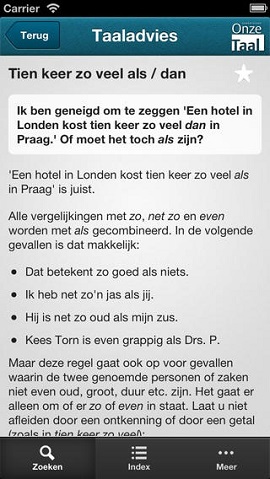
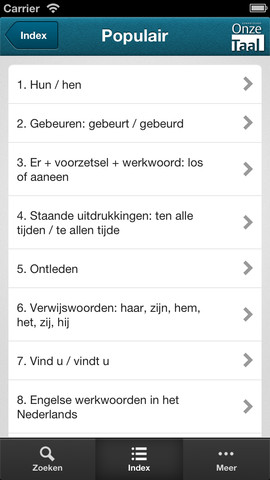
A few weeks ago I re-downloaded an app that I had previously downloaded last year sometime. Originally when I downloaded it I was pretty lost – because it is all in Dutch and actually designed for a native Dutch speaker. The app is Onze Taal (Apple | Android), which translates into ‘Our Language’. It makes a lot more sense now, for the record.

The app is actually an extension of a website that appears frequently in Google results when searching for a Dutch grammar question. The site answers a lot of questions, popular or obscure, like How do I properly conjugate the English verb ‘to email’/say ‘I have emailed you’? Ik heb jou ge-e-maild. Yes, two hyphens. No – seriously. Originally it was geë-maild, because:

1. ge = a prefix that goes in front of a lot of verbs when conjugated in the perfectum (present perfect)

2. ë = two dots over a vowel signify that it is the beginning of a new syllable

3. – = a hyphen because in English you can also write it as e-mail

3. maild = this is actually a typical Dutch conjugation. The verb is e-mailen, so -en is removed and -d added.

But in 2005 the rule changed; letters that stood apart (like the ‘e’ in e-mail) should instead be preceded by a hyphen. Thus: ge-e-maild.

Better to use the verb sturen, or to send…

The website gets the rules from the “Green Book”, which is a publication through the Dutch Language Union.

Screenshots:

Oneze Taal app screenshot


Oneze Taal app screenshot 2


Categories: Apps | Tags: , | Leave a comment

d, t, or dt? (Or: B2 Dutch course #25)

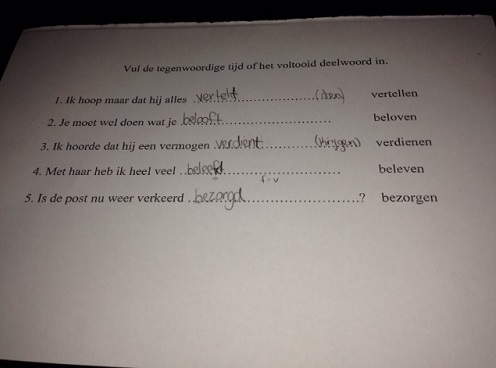
I did not take many notes for last night’s course, although I did take a picture of one of the exercise sheets we were given:

conjugating Dutch verbs T or D exercise

It looks pretty simple but there are some tricky parts to these. The point of the exercise is to determine if the verb ends in -t (present tense), -d (present perfect tense) or -dt (could be either).

1. Ik hoop maar dat hij alles vertelt.

The trick with this one is realizing that the dependent clause (dat hij alles vertelt) is in the present tense, so you cannot use the kofschip rule. If you are not sure which it is, you can always try replacing the verb (vertellen) with a simpler verb like doen and see how you would conjugate that.

2. Je moet wel doen wat je belooft.

Again, the dependent clause is in the present tense so it is a simple -t.

3. Ik hoorde dat hij een vermogen verdient. (Same as above – present tense.)

4. Met haar heb ik heel veel beleefd.

Here is a trick – the original verb is beleven, but the v turns into an f in some tenses. However, since it is in the perfectum you can use the kofschip rule linked to above. In that case, you still need to use the v to determine what the ending is, not the f. Because of this, the verb ends in -d (since there is no ‘v’ in kofschip). If that does not make sense to you because you don’t live in the Netherlands, please forgive me. ;p

5. Is de post nu weer verkeerd bezorgd?

The tense is perfectum (present perfect) so you look at the last letter of the root verb (g). Since ‘g’ is not in kofschip, the verb ends with a -d.

The exercise is harder than it looks… apparently even native Dutch speakers can have trouble with the d/t/dt conundrum.

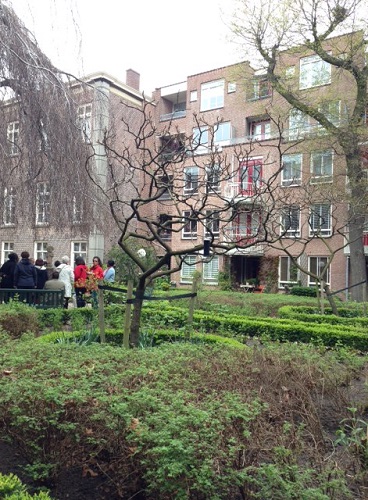
Just for fun, here is a random picture from a garden in The Hague, taken a few weeks ago:

bare tree in April, The Hague

And now Marco and I are off to check out the Life I Live festival in The Hague. Seeya!

Categories: Courses | Tags: | 2 Comments

Building on the passive tense (Or: B2 Dutch course #25)

This post is a continuation of the post last week, Actively Passive, which covered the basics of the passive form. There is only one other thing to cover – using the modal verbs with the passive form.

What are the modal verbs again?

1. willen – to want. He wants…

2. kunnen – can (to be able to) He can…

3. mogen – may (to be allowed to) He may…

4. moeten – must. He must…

5. zullen – will. He will go to… / He will do this…

How are they used with the passive form?

Method #1: modal verb + worden (in the infinitive form) + participle

Method #2: modal verb + participle + worden (in the infinitive form)

Thus the two methods only differ in the word order of ‘worden’ and the participle (examples of participles include gewerkt, gehaald, gedanst).

Can you give some examples?

Sure – these are from the textbook, De Finale. The examples use method #1, but of course the order of ‘worden’ and the participum can also be switched, i.e. geopereerd worden.

zullen – Hij zal volgende week vrijdag worden geopereerd. He is going to be operated on next week.

kunnen – Het voorstel kan nog worden verworpen. The proposal can still be rejected.

mogen  – Deze opdracht mag ook morgen worden ingeleverd. This assignment can also be turned in tomorrow.

******

And here’s a random photo from Lebkov’s serving area, a café near Central Station:

Lebkov - coffee in The Hague

You can also see the various types of sugar they had available – including chocolate flavored sugar, vanilla flavored sugar and cinnamon flavored sugar.

It’s still our favorite place to go and scheme, as they don’t mind if you sit there for 2-3 hours and do your work.

Categories: Courses | Tags: , | Leave a comment

Blog at WordPress.com.